When you purchase through links on our site, we may earn an affiliate commission. Here’s how it works.
5 Best VPN Browser Extensions in 2026



Our experts have reviewed 53 VPN providers, which were put through extensive rounds of testing. To learn more about that process, here’s how we review VPNs, where we explain our criteria and our policy of being fully transparent.
Web browsers have limits. Additionally, they’re vulnerable to IP, DNS, and WebRTC leaks that expose your location and browsing habits. They also can’t reliably bypass geo-blocks, block ads, or stop malware.
A VPN browser extension can fix this by hiding your online activity, blocking ads, preventing data leaks, and unlocking geo-restricted content.
In this guide, we'll talk about the best browser VPNs, explain why you need one and how to use it, explain the differences between VPN browser extensions and VPN native apps, what to look for in one, answer some related FAQs, and plenty more.
Key Takeaways
- Server Network Size Drives Versatility: A wide-ranging server network enhances speed, stability, and the ability to bypass regional restrictions. Top performers like NordVPN, Surfshark, and Proton VPN offer thousands of servers across 100+ countries. NordVPN delivers the best all-around value and performance for browser-based VPN users.
- Not All Extensions Are True VPNs: Many browser add-ons function as proxies. Prioritize VPN extensions that offer real encryption, WebRTC/DNS leak protection, and integration with full native apps for complete online security.
- Security Should Be Ironclad: Look for military-grade encryption (AES-256 or ChaCha20), modern protocols (WireGuard, OpenVPN), and features like a kill switch, tracker blocking, and strict no-logs policies, all of which are delivered by the top providers.
- Browser Compatibility Matters: Ensure the VPN supports your browser, Chrome and Firefox are widely covered, but Edge, Brave, and Opera users should double-check compatibility before subscribing.
Editor's Picks: Best Browser VPNs
- NordVPN - Our top-rated VPN browser extension in 2026, offering extensive global servers, fast, reliable connections, built-in ad and tracker blocking, plus robust protection against DNS and WebRTC leaks for secure browsing.
- Surfshark - An easy-to-use VPN extension perfect for beginners, delivering automatic connection, strong encryption, fast speeds, and effective ad and tracker blocking, ensuring instant privacy and seamless access to geo-blocked content.
- ExpressVPN - Combines powerful native apps with browser extensions to provide high-level encryption, advanced leak protection, and traffic obfuscation, ideal for users wanting both convenience and comprehensive online security.
- PIA - Boasts 90+ countries’ servers and extensive customization options, making it perfect for power users who want granular control over security settings, ad blocking, and connection protocols for an optimized browsing experience.
- Proton VPN - Focuses on privacy with a strict no-logs policy, secure core architecture, and easy-to-use browser extensions. It offers reliable speeds and strong protections against leaks while respecting user anonymity.
How to Choose the Best Browser VPN Extension?
To choose the best option available, take a good look at its set of features. You'll want one compatible with your browser of choice, offering strong privacy, plenty of servers, and the ability to unblock the Web. Here's what to keep in mind.
- Full Support for Web Browsers - You need to pick a VPN based on the Web browser(s) you use. You'll have an easy time finding a VPN for Chrome and Firefox, but you need to pay more attention if you use a more "exotic" Web browser, such as Tor Browser.
- Plenty of Servers Worldwide - You'll want a VPN with as many servers as you can find in as many countries as possible. That will give you the ability to bypass more geo-blocks and change your Chrome location, and you can do the same in Firefox, Edge, Safari, and more.
- High-End Privacy & Security - Go for a VPN that offers high-end encryption, such as AES-256. You'll also want strong protocols and some form of obfuscation. Also, keep in mind that most VPNs that come as browser add-ons are just proxies, which you'll want to avoid.
- Protection Against Leaks - Most extensions are made to protect you from IP, DNS, and WebRTC leaks, as well as browser fingerprinting, which means they work by closing your browser's vulnerabilities and ensuring malicious actors stay away from your data.
- Ability to Bypass Access Restrictions- There's little you can do in your browser to bypass geo-blocks. The only reliable way to do so is by changing your IP address, and that's what a VPN can do. So, ensure to get a VPN with a large pool of IPs.
- Fast Speed & Stable Performance - Many VPNs are extra-fast, but that's because they use low-end encryption. Your goal should be to use encryption like AES-256 to protect your data, but without imposing limiting speed caps.
- Plenty of Simultaneous Connections - If you have multiple devices, ensure to get a VPN that allows you to use its extensions simultaneously on all your computers. Also, your VPN should offer apps that help you stay protected even on the go.
- Wallet-Friendly Pricing Plans - As you can see by now, your VPN should meet a hefty set of requirements. That said, your chosen VPN doesn't have to cost a lot. Pick a VPN that brings plenty of value overall, and know that you can lower your VPN cost with long-term plans.
- Generous Money-Back Guarantees - If you're after a risk-free purchase, get a VPN that offers a generous money-back policy. Most reputable VPNs will give you from 30 to 45 days to change your mind and ask for a refund with no questions asked.
- Helpful Customer Support - As recommended above, you should get a VPN with 24/7 live chat support. That way, you can count on a speedy solution if something goes wrong without having to pause your online activities.
The Best VPN Browser Extensions in 2026
To choose the right VPN browser extension, look for compatibility with your browser, a large server network, strong privacy features, and leak protection. Speed, stability, and the ability to bypass geo-blocks are also key, especially for streaming. You’ll also want good value, a fair refund policy, and responsive customer support.
In our search, we tested more than 60+ providers hands-on. Based on those findings, these are the 5 best VPNs for a browser in 2026:
1. NordVPN
NordVPN is perhaps the most capable VPN provider available today, allowing you to protect your privacy and unblock the Web. It's very easy to use, and you can set it up in minutes. Also, you'll find NordVPN's extensions for Chrome, Firefox, and Edge.
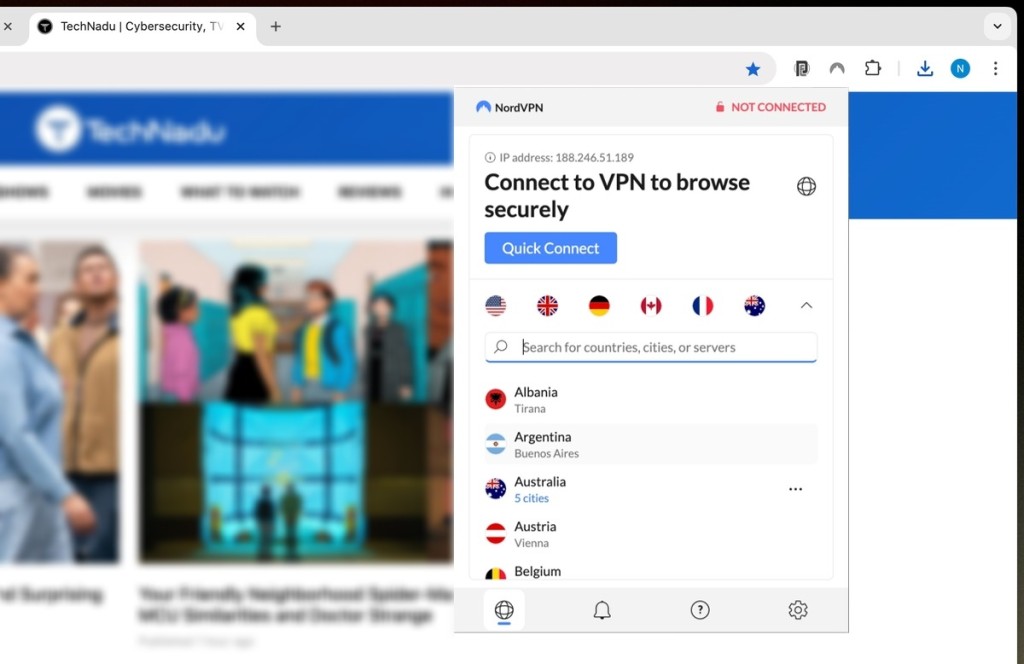
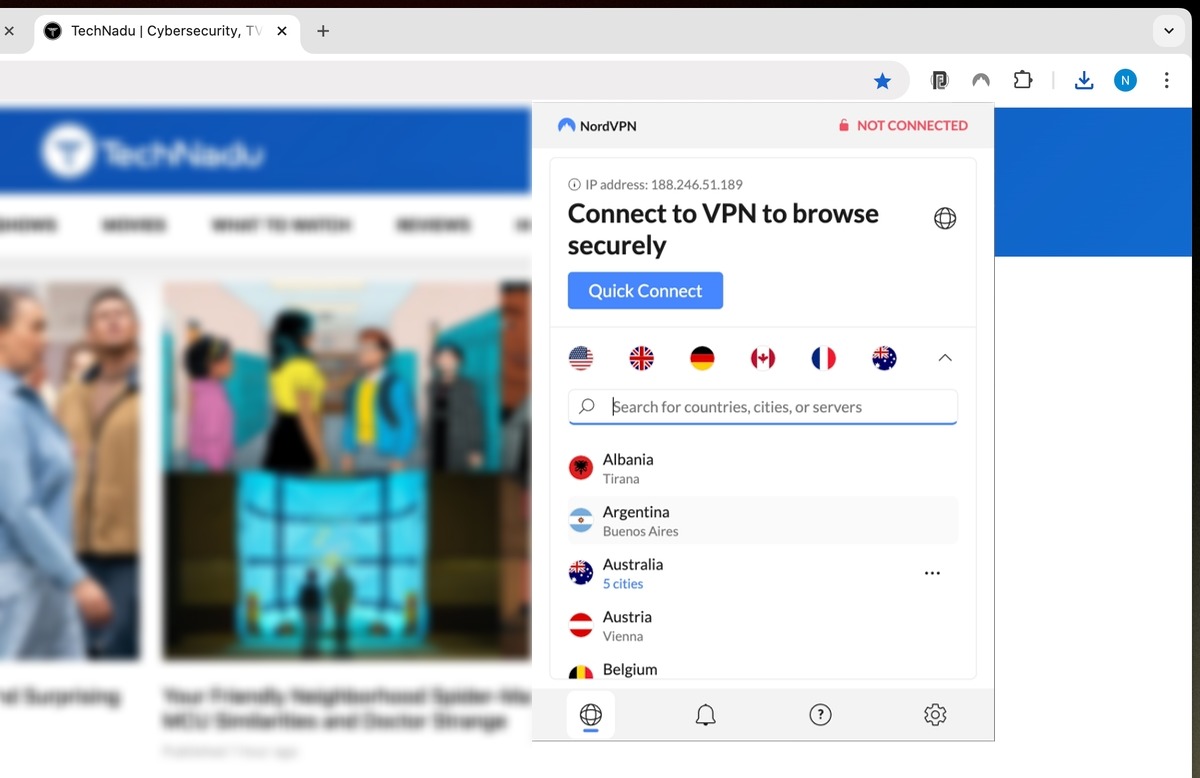
NordVPN has a wide server network that consists of 8,900+ servers in 129 countries. It also has excellent privacy as it uses the Transport Layer Security (TLS) protocol for data protection. Next, there's military-grade encryption, split tunneling, and a no-logs policy, and it blocks ads and malicious websites with the 'Threat Protection Lite' feature.
This Panama-based VPN prevents your IP address from leaking by blocking WebRTC. It also creates very strong data tunnels with no chance of a DNS/IP leak. On top of that, NordVPN unblocks popular streaming platforms like Netflix, Hulu, BBC iPlayer, and Disney+ while allowing you to stream in 4K.
We can also praise this VPN's performance, as NordVPN is among the fastest VPN providers right now. No matter if you connect to nearby or remote servers, you won't notice any drops in your connection's speed and overall performance. We'll also note that NordVPN supports 10 simultaneous connections.
Everything mentioned above is available at $3.09 per month for 24 months. It also offers a 30-day money-back guarantee and 24/7 customer support, which you can access via the live chat feature on its website.
Some Standout NordVPN features that make it a Good Browser Extension:
- Web Browser Compatibility: NordVPN’s extension works seamlessly with Chrome, Firefox, and Edge, offering lightweight protection without affecting browser speed or usability.
- Threat Protection Lite: Blocks ads, trackers, and malicious websites directly within your browser, enhancing both speed and safety while you browse.
- One-Click Connect: Instantly secures your browser traffic with a single click, auto-connecting to the fastest available server for a hassle-free experience.
- Strong Leak Protection: Prevents IP, DNS, and WebRTC leaks, keeping your identity and location hidden even if the connection drops.
- Post-Quantum Encryption – Uses cutting-edge encryption to secure your dating activity against future, quantum-level cyber threats.
- No-Logs Policy: Backed by independent audits, NordVPN guarantees your browsing activity isn’t tracked, stored, or shared.
PROS
- Sizable server network.
- Compatible with many browsers.
- Blocks ads and trackers.
- Standalone VPN extension.
- 24/7 customer support.
- 30-day money-back guarantee.
CONS
- Pricey month-to-month plans.
2. Surfshark
Surfshark is an easy-to-use provider from the Netherlands with modern extensions for Chrome and Firefox. You can use the Chrome extension on Brave, Opera, Edge, and other Chromium-based browsers, and the Firefox extension works with Gecko-based browsers.
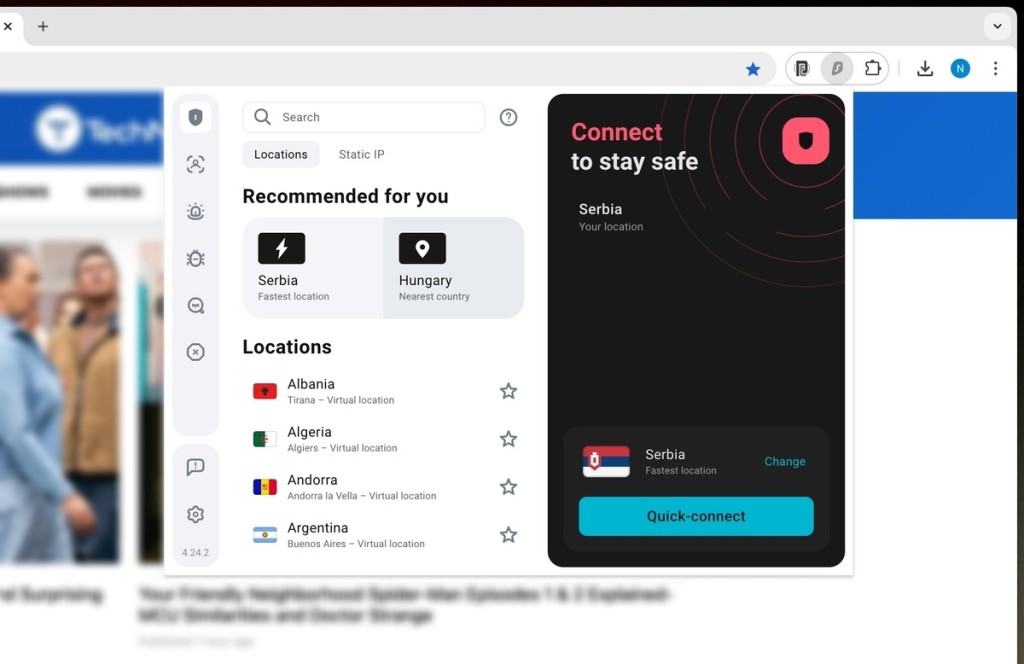

With Surfshark, you can choose from more than 4,500+ servers in 100 countries. Furthermore, you get military-grade encryption, split tunneling, and a strict and audited no-logs policy. The provider’s extension blocks ads, pop-ups, and WebRTC leaks, and also offers data breach and malware alert tools.
Additionally, Surfshark Search performs Web searches in complete privacy with no ads, no logs, and no trackers, displaying purely organic results. However, that add-on comes priced extra (it's priced at only a couple of dollars per month).
You'll have access to all the popular streaming platforms and won't have any problems streaming in 4K because Surfshark's super-fast connections won't let you down. Another great thing about Surfshark is that it supports unlimited simultaneous connections, so you can use it with your Web browser as well as on the go.
To become a subscriber, you'll need to pay $1.99 per month for , which you can use as a risk-free trial. On top of that, its website has 24/7 customer support via live chat, in addition to plenty of other support resources.
Some Standout Surfshark features that make it a Good Browser Extension:
- Wide Browser Support: Surfshark’s extension is available for Chrome, Firefox, and Edge, offering a simple interface and fast setup across major browsers.
- CleanWeb Ad Blocker: Blocks ads, malware, and phishing attempts directly in your browser, improving page load times and security.
- Instant Connect: With one click, you’re connected to the fastest server available, securing your browser traffic without slowing down performance.
- Strict No-Logs Policy: Surfshark doesn’t track or store your browsing data, ensuring complete anonymity while using the extension.
- Bypasser (Split Tunneling): Lets you choose which sites go through the VPN and which don’t, perfect for accessing local content while staying protected.
- Camouflage Mode: Hides your VPN usage from networks and ISPs, which is useful in restrictive regions or under strict firewalls.
PROS
- Works with Chrome, Firefox, and more.
- Beginner-friendly extension.
- Excellent security.
- Blocks WebRTC and ads.
- 30-day money-back policy.
- 24/7 customer support.
CONS
- Can take a few moments to connect.
3. ExpressVPN
ExpressVPN is a high-end VPN that offers a fully-featured experience on Chrome, Firefox, Edge, Brave, Vivaldi, and more. It’s important to note that ExpressVPN doesn’t have a standalone extension, and it's not available for Safari - you have to download the app on your device so the two can work together to provide better encryption.
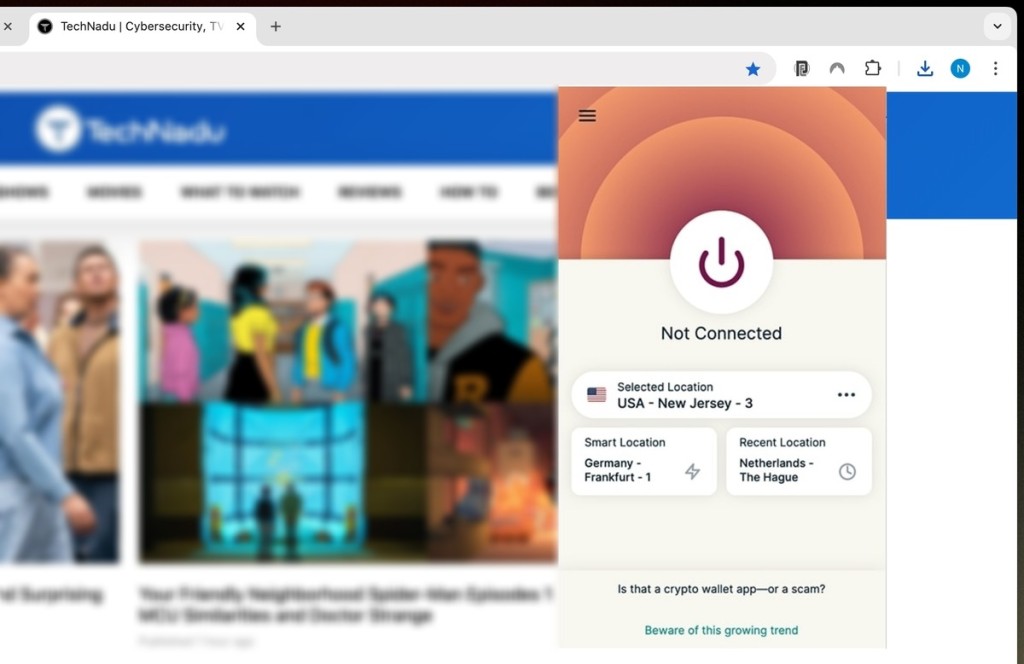
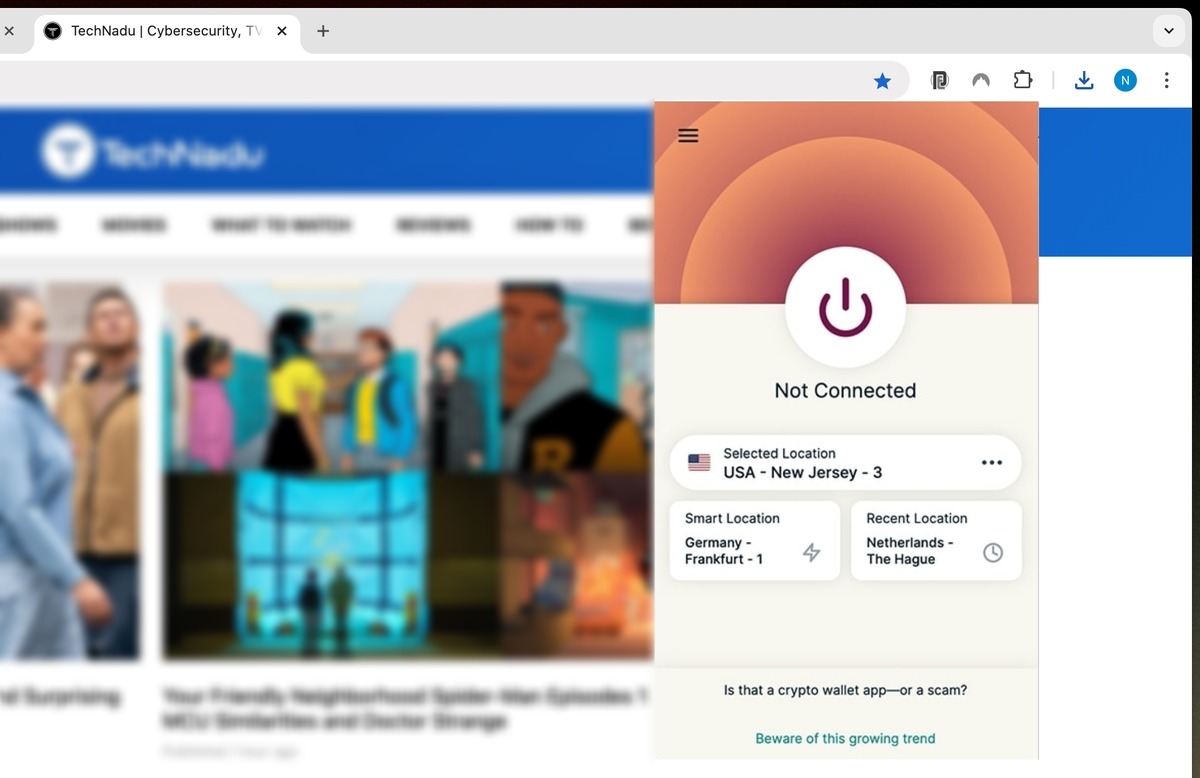
This VPN has an undisclosed number of servers in 105 countries. It also includes advanced security features such as AES-256 and ChaCha20/Poly1305 encryption, and it blocks WebRTC, so sites can't detect your real location and IP address. The provider also has a strict no-logs policy, and unlike most other extensions, this one uses protocols like OpenVPN, Lightway, and IKEv2.
According to our tests, this British Virgin Islands-based VPN is among the fastest, making it ideal for streaming, torrenting, and playing browser-based games. It unblocks any streaming platform, including Netflix, Hulu, Disney+, iPlayer, and more. It also works excellent for bypassing censored websites, as it offers obfuscation.
Thanks to its lightning-fast Internet connection speeds, you can stream all these services in 4K with no buffering. Let's not forget that ExpressVPN supports 10-14 simultaneous connections, which seems quite generous.
You can start using ExpressVPN at $2.44 per month for 24 months. The provider also has a 30-day money-back guarantee, and if you don't like its services, you can request a refund via its 24/7 live chat feature.
Some Standout ExpressVPN features that make it a Good Browser Extension:
- Full VPN Control via Extension: Unlike most, ExpressVPN’s extension controls the full desktop app, encrypting all browser and non-browser traffic for comprehensive protection.
- HTML5 Geolocation Spoofing: Overrides your browser’s geolocation data to match your VPN IP, helping you bypass even advanced geo-blocks and regional restrictions.
- WebRTC Leak Protection: Built-in features block WebRTC leaks, safeguarding your IP address from being exposed through your browser.
- HTTPS Everywhere Integration: Forces secure HTTPS connections where available, automatically improving your safety on poorly secured websites.
- TrustedServer Technology: All ExpressVPN servers run on RAM only (no hard drives), ensuring that no data can be stored or retrieved after each session.
- Audited No-Logs Policy: Regular third-party audits verify ExpressVPN’s strict no-logs commitment, reinforcing its reputation for privacy and transparency.
PROS
- Works on all Web browsers.
- High-end data encryption.
- Unblocks any site.
- Audited no-logs policy.
- 24/7 customer support.
- 30-day money-back policy.
CONS
- Not a standalone extension.
- On the pricier side.
4. PIA
PIA (Private Internet Access) provides extensions for Chrome, Firefox, Edge, and Opera. It's known for its high-end data privacy features and a high level of customization. As such, it's a perfect option for more advanced users.
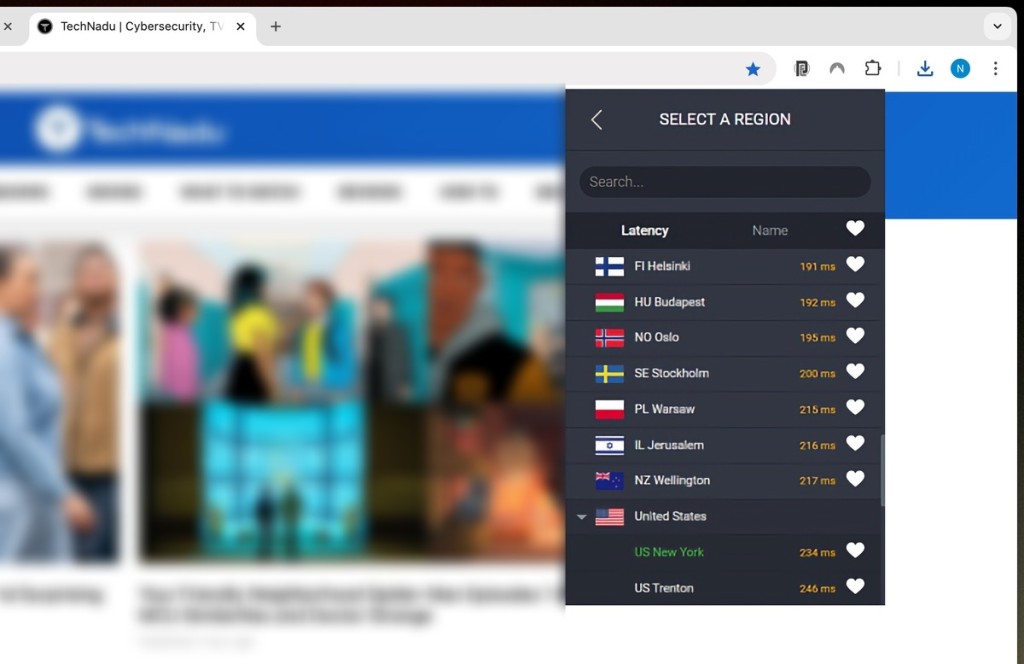

This US-based VPN has an extensive network with an undisclosed number of servers in 91 countries. It's known for its presence in the US, especially - as it has servers in all 50 US states. Additionally, PIA provides military-grade encryption, strong protocols, and doesn't collect any activity or connection logs. It also blocks ads, disables trackers, and protects your microphone and webcam from unauthorized access.
You'll also get features like WebRTC blocking, sorting gateways by latency, URL whitelisting, and an easy ON/OFF switch. That said, this VPN allows you to customize plenty about your data tunnel, so we recommend it to advanced users.
PIA works well for bypassing geo-blocks, as well. If you wish to access censored or geo-blocked sites, including media streaming services, PIA will get the job done. Also, this VPN switched to unmetered connections recently and now supports unlimited simultaneous connections.
In terms of its price, expect to pay $2.03 per month for 24 months. You can try out PIA's services risk-free thanks to its 30-day money-back guarantee, and if you have any questions, you can ask for help via its 24/7 live chat.
Some Standout PIA features that make it a Good Browser Extension:
- Highly Customizable Settings: PIA offers unmatched control within its browser extension, letting you tweak encryption, proxy settings, and privacy features to suit your needs.
- Extensive Server Network: With thousands of servers in 90+ countries, PIA ensures fast, stable connections and great access to geo-restricted content worldwide.
- Advanced Privacy Features: Blocks access to camera, microphone, location, and even credit card autofill to prevent websites from collecting unnecessary personal data.
- WebRTC & Flash Blocking: Prevents WebRTC leaks and disables Flash content by default, reducing both tracking risks and potential attack vectors.
- Easy Bypass List: Includes a customizable whitelist feature, so you can exclude trusted websites from the VPN tunnel while keeping the rest protected.
- Open-Source Transparency: PIA’s browser extension and core apps are open-source, letting anyone review the code for privacy, security, and accountability.
- Strict No-Logs Policy: Backed by a solid track record and proven in court, PIA’s no-logs stance ensures your browsing activity remains fully private.
PROS
- Works with many browsers.
- Extra-big server network.
- Excellent security.
- Plenty of fine-tuning.
- 30-day money-back policy.
- 24/7 live chat support.
CONS
- Might be overly technical for some.
- Medium-fast connection speeds.
5. Proton VPN
Proton VPN is a Switzerland-based VPN service built by the team behind ProtonMail, known globally for its commitment to privacy and open-source technology. This VPN is designed for users who value security, transparency, and freedom online, making it especially suitable for privacy-focused individuals and tech-savvy users.
One of Proton VPN's standout features is its Secure Core architecture, which routes your traffic through privacy-friendly countries like Switzerland and Iceland before it exits to the internet, adding an extra layer of protection against network-based attacks. The VPN also offers AES-256 and ChaCha20 encryption, WireGuard, OpenVPN, IKEv2, and Stealth protocols, and a strict no-logs policy independently audited and verified.
Proton VPN includes advanced features like NetShield (ad and tracker blocker), kill switch, DNS leak protection, Tor over VPN, and split tunneling. It also provides WebRTC and IPv6 leak blocking, as well as a clear and customizable interface for Windows, macOS, Linux, iOS, and Android. Unlike many VPNs, Proton VPN’s desktop apps are open source and have undergone independent security audits.
The service has a global server network, with 17,276 servers in 127 countries (130 secure core in 67 countries) , including high-speed Plus servers optimized for streaming and P2P. It's also one of the few VPNs that can unblock Netflix, Hulu, BBC iPlayer, and more, even from countries with heavy internet censorship.
Proton VPN supports 10 simultaneous connections, and all of its apps include an easy-to-use ON/OFF switch with access to settings like server sorting by country, speed, and load.
Pricing starts at $2.49 per month on long-term plans, and there's even a completely free plan with no ads, no logs, and no bandwidth limits, something that sets Proton VPN apart. Paid plans come with a 30-day money-back guarantee, and if you run into any issues, there's email support and a comprehensive help center available.
Some Standout Poton VPN features that make it a Good Browser Extension:
- Swiss-Based Privacy Laws: Proton VPN is headquartered in Switzerland, offering strong legal protections and no mandatory data retention requirements.
- NetShield Ad & Malware Blocking: Built-in DNS filtering blocks ads, trackers, and malware for faster and safer browsing.
- Quick Connect & Auto Reconnect: Instantly connects to the fastest server available and automatically reconnects if the connection drops.
- Lightweight & User-Friendly Interface: Clean, simple design with easy server selection and a one-click ON/OFF toggle directly from the browser.
How to Use a Browser VPN Extension
First, you need to subscribe to a VPN, access its extension using your browser's add-on store, and install it from there. Then, you can start connecting to servers. Use the following steps:
- Subscribe to a VPN that has a capable browser extension (we recommend NordVPN).
- Visit your browser’s Add-Ons Store and download the extension: Go to your browser’s official extension store (Chrome Web Store, Mozilla Add-Ons, etc.), search for the VPN provider, verify it’s official, and install the extension.
- Launch the extension to activate it: Click the extension icon near your browser’s address bar to open its interface and prepare for login and connection.
- Provide your credentials to log in: Enter your VPN account username and password to link the extension to your subscription and unlock full features.
- Connect to a suitable VPN server. That’s it!: Select a server manually or use Quick Connect to secure your browser traffic and enjoy private, unrestricted internet access.
How We Rank the Best Browser VPN Extensions?
We have focused on the top-rated VPNs as reviewed by our team, which our team tested hands-on. In preparation for this guide, we focused on checking each VPN's compatibility with browsers like Chrome, Firefox, Edge, Safari, and more. Let's have a look at each of them:
1. Hands-On Testing by TechNadu
At TechNadu, we prioritize real-world performance, so our expert team personally tests each VPN browser extension. This hands-on approach allows us to evaluate usability, speed, and stability across multiple browsers, ensuring that our recommendations meet high standards.
2. Compatibility Across Major Browsers
TechNadu’s testing covers popular browsers like Chrome, Firefox, Edge, and Safari. Since VPN extensions often act as proxies, we assess how well each one integrates with these browsers, looking for smooth installation and seamless operation.
3. WebRTC Leak Protection
One big privacy risk many overlook is WebRTC leaks, which can expose your real IP address even when connected to a VPN. TechNadu makes sure every VPN extension we recommend includes solid WebRTC leak protection to keep your identity truly hidden.
4. Comprehensive VPN Features Over Simple Proxies
Many browser extensions claim to be VPNs but actually work as limited proxies. TechNadu focuses on extensions that provide full VPN functionalities, such as strong encryption, leak protection, and no-logs policies, ensuring users get true VPN protection rather than basic masking.
5. Strong Protocols and Advanced Encryption
Security is a top priority at TechNadu. We examine which VPN protocols each extension supports (like OpenVPN, WireGuard, or IKEv2) and verify that they implement high-end encryption standards to protect user data during browsing sessions.
6. Extensive Server Networks
A vast and diverse server network enhances connection speed and access to geo-blocked content. TechNadu ranks VPN extensions higher if their service offers many server locations worldwide, providing users with more options and better performance.
7. Performance Testing on Nearby and Remote Servers
TechNadu conducts detailed speed and latency tests on both nearby and distant servers to assess how well each VPN handles real-world browsing. This helps us identify extensions that maintain fast, reliable connections regardless of location.
8. Data Leak Protection and Privacy Measures
Protecting user privacy is crucial. TechNadu checks for DNS, IP, and WebRTC leak protections within each VPN extension, ensuring that no sensitive data is exposed during browsing.
9. Content-Unblocking Capabilities
Many users rely on VPN extensions to access geo-restricted content. TechNadu tests each VPN’s ability to bypass regional restrictions on popular streaming platforms and websites to recommend those that provide smooth, unrestricted access.
10. User Experience and Interface Quality
Our team also evaluates the design and ease of use of VPN browser extensions. A well-designed interface with simple controls makes it easier for users of all levels to benefit from VPN protection.
11. Transparency and Privacy Policies
Finally, TechNadu reviews each VPN provider’s privacy policy and logging practices to ensure they uphold user anonymity and do not keep logs that could compromise privacy.
Why Do You Need a VPN Extension for Browsers?
You need a VPN to protect your privacy, unblock websites, and make sure no one tracks you online. Find more information just below.
- Access Global Content - To access websites not available in your country, you need another country's IP address. That's exactly what a VPN gives you, plus the ability to unblock streaming platforms and plenty more.
- Avoid Local Censorship - If your country imposes website blocks, you won't be able to bypass them, no matter which browser you use. Still, that changes as soon as you create a VPN session, which allows you to bypass censorship and anti-VPN blocks.
- Browse Home Sites While Traveling - If you want to use the same websites you used back home, go for a VPN while traveling. Just launch your VPN extension, pick your country, and you'll get to unblock your home websites.
- Prevent Data Leaks - Aside from IP and DNS leaks, today's browsers are prone to WebRTC leaks, which allow trackers to follow you on the Web. But once you start using a VPN, you'll plug those vulnerabilities and stop trackers from following you.
- Avoiding Bandwidth Throttling – Chances are that your ISP (Internet Service Provider) will slow down your connection if it sees that you're using a lot of data. You can prevent throttling with a VPN because it stops your ISP from seeing what you do online.
- Eliminate Online Ads - Most of today's VPNs use special DNS routing to remove ads, which means that they act as ad-blockers. This can speed up your Web browser, as well as keep you more private online as some ads can be malicious.
- Shop Safely Online - It's true that e-commerce websites typically use encryption to hide your payment information. However, don't trust third-party websites to handle your privacy with care when a VPN can do the same in a much better way.
- Avoid Price Discrimination - It's no secret that online stores determine their prices based on your location. In other words, a VPN can make you appear somewhere else where the prices are cheaper in general.
- Hiding Your Browsing Activity – Browsers track your online history. To hide what you do online, including what you search for, you'll need a VPN to encrypt your Internet connection and shield your activity.
- Hide Your IP Address - Your browser uses your IP address to pinpoint your location, which is an obvious privacy intrusion. However, a VPN hides your IP by replacing it with one associated with the location of your chosen server.
- Connect Safely to Public Wi-Fi – Public Wi-Fi networks are easy to hack and might retain your information. To avoid this, you can use a VPN and secure your connection to ensure no one gets access to your data.
VPN Extensions vs. Native VPN Apps: Which Is Better?
When comparing VPN extensions and native VPN apps, we can conclude that native VPN apps are the better choice overall. However, it can depend on what you need to use a VPN for. Let's have a look at the comprehensive comparison:
A native VPN app, hence, protects all your data on any device it's installed on. Whether you use it to play a game or watch a streaming service like Netflix, your data and traffic will always be protected. Better yet, if you set up your VPN on a router, all the devices connected to that Wi-Fi network will automatically be secured.
Can You Use a Free VPN Extension for Browser?
Yes, you can use a free VPN for your browser. However, doing so is not recommended because they have weak privacy and security protocols.
As you can imagine, free VPNs need continuous revenue streams. Since they won't get any revenue from their extensions, they need to make money elsewhere. Unfortunately, many of them opt to sell your data to do so. Let's do a side-by-side comparison of free VPNs v/s Paid VPNs to analyze the differences:
Our strong and honest recommendation is to go for a premium VPN. You can use any of the options found above, or you can consult our guide to the most popular VPNs. Even better, you can go for a VPN free trial, which is a risk-free way to get premium VPN features for a limited time.
For example, we recommend NordVPN's free trial, which can be activated on Android and used for 7 days. For other platforms, NordVPN has a 30-day money-back policy.
Final Thoughts
A reliable VPN browser extension is a good option for anyone looking to protect their privacy, block ads, and bypass geo-restrictions. While built-in browser privacy tools help, they don’t offer full protection against IP leaks, tracking, and censorship. A well-rounded VPN extension adds encryption, leak protection, and secure access to global content, all with just a click. However, for more extensive protection, using a full VPN app rather than just a browser extension is recommended.
That said, NordVPN is our top recommendation, offering fast speeds, strong security, and an intuitive extension for Chrome, Firefox, and Edge. With features like Threat Protection Lite, WebRTC blocking, and post-quantum encryption, it delivers unmatched value and performance. It’s the best all-around option for most users.
Still, other VPNs shine in their own ways. Surfshark is affordable and user-friendly with unlimited connections. ExpressVPN offers top-tier security through full app integration. PIA is highly customizable, and Proton VPN stands out for privacy-focused users. All five deliver strong protection for your browser-based activities.
More VPN Guides You May Find Helpful:
- Free vs. Paid vs. Free Trial VPNs – Understand the pros and cons of each to find the right fit for your needs.
- 6 Best Cheap VPNs in 2026 – Affordable VPN services that still deliver on privacy, speed, and features.
- Fastest VPNs in 2026 – Discover which VPNs offer the best speeds for browsing, streaming, and gaming.
- 5 Best No-Log VPNs in 2026 – Stay truly anonymous online with VPNs that don’t track or store your activity.
- 6 Best VPNs for Torrenting in 2026 – VPNs optimized for safe, fast, and anonymous P2P file sharing.
- 5 Best VPNs for Geo-Blocking in 2026 – Unblock region-locked websites and streaming content worldwide.
- How to Bypass Blackout Restrictions in 2026 – Watch your favorite sports or shows from any region.
- 6 Best Travel VPNs in 2026– Secure your connection on public Wi-Fi and access content while abroad.
That's all that we have prepared for this guide on the Best Browser Extensions on 2026. If you have any comments or remarks, share them via the comments section below. Thanks for reading!