When you purchase through links on our site, we may earn an affiliate commission. Here’s how it works.
Best VPNs for the USA in 2026



Our experts have reviewed 53 VPN providers, which were put through extensive rounds of testing. To learn more about that process, here’s how we review VPNs, where we explain our criteria and our policy of being fully transparent.
- After testing a bunch of VPNs on US servers from outside the country, NordVPN came out on top for overall performance. It felt the most consistent in everyday use, with stable connections, smooth streaming, and reliable access across different US regions like New York, Chicago, and Los Angeles. A solid alternative is ExpressVPN, which also performed really well with strong speeds and features..
Ever tried hopping onto a US server only to watch the connection spin, buffer, or randomly drop at the worst possible moment? Yeah… that happened more than a few times during testing. Not all VPNs handle the jump to US locations smoothly. Some feel instant and stable, while others take their sweet time, slow things down, or act unpredictable when switching between regions like New York, Chicago, or Los Angeles.
To figure out which ones actually hold up in real-world use, I tested each VPN from outside the US under normal conditions, checking how they perform across different servers, how stable the connections stay, how fast they load, and whether they can reliably stream and browse without interruptions. Here’s the list of VPNs that managed to keep things smooth, consistent, and frustration-free when connecting to US content.
Quick Comparison Table
Quick Facts About VPN Use in the USA
How We Test and Evaluate VPNs for the USA
To find the best VPNs for the USA in 2026, we ran hands-on tests focused on how well each provider performs when connecting to US servers from outside the country. We tested on VPN Windows apps on our Lenovo ThinkPad (Intel® Core™ Ultra 7 155H processor, x64-based system running Windows 11 Pro), simulating real-world usage to see how these VPNs perform in a typical desktop setup. All tests were conducted from India, connecting to US servers to replicate how international users would access US content and services.
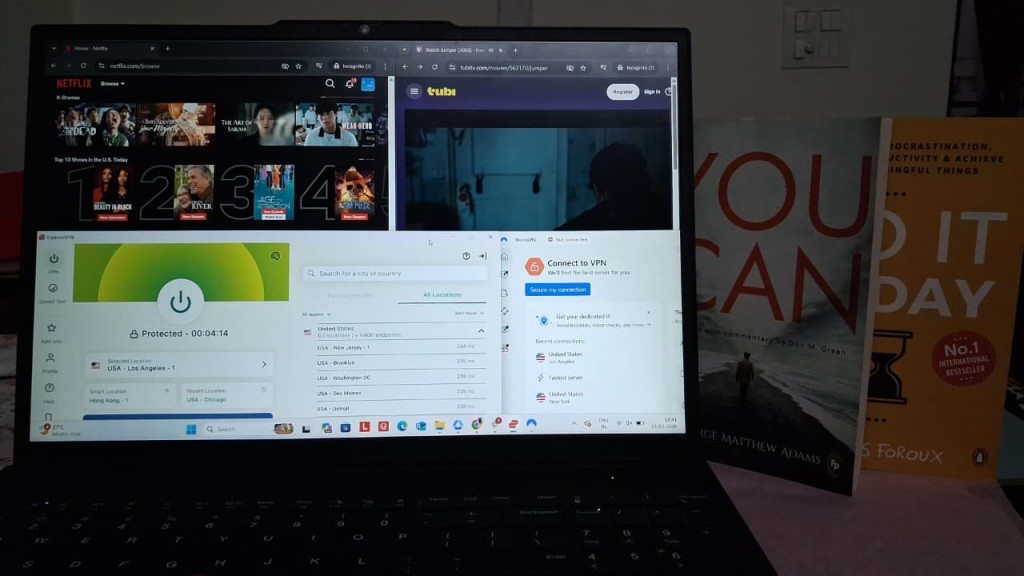
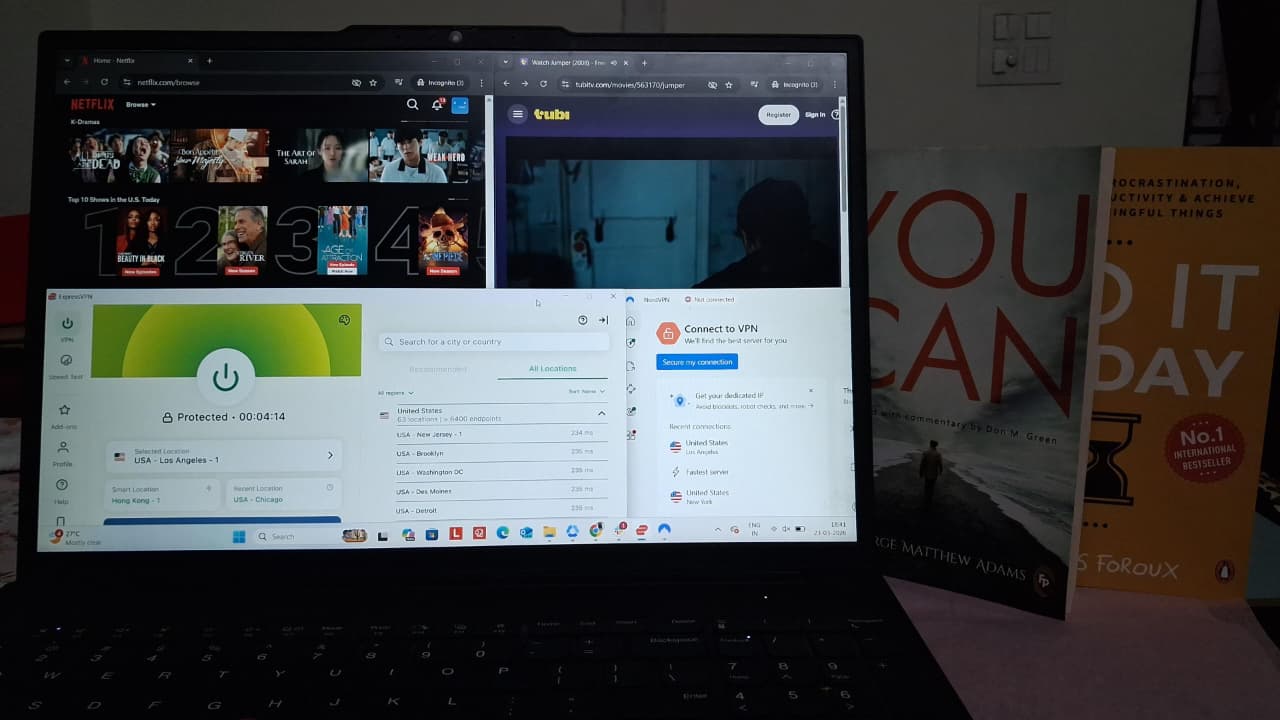
US Server Availability and Coverage - We evaluated how each VPN’s server network is distributed across the United States, taking into account coverage across major regions such as the East Coast, West Coast, and Central areas. In addition to geographic distribution, we also considered the availability of servers across different US cities and states, along with the presence of both physical and virtual servers. The inclusion of specialty servers was also taken into account, as these can offer optimized performance for specific use cases and enhance overall flexibility.
Access to US Websites and Services - Not all VPNs handle US platforms equally well, so we evaluated their ability to consistently access popular services including Netflix, Tubi TV, Pluto TV, Amazon.com, Google, and Reddit. The assessment focused on whether connections were smooth and whether any restrictions were triggered during use. Particular attention was given to signs of VPN detection, such as proxy errors, repeated CAPTCHA prompts, or access blocks, all of which can indicate difficulty in bypassing platform restrictions.
Speed and Latency on US Servers - We connected to multiple US locations, including New York, Chicago, and Los Angeles, and ran speed tests using Cloudflare’s Speed Test tool to measure download speeds, upload speeds, latency, jitter, and overall consistency. The baseline connection recorded a download speed of 234 Mbps and an upload speed of 234 Mbps, with a latency of 43.9 ms and jitter of 18.5 ms. These baseline figures provide a reference point to understand the impact of each VPN on real-world performance, including any variation in speed and responsiveness across different server locations.
Connection Reliability - We monitored how consistently each VPN established and maintained a connection over extended sessions lasting between 25 to 30 minutes. During this period, we observed connection behavior to see how smoothly the VPNs handled initial handshake times, as well as whether they remained stable without unexpected drops or interruptions. Browsing performance was also evaluated in real-time, focusing on page load responsiveness and general usability while connected. In addition, we assessed how well each VPN handled streaming and content access, checking for buffering, playback stability, and the ability to maintain access to geo-restricted platforms without disruption.
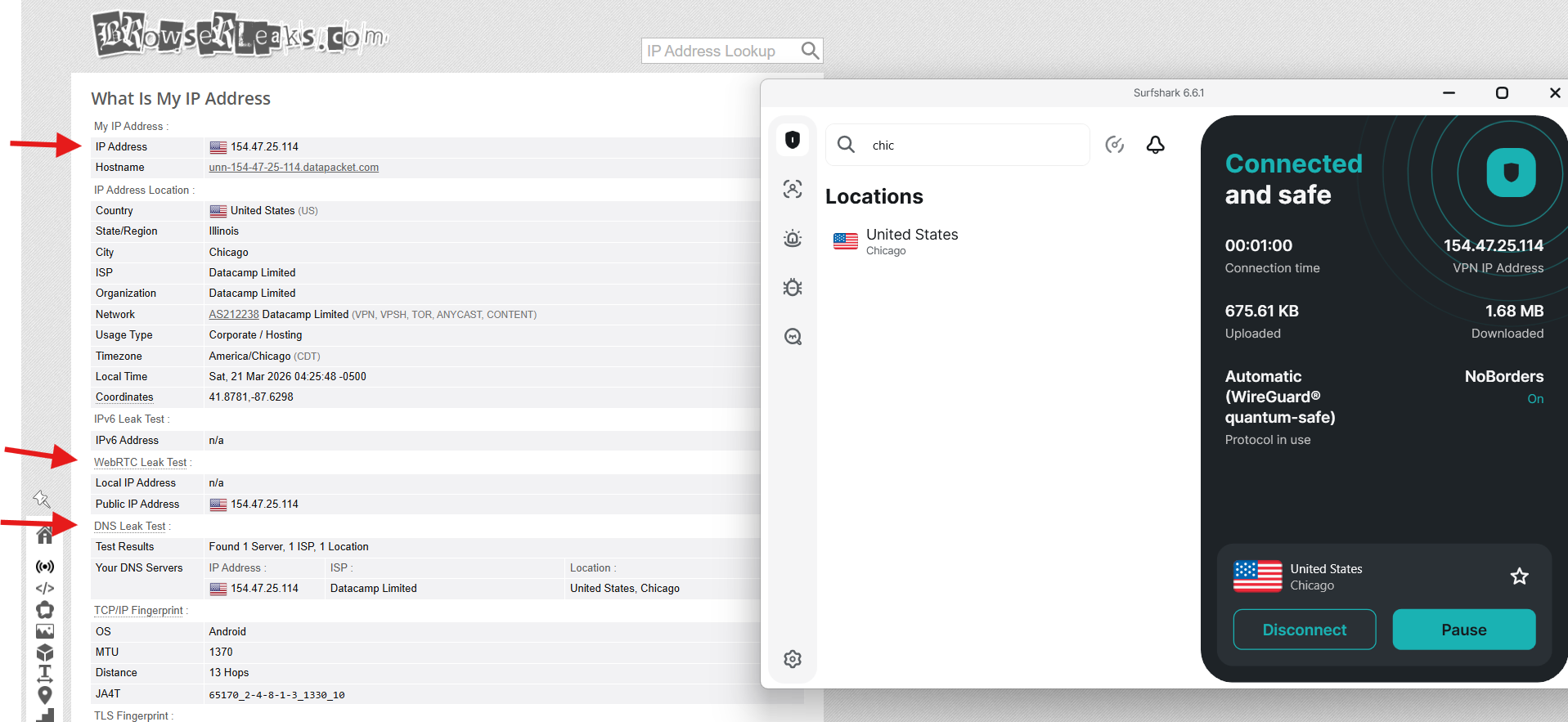
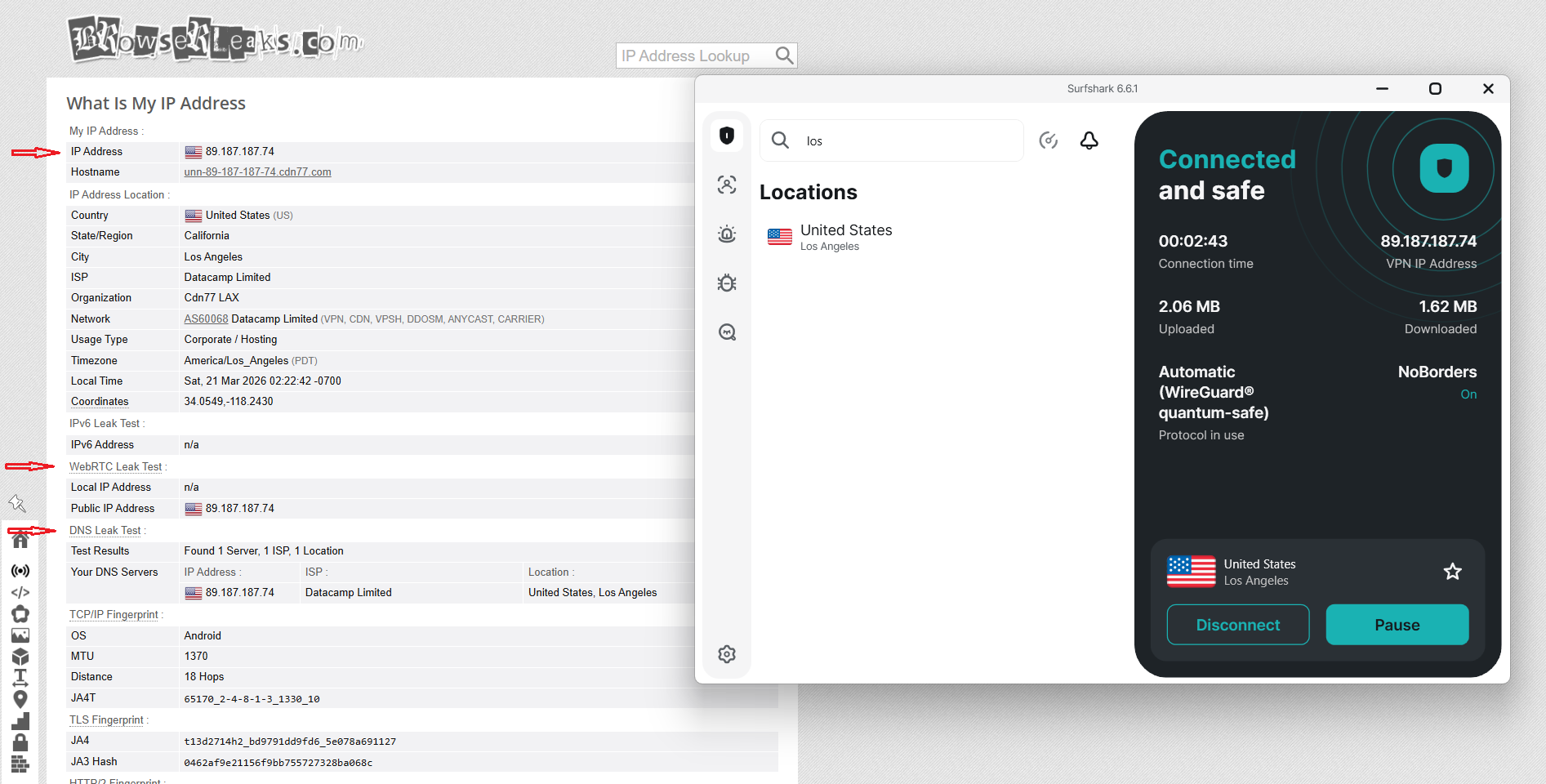
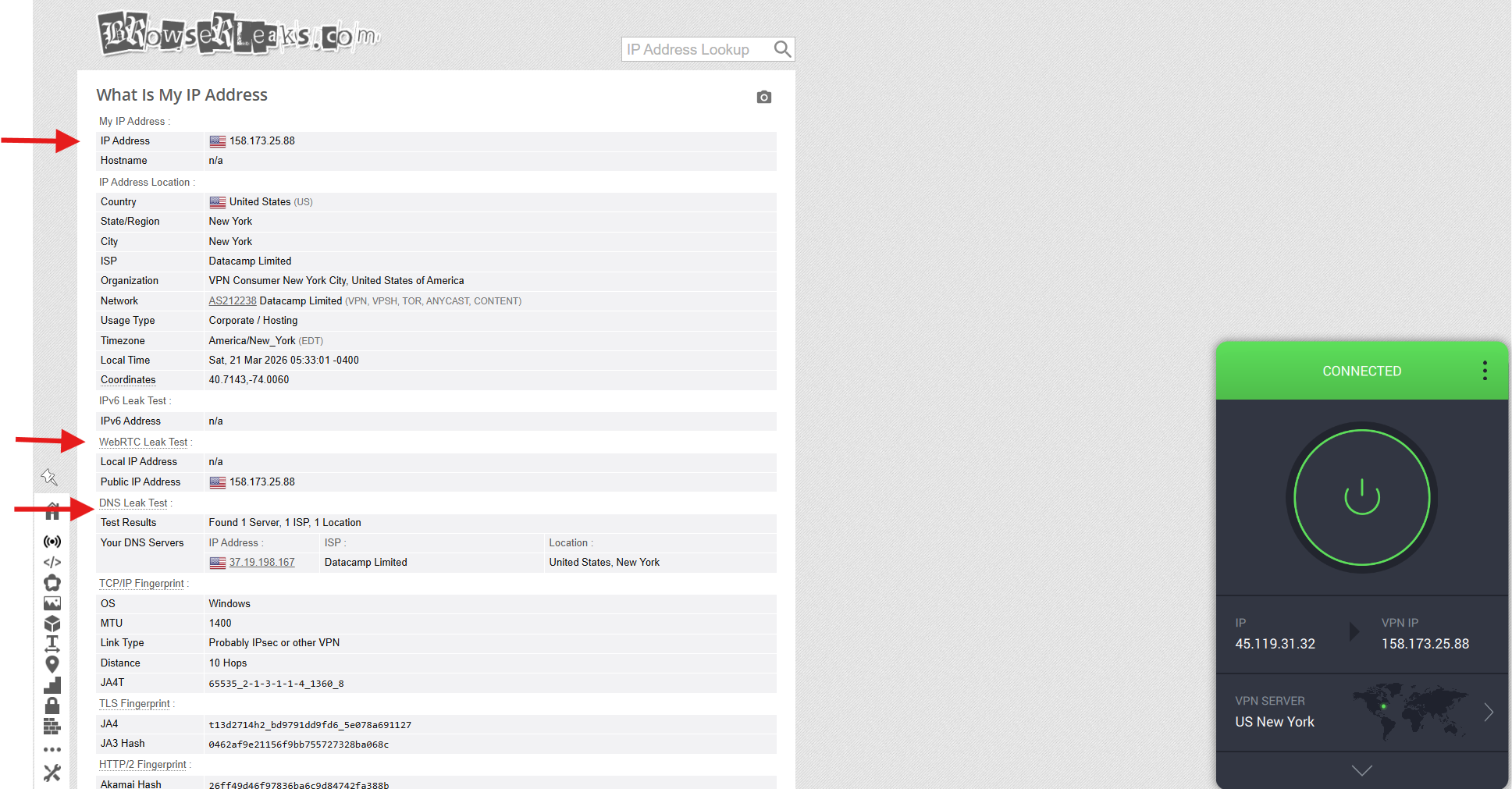
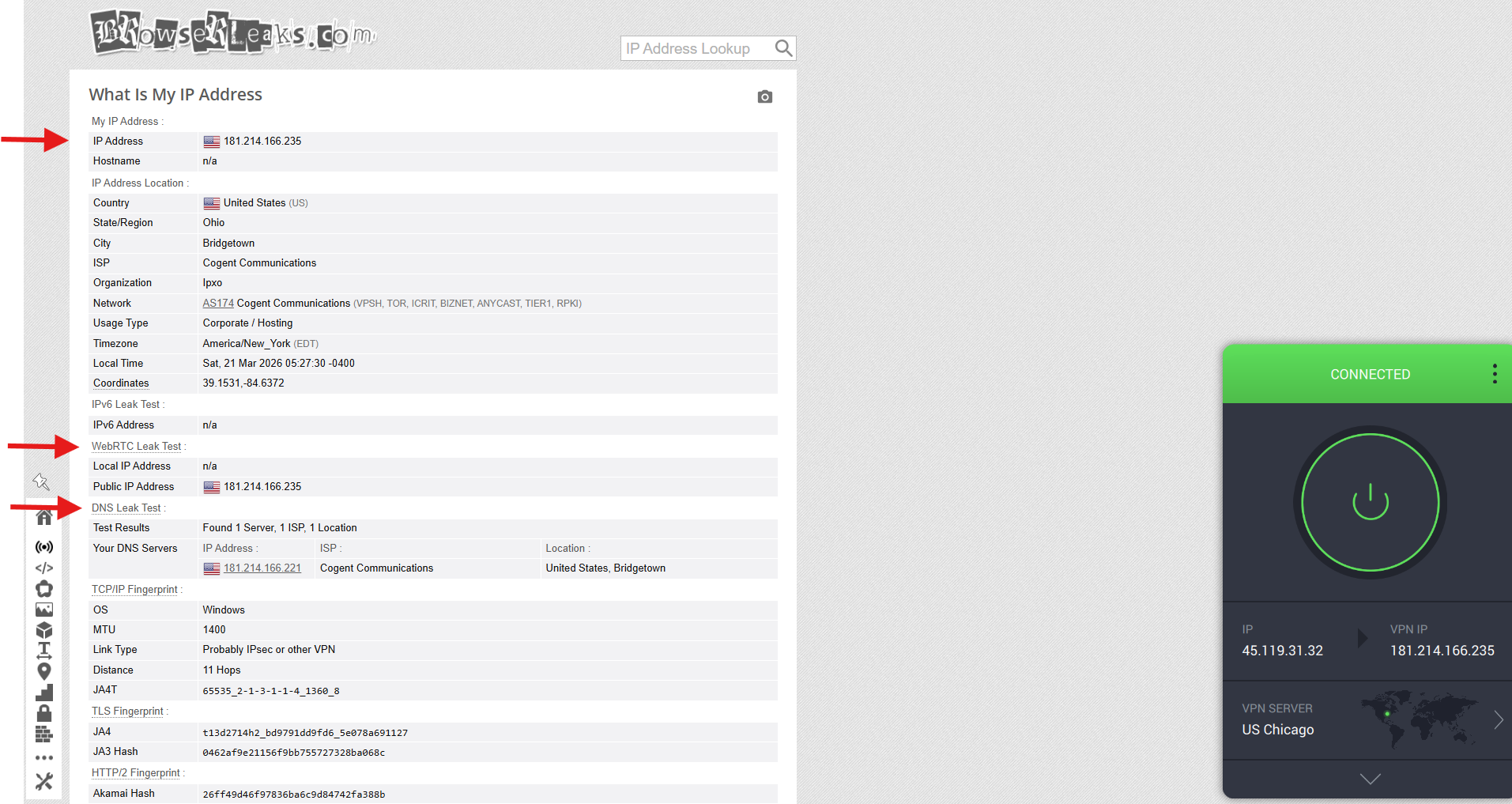
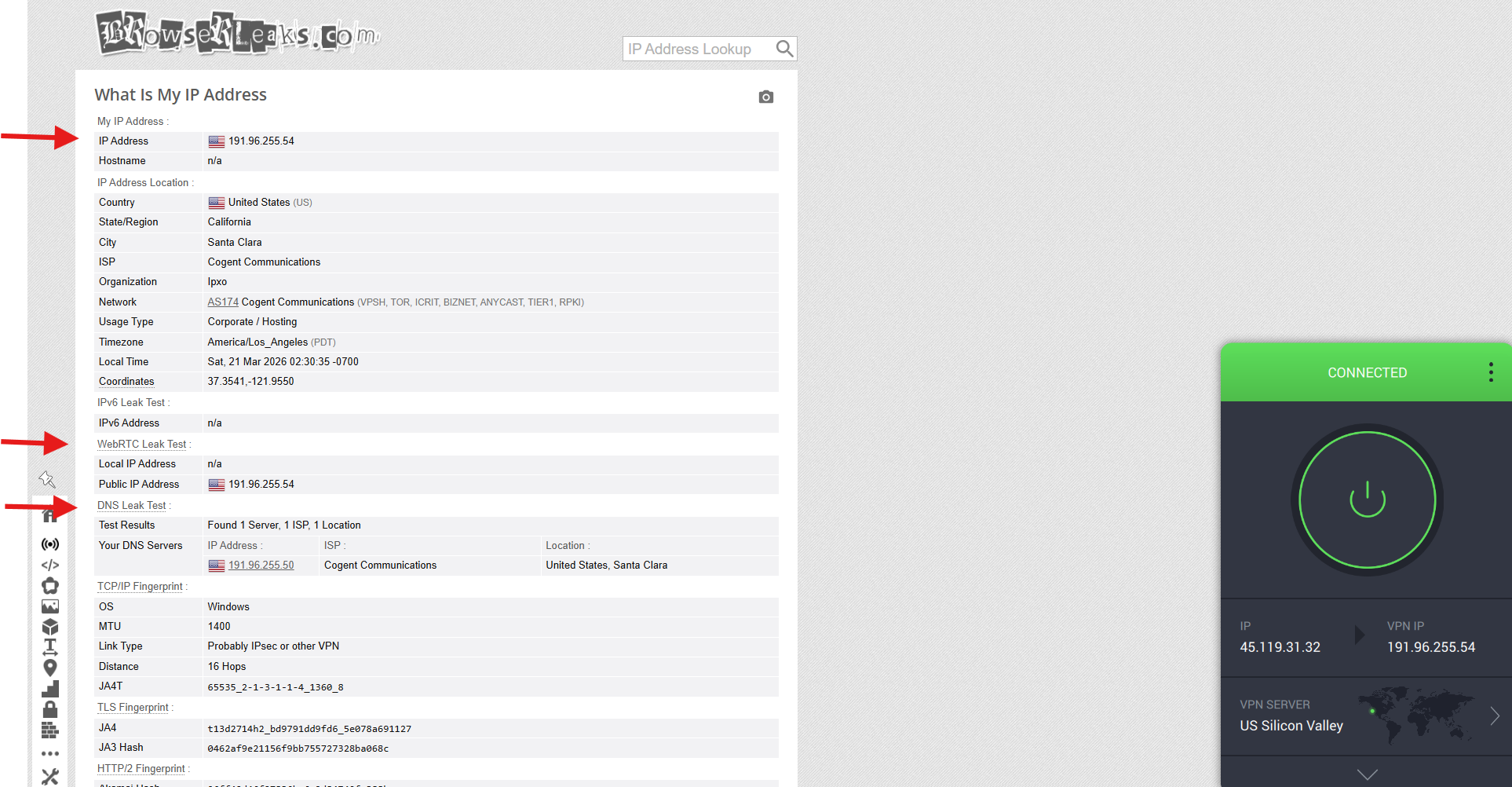
Leak Protection and Kill Switch: We used a single tool, i.e., BrowserLeaks, to test for IP, DNS, and WebRTC leaks while connected to three US servers - Chicago, New York, and Los Angeles. For PIA, we used the Silicon Valley server as the Los Angeles server was unavailable. We did so to ensure no real user data was exposed. The results confirmed that only VPN-assigned IP addresses and DNS information were visible. To evaluate the Kill Switch, we simulated connection drops by disabling the internet and forcing VPN interruptions.
Server Infrastructure - We looked at the overall server network, including total server count, geographic distribution, and whether servers are physical or virtual.
Privacy and Jurisdiction - We reviewed where each VPN company is based, what kind of data laws apply to them, and how transparent their no-logs policies are, including whether they’ve been independently audited.
Security Features - We checked the encryption standards and tested available protocols like WireGuard and OpenVPN to see how they balance speed and security.
Compatibility and Ease of Use - Since this testing is Windows-focused, we evaluated how easy each VPN is to install and use on desktop, including interface design and configuration options.
Customer Support - We reached out via live chat and email to see how responsive and helpful each provider is when you actually need support.
Pricing and Value - Finally, we looked at subscription costs, renewal pricing, refund policies, and whether the overall offering feels worth the price long-term.
Best VPNs for the USA – Detailed Review
Based on the criteria mentioned above, the 5 best VPNs for the USA are:
1. NordVPN - ⭐Best Overall
Using NordVPN for US-based usage felt smooth and dependable throughout my testing, and it comfortably passed all the key checks I ran. From connecting to different US regions to browsing and streaming on real platforms, everything worked without interruptions, which made the overall experience feel consistent and practical rather than overly technical.
What stood out most was how easy it was to find and stick with a stable connection. US servers were spread out well across major regions, and once connected, browsing felt responsive with no noticeable delays in everyday use. Streaming also kicked in quickly, settling into higher quality within seconds, without buffering or playback issues.
Speed performance varied slightly depending on the server location, with nearby servers feeling more responsive than distant ones, especially in terms of latency. Even so, the connection remained stable across the board, and I didn’t run into disconnects, lag spikes, or interruptions during extended sessions. Access to US platforms worked without friction, and there were no detection issues or verification loops. Overall, the experience felt reliable, balanced, and well-suited for regular use in the US.
Performance Testing Results
When it comes to coverage in the United States, NordVPN does a solid job of spreading its servers across the country rather than concentrating them in just a few major cities. And the best part is that it covers all 50 US states.
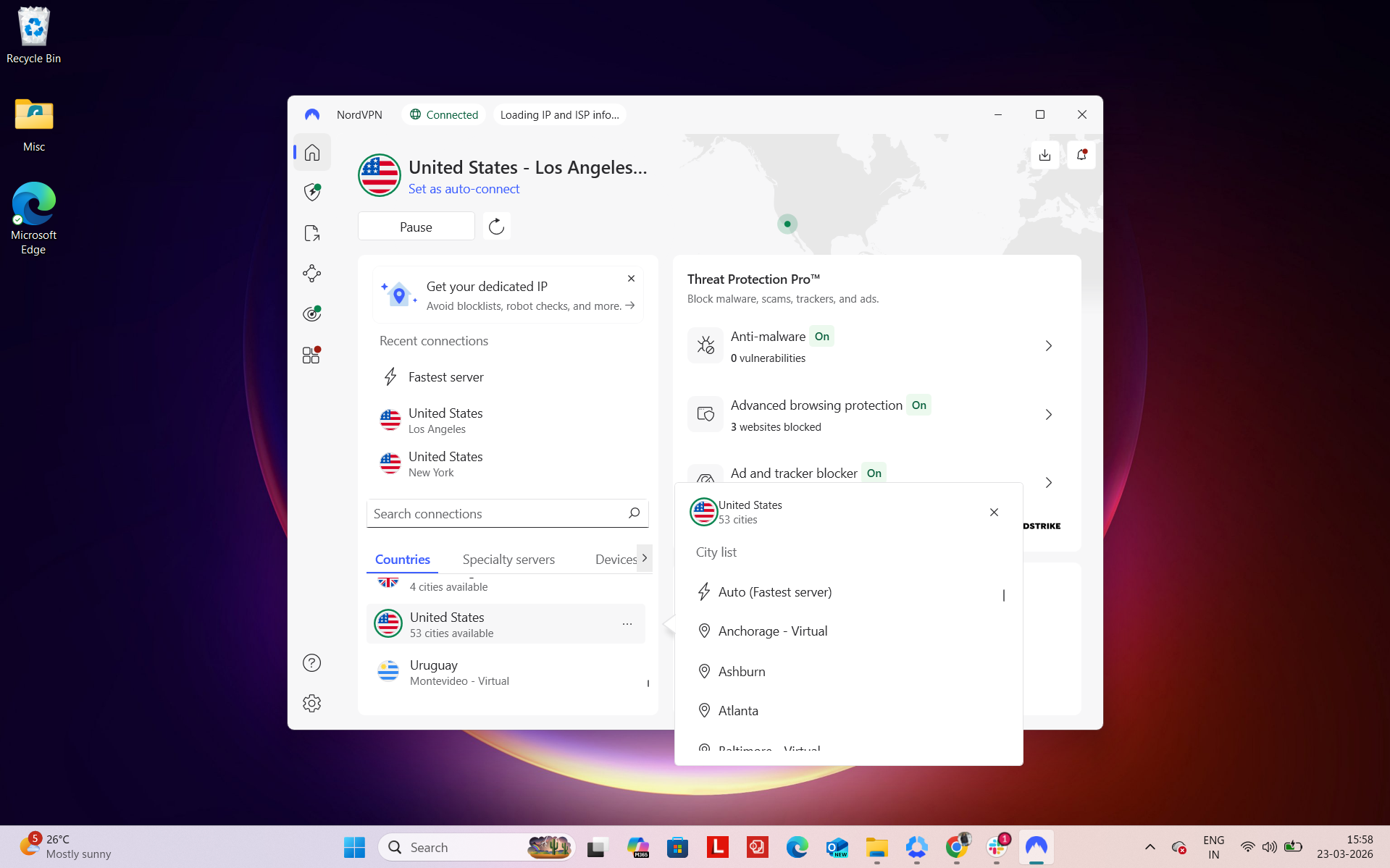
Number of US Cities & States - NordVPN has over 3,200 servers across 50 states and 55 cities. That kind of coverage makes a noticeable difference, especially when you’re trying to find a fast, nearby connection instead of being stuck with a crowded or distant server.
Regional Distribution - To get a better sense of how these servers are spread out, here’s a breakdown by region:
Total: around 55 cities across 50 states
What I liked most is that the distribution actually feels balanced. On the East Coast, you’ve got plenty of options like New York, Boston, Miami, Atlanta, Trenton, Baltimore, and more. Moving to the central regions, cities like Chicago, Dallas, Denver, Houston, and Kansas City are all available. And on the West Coast, you can connect to major hubs such as Los Angeles, San Francisco, Seattle, Phoenix, Las Vegas, and many more.
In practical terms, this means you can usually find a server close to your location, which helps keep speeds stable and latency lower. It also makes it easier to access region-specific content within the US without having to rely on just one or two overloaded locations.
Physical vs Virtual Servers - NordVPN is fairly transparent in this area. It includes around 79 virtual servers, and these are clearly labeled, so you know exactly what you’re connecting to. The rest of the network consists of physical servers, which adds an extra layer of reliability and trust.
Specialty Servers - Beyond standard servers, NordVPN also offers a strong range of specialized options, including:
- P2P-optimized servers
- Obfuscated servers (for bypassing VPN restrictions)
- Double VPN (routes traffic through two servers)
- Onion over VPN (extra privacy via the Tor network)
- Dedicated IP servers
These options make it more flexible depending on whether your priority is streaming, privacy, or bypassing restrictions.
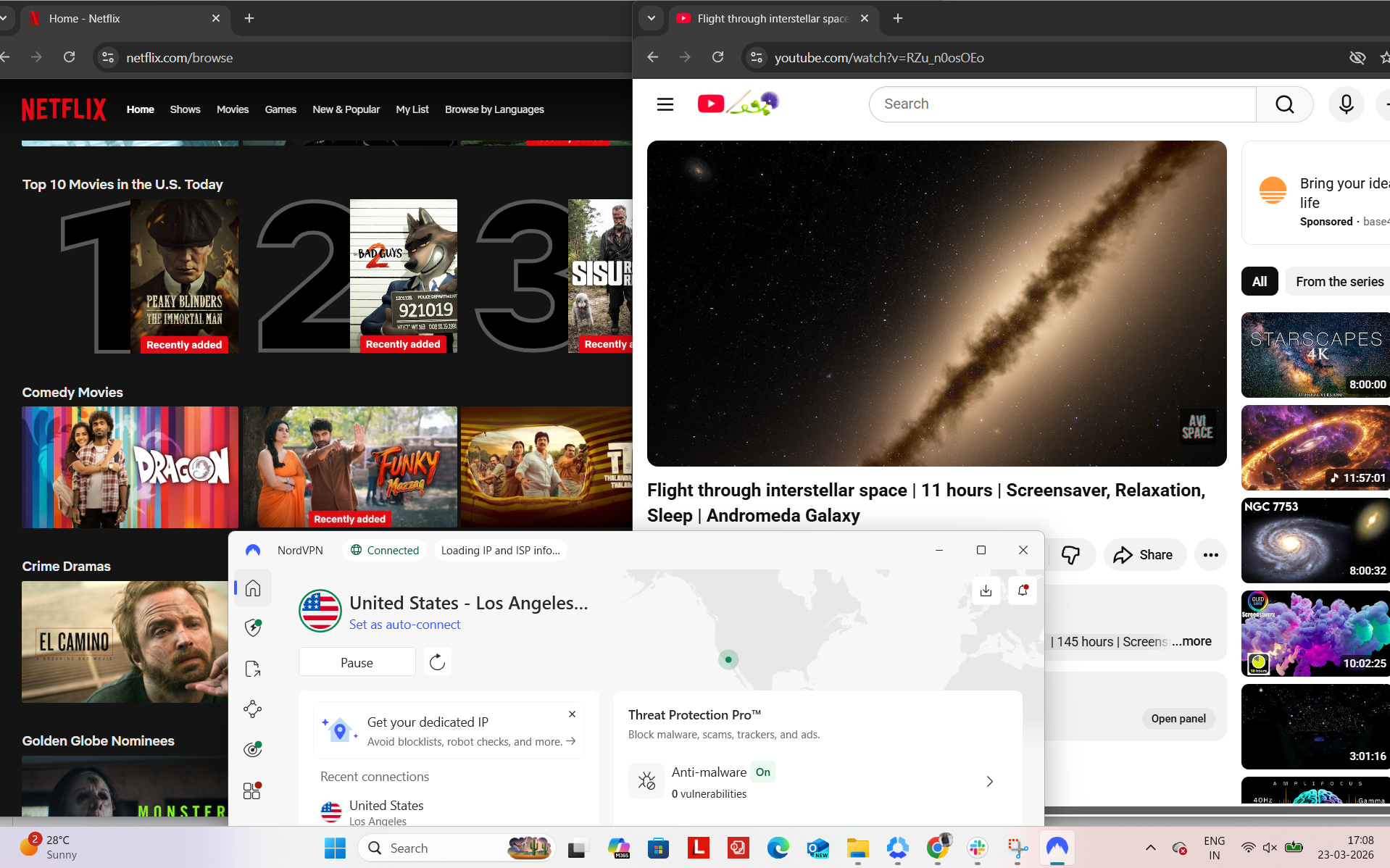
In actual usage, I didn’t have to deal with verification loops, blocked pages, or repeated sign-in checks. Pages and services opened directly, and the experience remained consistent across different sites. There were no interruptions or signs that the VPN was being flagged, which made accessing US content straightforward and hassle-free throughout the session.
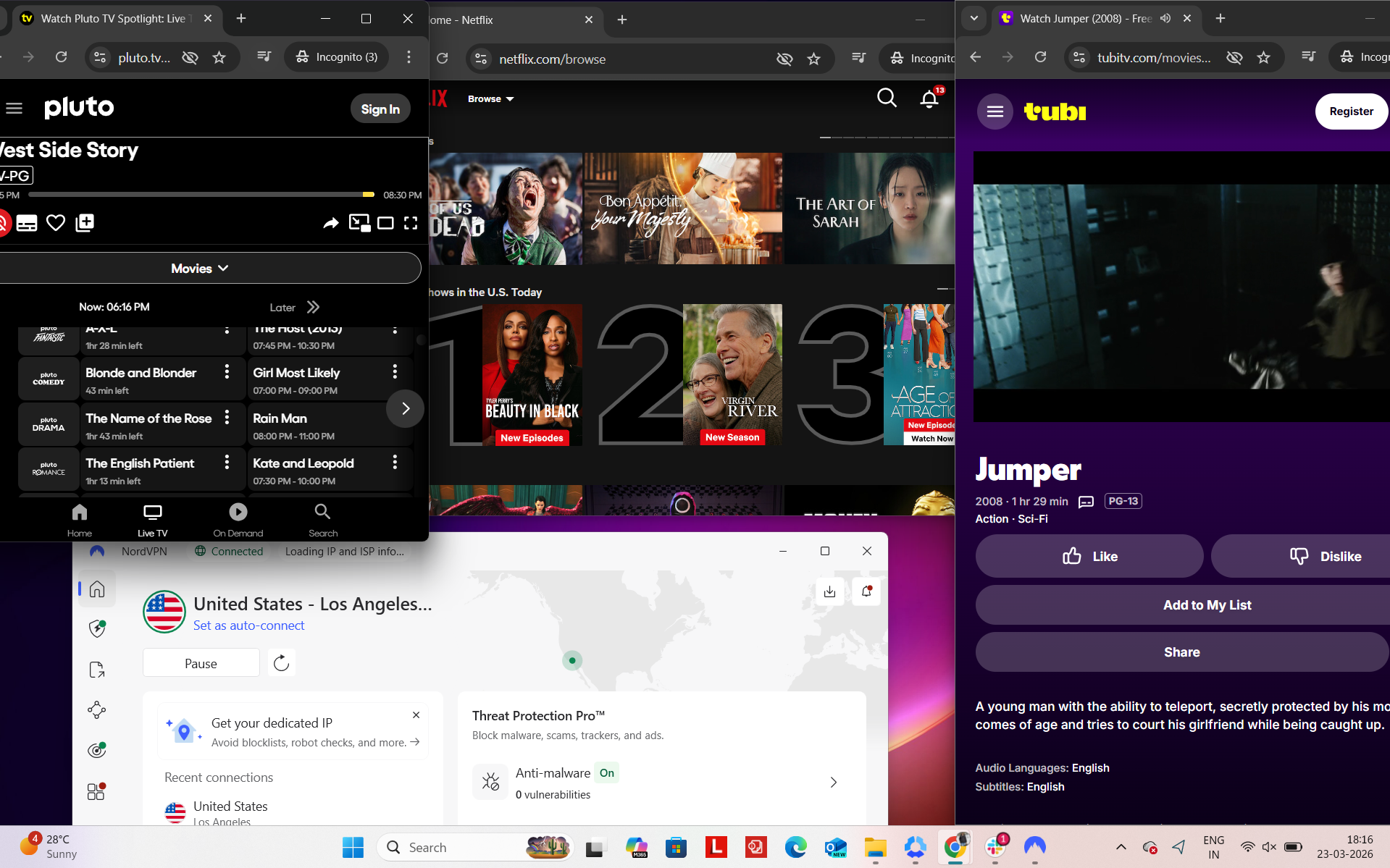
NordVPN handled access to US platforms smoothly during testing, and I didn’t run into any friction while using popular services. From the moment I connected, everything felt fairly “normal,” as if I wasn’t using a VPN at all.
Real-World Access Experience
- Netflix - Loaded without any errors and worked as expected
- Tubi TV - Accessible with no interruptions
- Pluto TV - Streamed without restrictions
- Amazon.com - Browsing worked smoothly with no delays
- Google - Pages loaded instantly, just like a regular connection
- Reddit - Fully accessible with no limitations
Detection & Verification Behavior
- Proxy errors - None encountered
- CAPTCHA prompts - Did not appear during testing
- Service blocking - No issues bypassing major platforms
From my experience, speeds stayed fairly usable across all US locations, though there was a noticeable drop compared to the baseline. The Los Angeles server performed the best in terms of download speeds, while Chicago showed more fluctuation, especially in upload and jitter. Latency increased significantly on all servers, which I expected due to routing distance, but in real use, it didn’t affect basic browsing or streaming. Overall, performance felt stable, with no major slowdowns during testing.
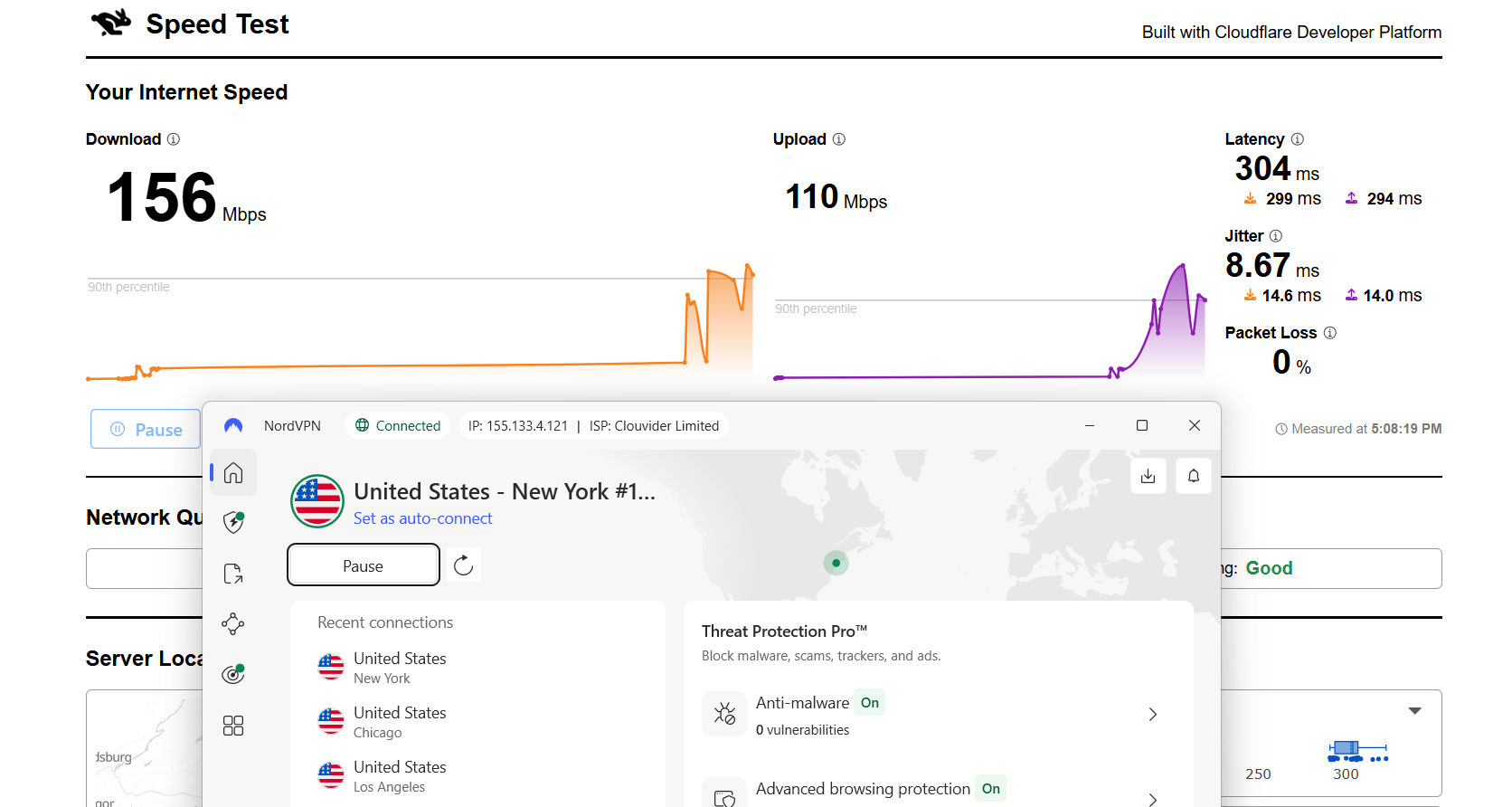
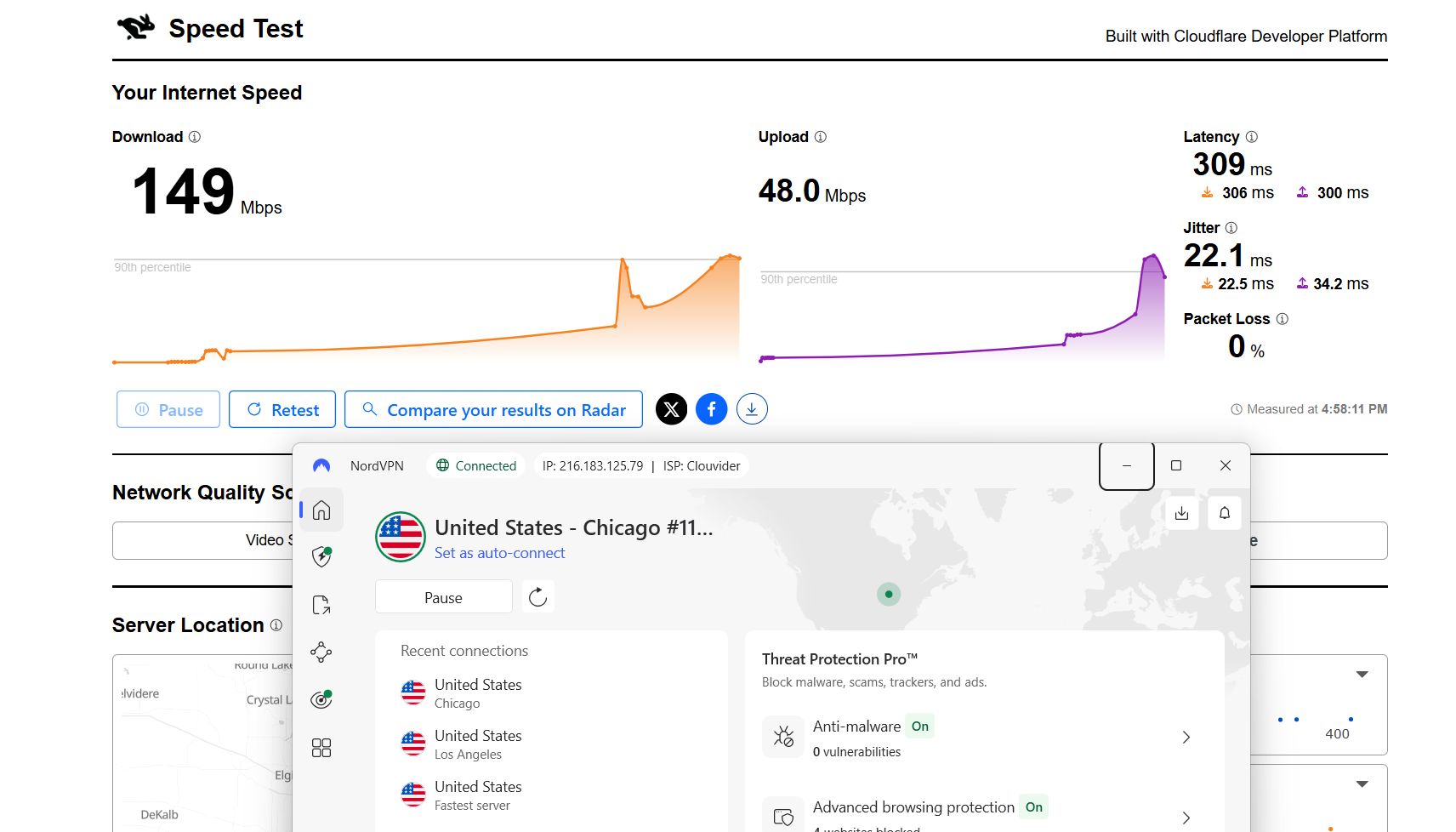
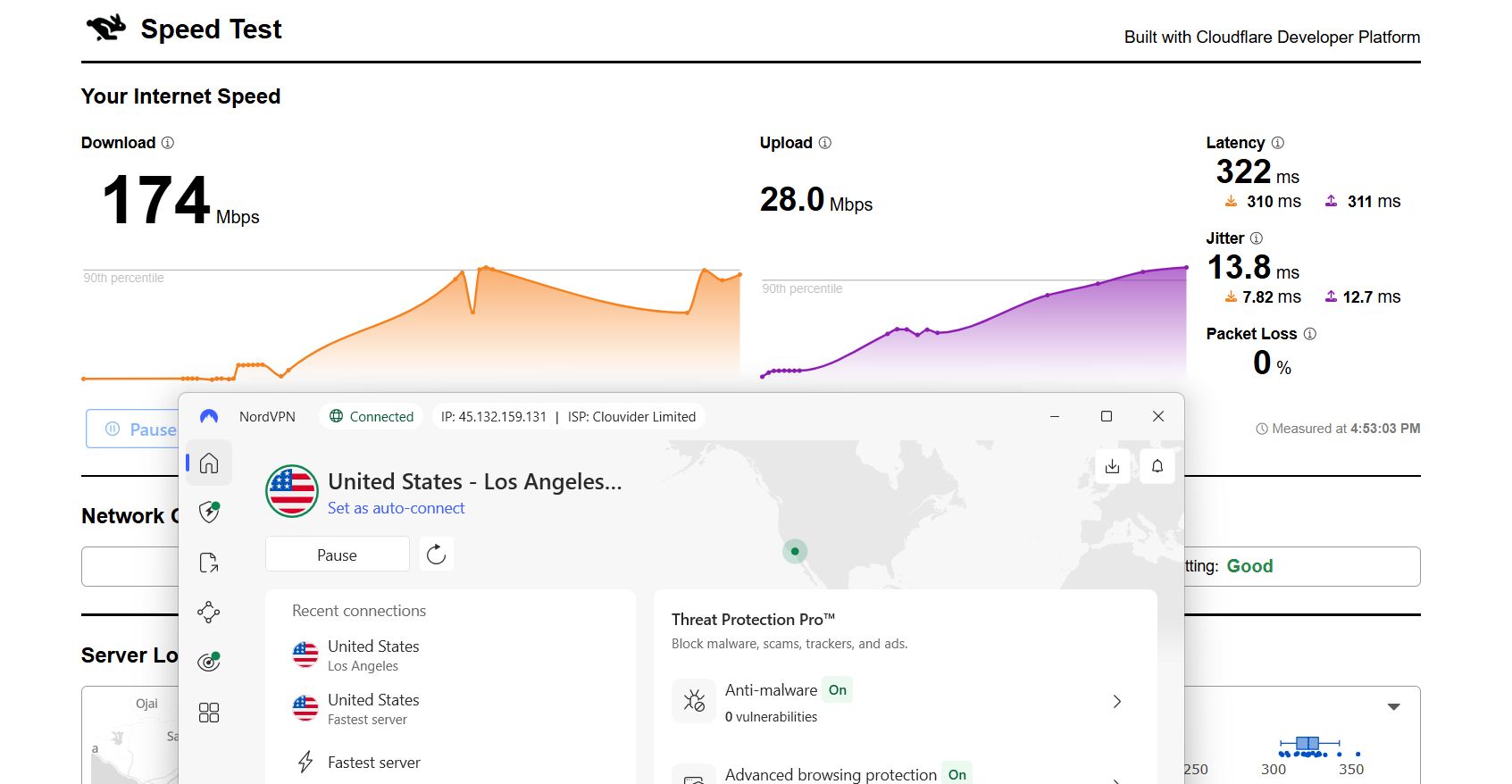
Here are the results against a baseline to understand how much speed was affected in real usage:
NordVPN delivered a consistently stable experience throughout testing, with no interruptions affecting browsing or streaming activity. The connection remained active the entire time without requiring any manual intervention.
Observed Connection Behavior
- Unexpected disconnects - None observed
- Reconnection attempts - Not required
- Network drops - None during the entire session
- Lag spikes or buffering - Not encountered in normal usage
Browsing Performance - Websites loaded instantly, and navigating between pages felt smooth and responsive. There were no noticeable delays or slowdowns while switching tabs or accessing different sites, which made everyday browsing feel natural and uninterrupted.
Streaming & Content Handling
- Content typically began loading immediately and played in a slightly lower resolution at first before quickly stabilizing at optimal quality for both YouTube and Netflix.
- Video playback remained steady once started, with no buffering during continuous viewing
- Forward seeking worked smoothly with only brief loading
- Rewinding introduced a short delay (a couple of seconds) before playback resumed, after which it stabilized quickly
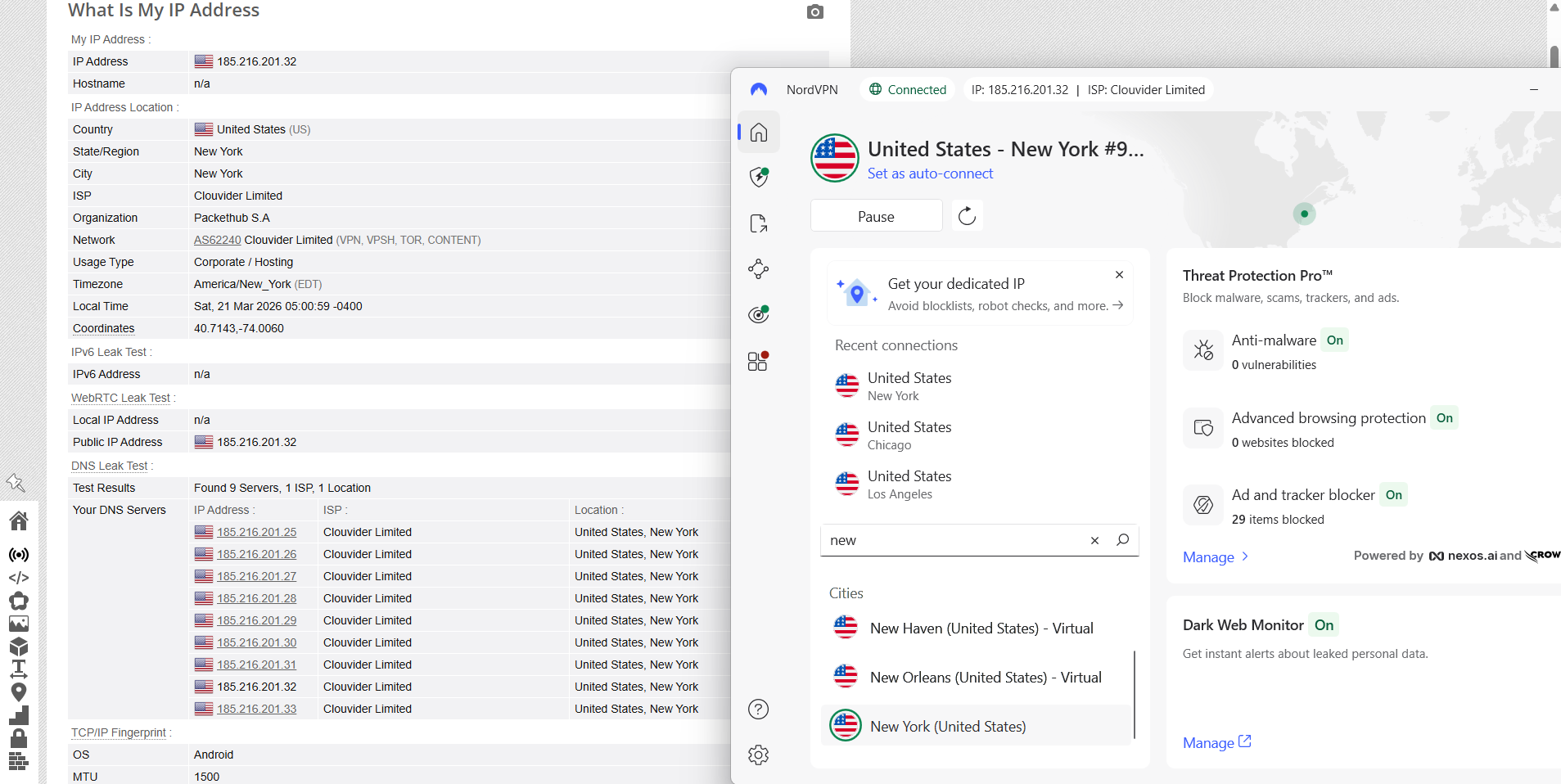
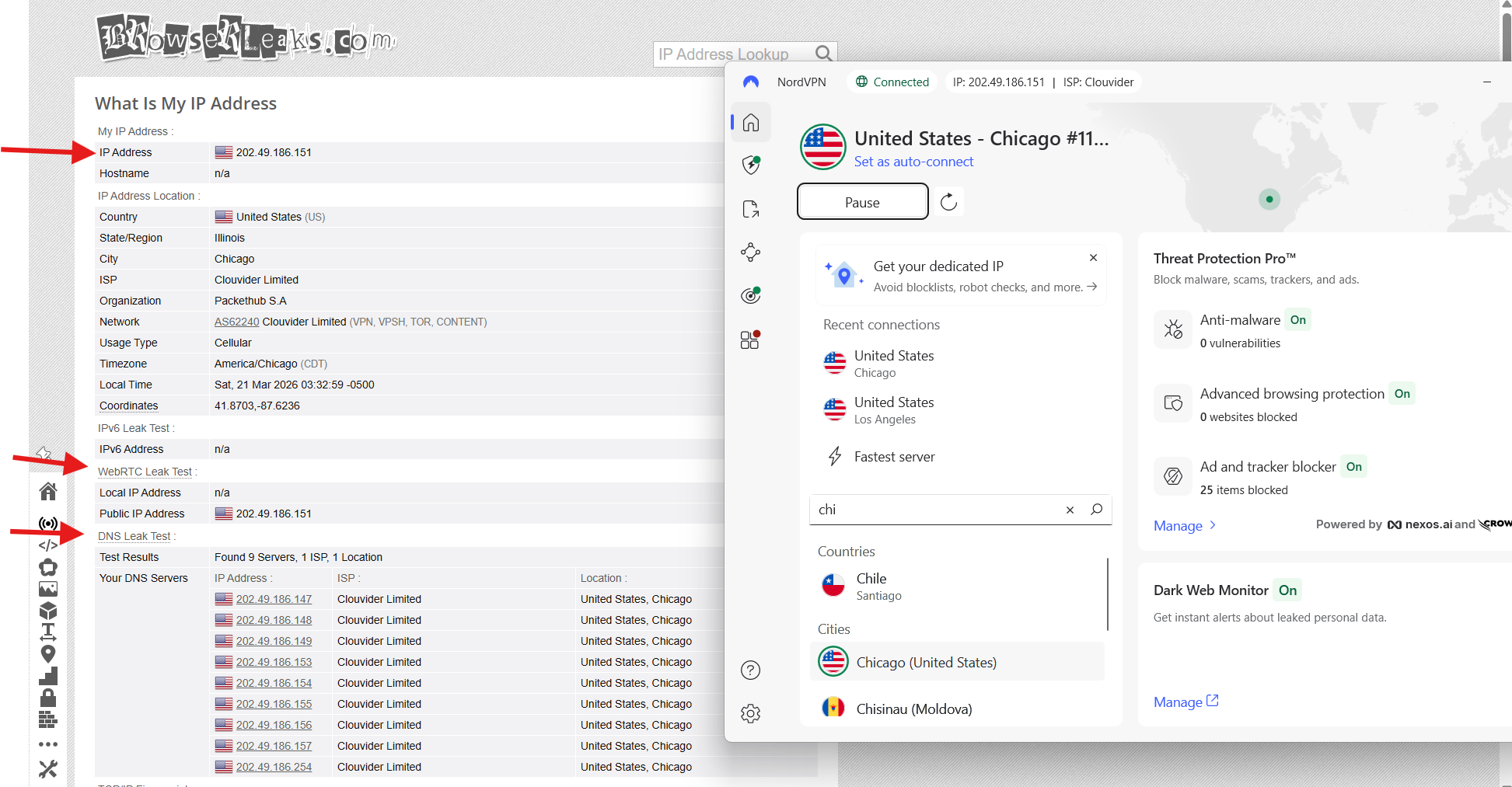
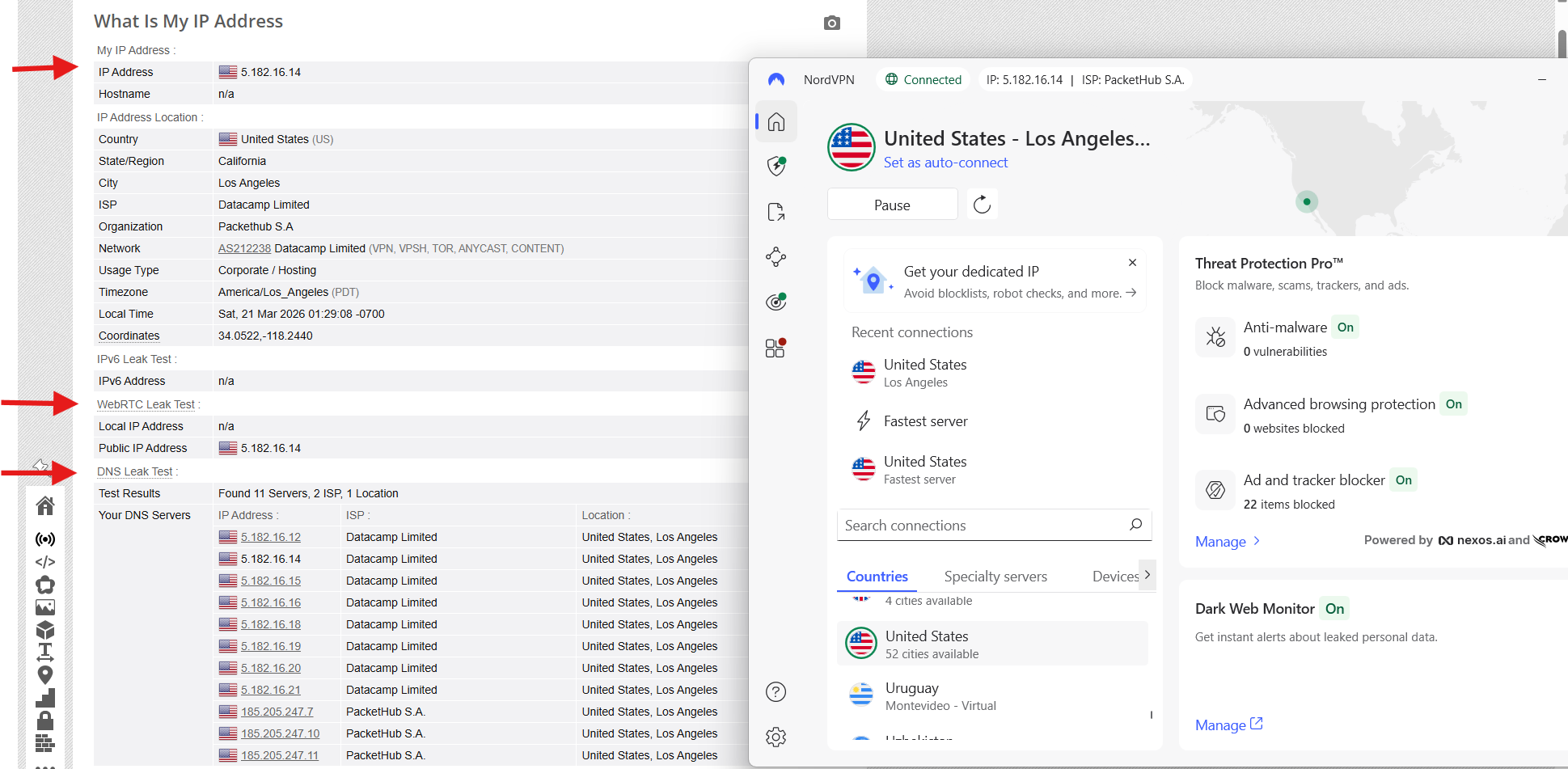
NordVPN delivered a solid performance when it came to safeguarding connection data. The visible IP address remained fully aligned with the selected server location at all times, with no signs of accidental exposure. DNS activity stayed within NordVPN’s encrypted network, preventing any outside interference, and WebRTC checks further confirmed that the real IP address was never revealed.
On the security front, the Kill Switch proved dependable. During simulated connection interruptions, it reacted instantly by cutting off internet access, ensuring that no traffic slipped through outside the protected tunnel.
PROS
- Massive US server network with 3,200+ servers across 55 cities and all 50 US states
- Strong regional distribution across East, Central, and West US
- Reliable streaming with instant playback and no buffering
- Stable connections with no disconnects or network drops
- Consistent access to major US platforms without detection issues
- No IP, DNS, or WebRTC leaks detected during testing for USA
- Transparent server labeling including virtual servers
- Wide range of specialty servers (P2P, Double VPN, Obfuscated, Onion over VPN)
- Smooth browsing experience with fast page loads and no lag spikes
CONS
- Some servers show noticeable jitter fluctuations during testing
2. ExpressVPN - 🥈Runner-Up
Using ExpressVPN felt straightforward from the moment I connected, with no setup hurdles or confusing steps in between. I could get online quickly and start browsing like normal, without needing to adjust settings or troubleshoot anything. The whole process felt clean and uncomplicated, which made it easy to settle into daily use.
Once connected to ExpressVPN US servers, performance felt stable in everyday use. Websites loaded quickly, scrolling was smooth, and switching between tabs didn’t cause any lag or delays. Streaming also worked without issues, with videos starting almost instantly and reaching good quality within seconds, which kept the experience smooth and uninterrupted throughout.
It remained consistent over longer sessions as well, without disconnects or unexpected interruptions, and I didn’t have to reconnect at any point. That said, speeds can vary depending on the server you choose, and some locations feel slower than others. It also lacks advanced server options, so it may not be ideal if specialized features are a priority. Overall, it remains an amazing option for the USA due to its coverage over the entire US.
Performance Testing Results
ExpressVPN offers one of the most extensive and well-distributed server networks among major VPN providers. Compared to NordVPN and PIA, its footprint is broader in terms of both total cities and state coverage, which gives users more flexibility when choosing nearby servers.
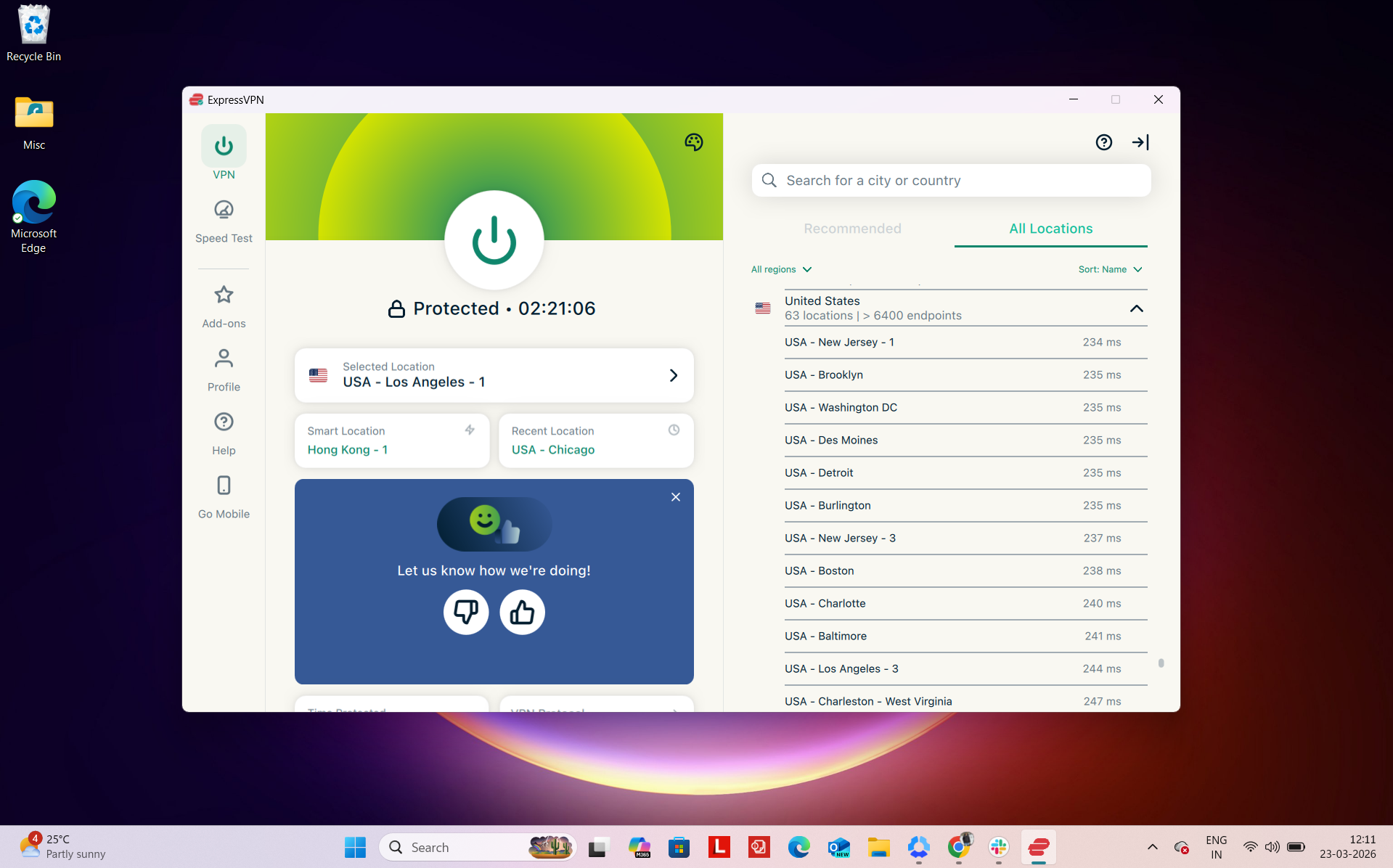
Number of US Cities & States - ExpressVPN provides access across 56 cities spanning 50 states and DC, which is notably comprehensive. This wide distribution ensures that users are rarely far from a nearby server, helping maintain stable speeds and low latency when connecting from within the US.
Regional Distribution - To better understand how these servers are spread out, here’s a complete region-based breakdown:
Total: around 56 cities across 50 states and DC
What stands out most is how evenly distributed the network feels across the country. On the East Coast, major hubs like New York, Boston, Miami, and Atlanta are all covered, along with many smaller but strategically important cities. In the Central region, ExpressVPN has its strongest concentration of locations, with access to cities such as Chicago, Dallas, Houston, Denver, and Minneapolis. On the West Coast, although the number of cities is smaller compared to the Central region, key locations like Los Angeles, San Francisco, Seattle, and Phoenix ensure solid connectivity for users in the western US.
In practical terms, this level of distribution means you can almost always find a nearby server, which helps maintain consistent speeds and minimizes latency. It also improves access to region-specific content across the country without being limited to just a handful of server hubs.
Physical vs Virtual Servers - ExpressVPN does not explicitly label all servers as physical or virtual in the same way some competitors do (such as NordVPN). However, many of its US server locations are indicated with “(via)” labeling, signaling that they are virtual server locations. In total, there are 101 virtual servers (38 virtual servers in US alone), which are clearly identified within the network.
Specialty Servers - Unlike some NordVPN, ExpressVPN does not offer a wide range of specialty server categories such as dedicated P2P, Double VPN, or Onion over VPN servers. Instead, it focuses on maintaining a consistent, high-performance standard across its general-purpose server network, which is optimized for speed, reliability, streaming, and general privacy use cases.
I connected to ExpressVPN and started using US sites right away without running into any roadblocks or interruptions, which made the whole experience feel very straightforward and close to a regular, non-VPN session.
Everything stayed stable throughout usage, and there weren’t any unexpected prompts or slowdowns when moving between different platforms, so browsing felt consistent and hassle-free across the board.
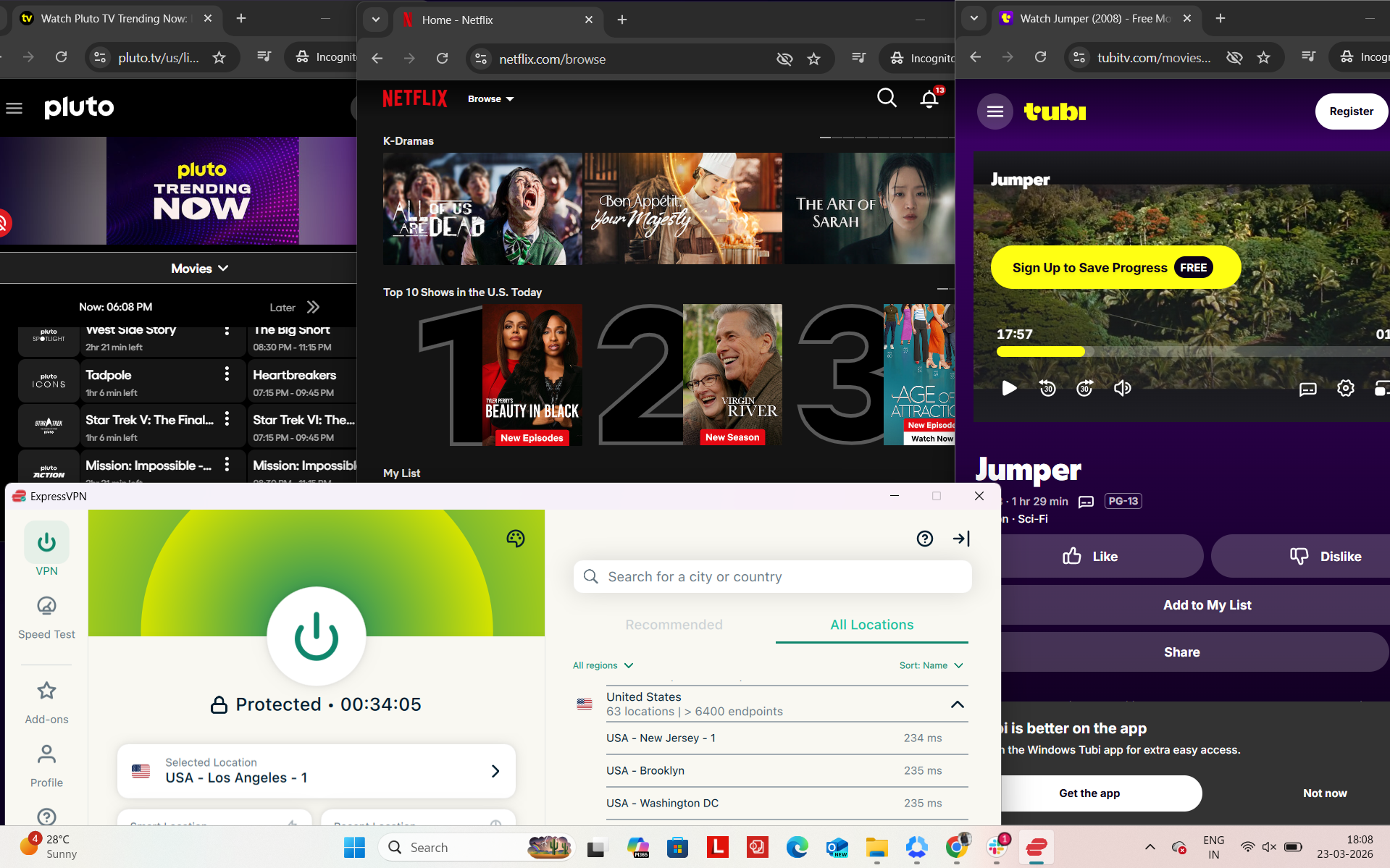
Real-World Access Experience
- Netflix - Loaded without any errors and worked as expected
- Tubi TV - Accessible with no interruptions
- Pluto TV - Streamed without restrictions
- Amazon.com - Browsing worked smoothly with no delays
- Google - Worked good. Pages loaded instantly
- Reddit - Fully accessible with no limitations
Detection & Verification Behavior
- Proxy errors - None encountered
- CAPTCHA prompts - Did not appear during testing
- Service blocking - No issues bypassing major platforms
With ExpressVPN, speeds felt consistently solid in day-to-day use, though there was a clear and noticeable drop from the baseline across all locations. The New York and Chicago servers delivered very similar download performance, making them the more reliable options overall, while Los Angeles trailed slightly behind. Latency increased significantly on every server, which is expected with VPN routing, but it didn’t meaningfully impact general browsing or streaming. Upload speeds were fairly consistent across servers, and overall performance remained stable without any major interruptions or throttling during testing.
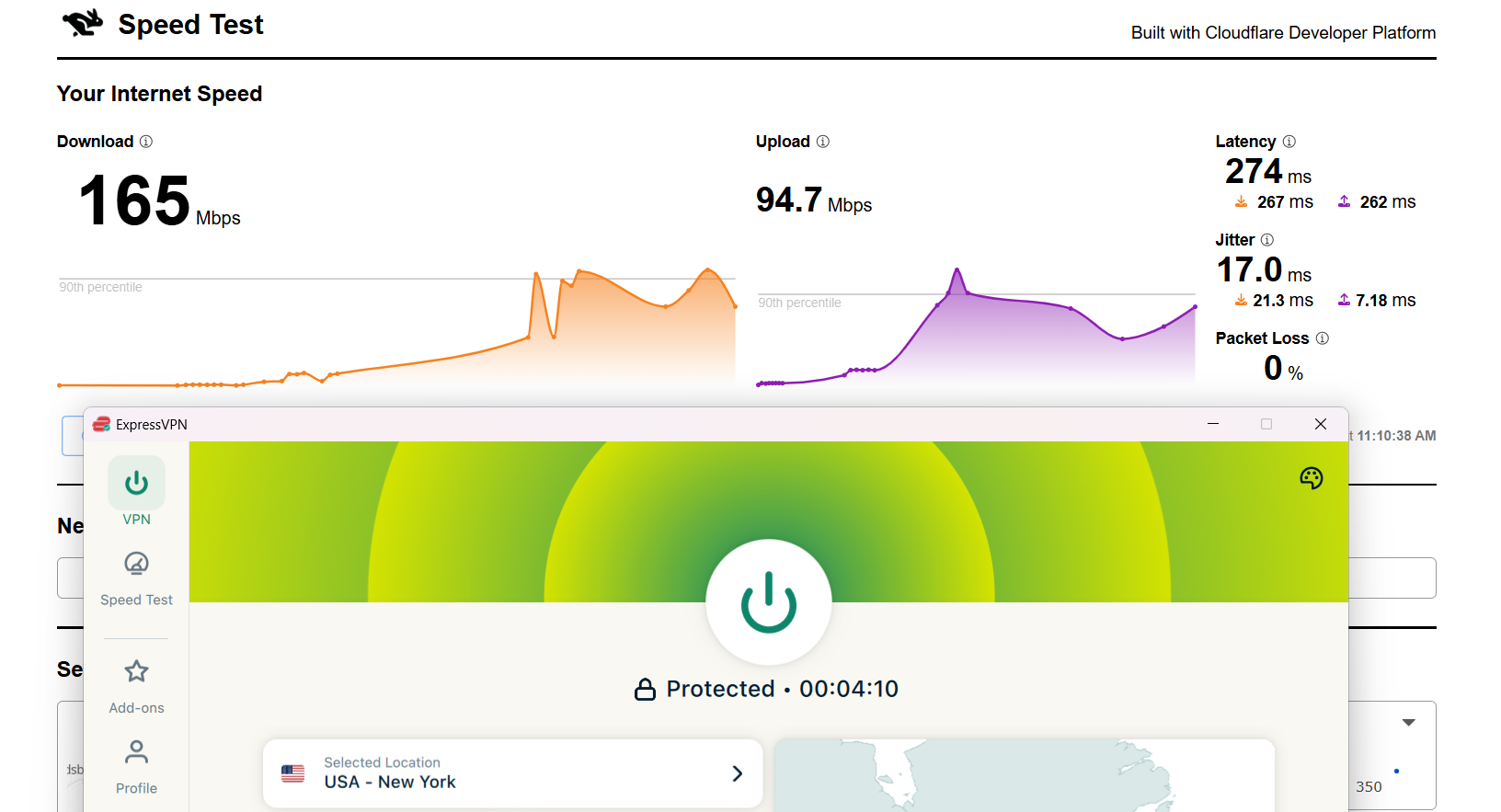
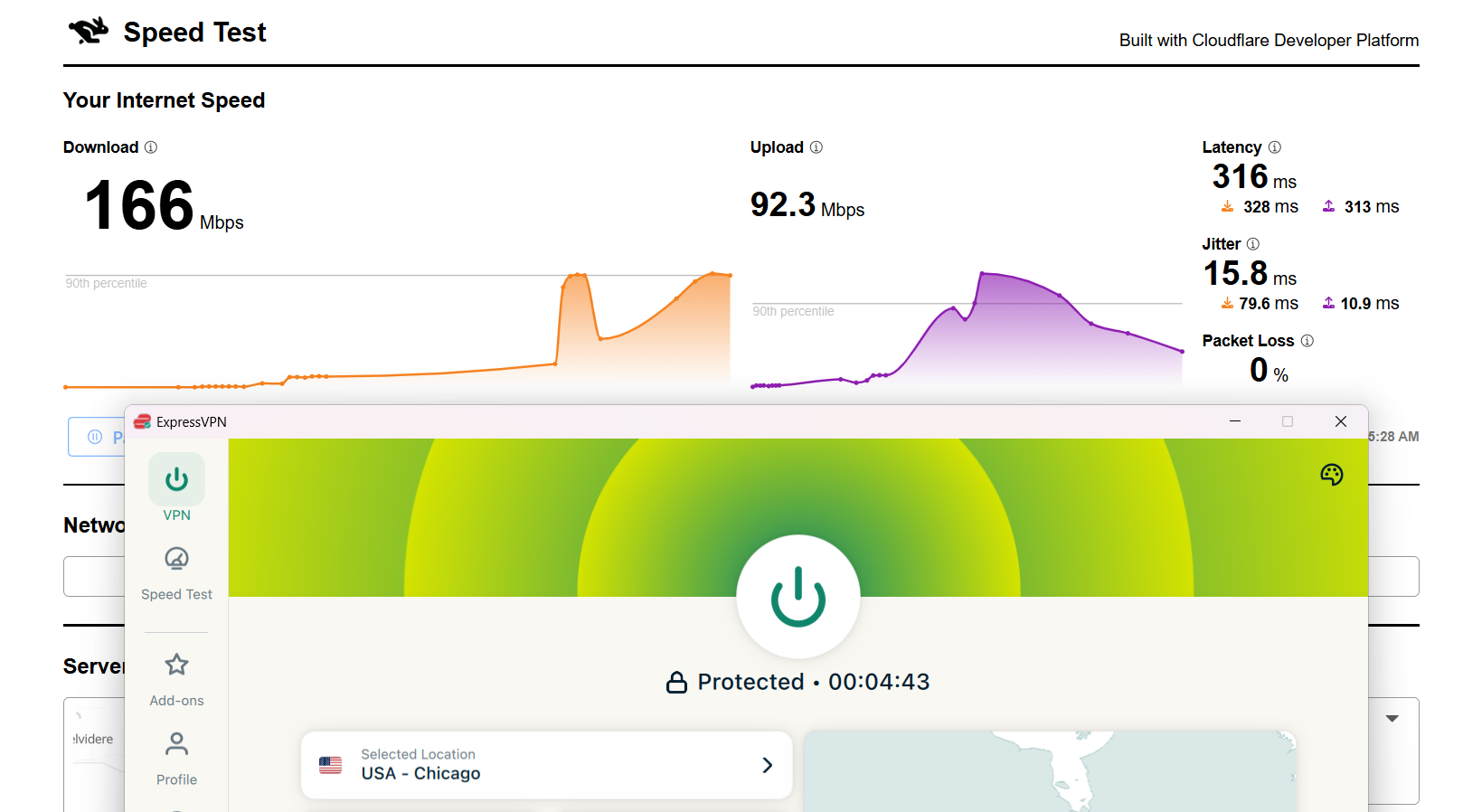
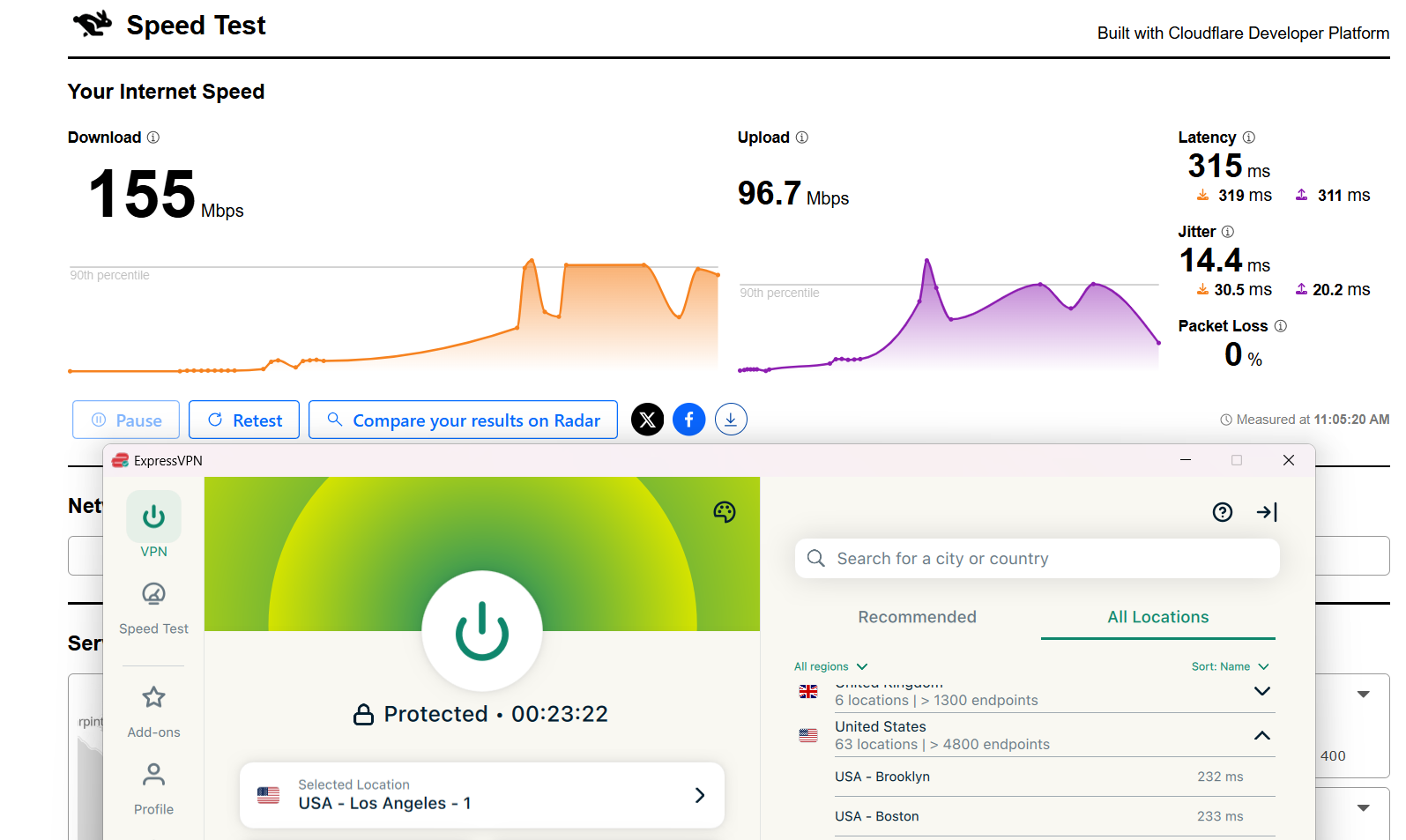
Here are the results against a baseline to understand how much speed was affected in real usage:
ExpressVPN felt smooth and dependable right from the start, with everything running in the background without interruptions or the need to step in at any point. Overall, the stability and reliability of the connection was commendable.
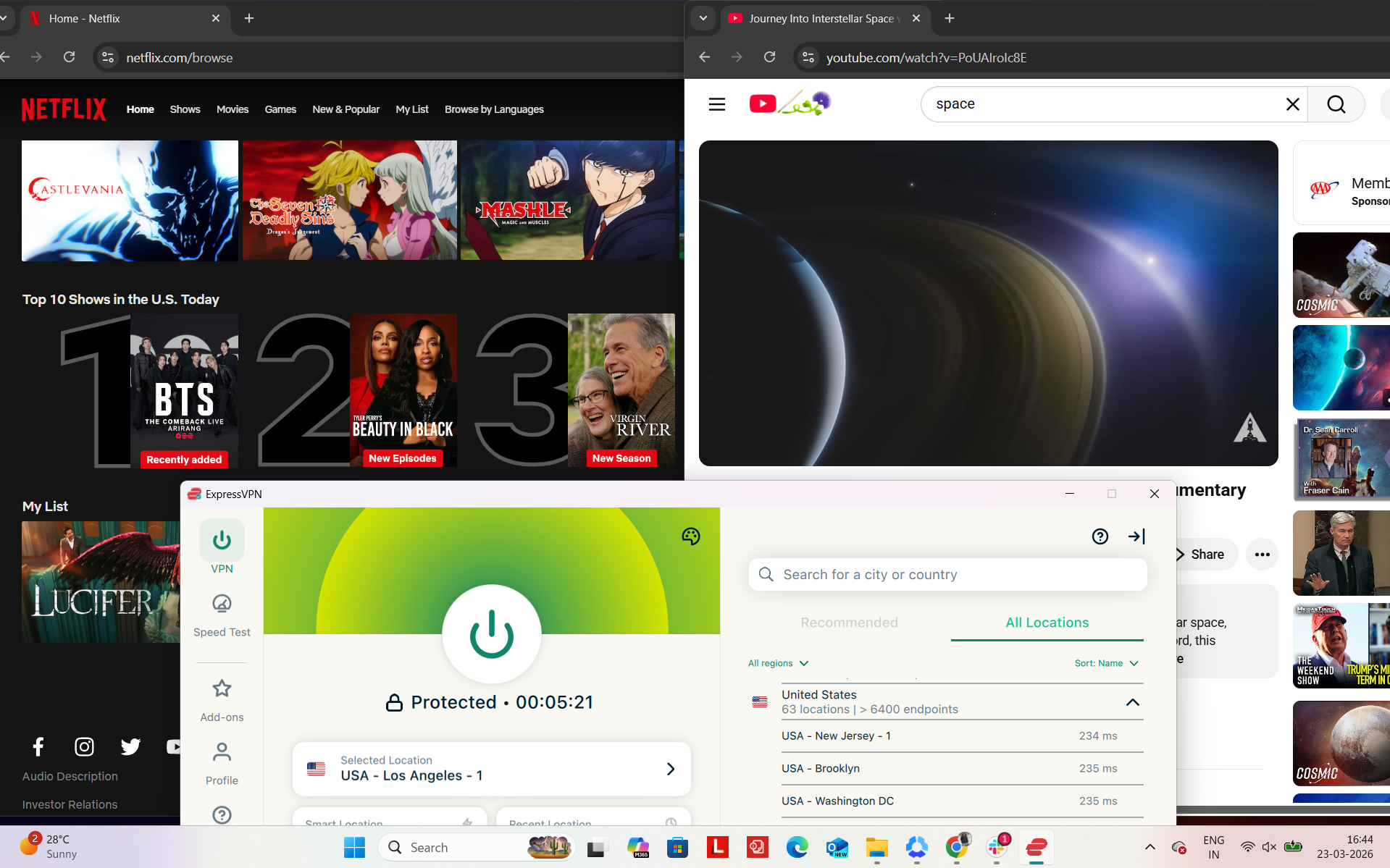
Observed Connection Behavior
- Unexpected disconnects - None observed
- Reconnection attempts - Not required
- Network drops - None during the entire session
- Lag spikes or buffering - Not encountered in normal usage
Browsing Performance - Web pages loaded quickly and consistently, with no noticeable delays when navigating between sites or switching tabs. General browsing felt responsive, and there were no moments where the connection slowed down or interrupted the flow of activity.
Streaming & Content Handling
- Videos on both YouTube and Netflix started almost instantly, beginning at 720p and then sharpening to 1080p within a few seconds without any manual adjustment
- Playback stayed steady once it got going, with no buffering or interruptions during continuous viewing
- Skipping forward through a longer video worked without issues, and playback picked up right where expected
- When rewinding, there was a short pause of a few seconds before the video resumed, but it quickly settled back into smooth playback without any further disruption
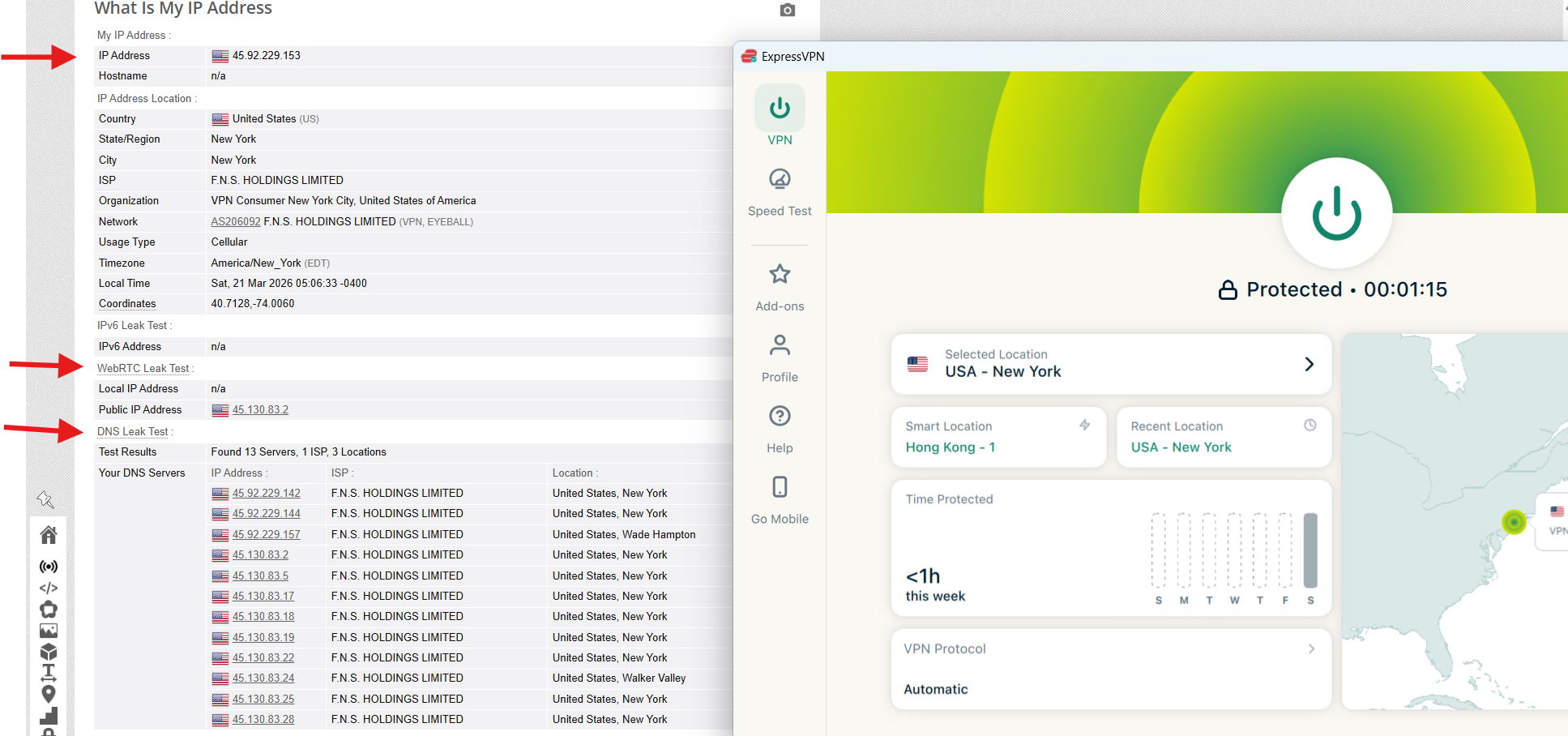
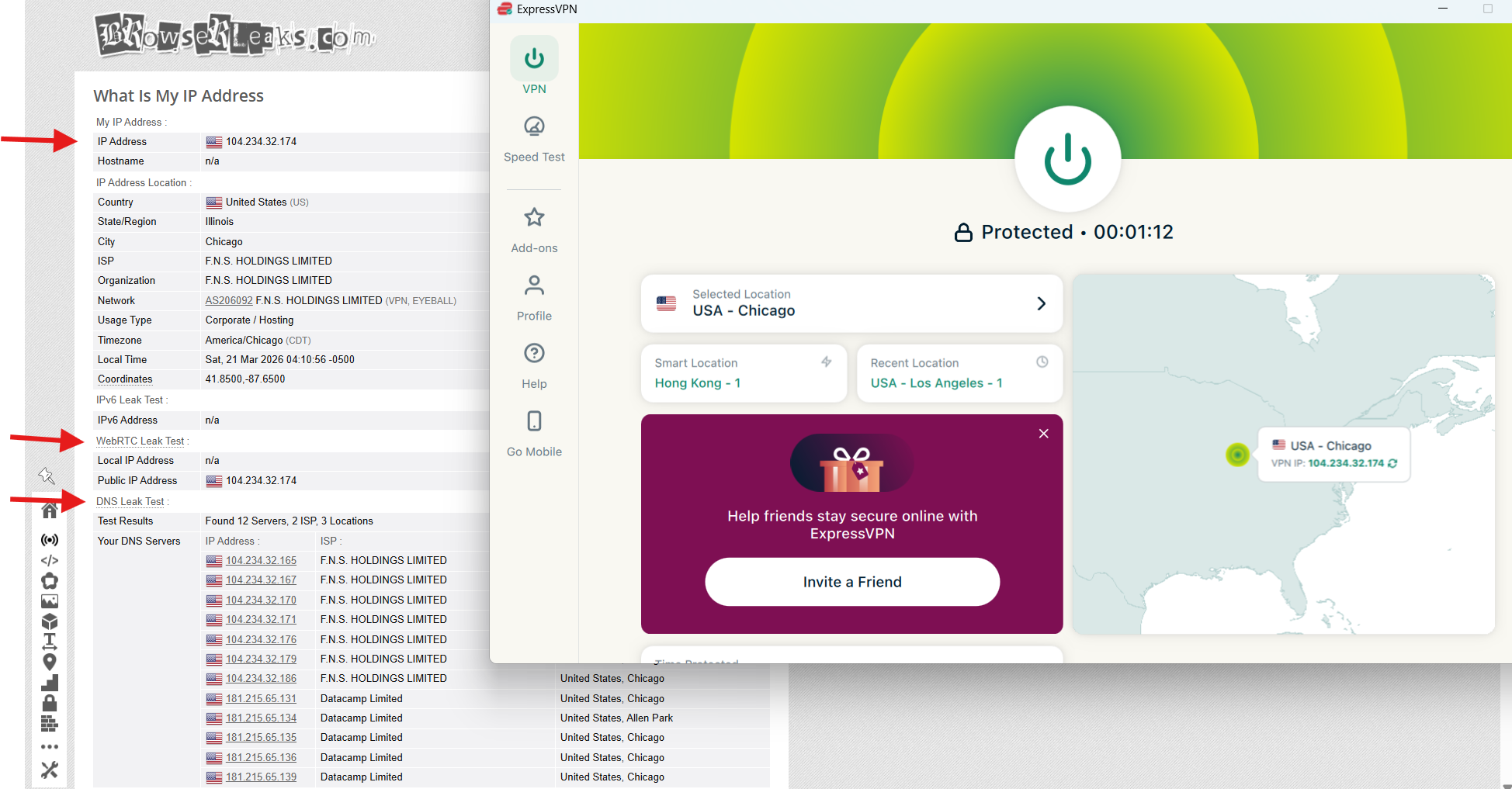
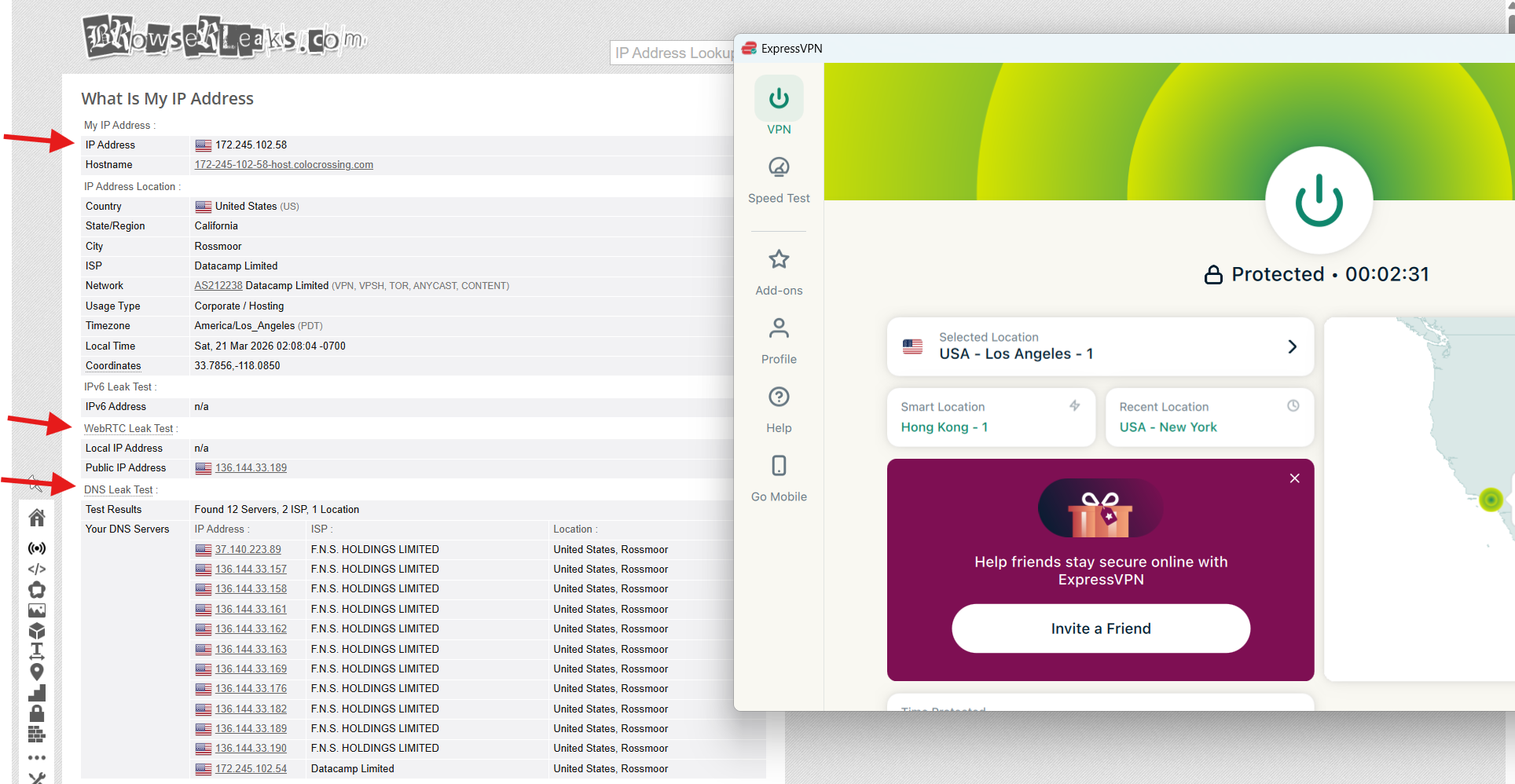
During testing with BrowserLeaks across US servers (Chicago, New York, and Los Angeles), ExpressVPN demonstrated reliable leak protection. The IP address shown always corresponded to the connected server, with no indication of exposure at any point. DNS data remained confined to ExpressVPN’s secure servers, avoiding any external leaks, while WebRTC results also confirmed that the real IP stayed hidden throughout.
For the Kill Switch evaluation, we intentionally disrupted the connection by cutting internet access. ExpressVPN responded instantly by blocking all traffic, ensuring there was no risk of unprotected data transmission during the interruption.
PROS
- The Best US coverage across 56 cities and all 50 states
- Strong streaming performance with instant playback and no buffering
- Highly reliable connections with no observed drops or interruptions
- Excellent unblocking of major platforms (Netflix, Amazon, etc.) and other US-specific websites
- Robust leak protection (no IP, DNS, or WebRTC leaks)
- Consistent day-to-day performance with stable browsing speeds
- Easy, seamless user experience with minimal configuration needed
- Responsive live chat support available
CONS
- No specialized servers (e.g., P2P, Double VPN, Onion over VPN)
- Limited advanced server labeling (less transparency on physical vs virtual)
👉 See full ExpressVPN review →
3. Surfshark - Inconsistent Performance with Weak Streaming
Jumping into Surfshark, the first thing I noticed was how quickly it got me connected without any friction. There wasn’t any setup hassle or need to figure things out. I could just pick a US server and start using it right away. The whole experience felt straightforward and easy to get into, especially for everyday tasks like browsing or streaming.
During regular use, browsing felt stable and mostly smooth, though some pages and videos took a bit longer to start loading. Once things were up and running, performance stayed consistent, and navigating between sites didn’t feel laggy. Streaming followed a similar pattern - there was sometimes a short delay before playback began, but after that, videos played in good quality without buffering or interruptions, which kept the experience steady overall.
Over longer sessions, the connection stayed reliable with no drops or reconnects, which definitely helped build confidence in using it continuously. Speeds were decent overall, though they could vary depending on the server, and some locations performed better than others. On the downside, those initial loading delays can get a bit noticeable, especially on video platforms, and there’s limited clarity around server types. Still, once everything settles in, it delivers a fairly smooth and dependable experience.
Performance Testing Results
When evaluating US coverage, Surfshark takes a fairly expansive and user-focused approach, aiming to provide broad geographic access while keeping performance consistent across major population centers. Its network is structured to give users plenty of choice when connecting within the United States, without overwhelming them with unnecessary fragmentation.
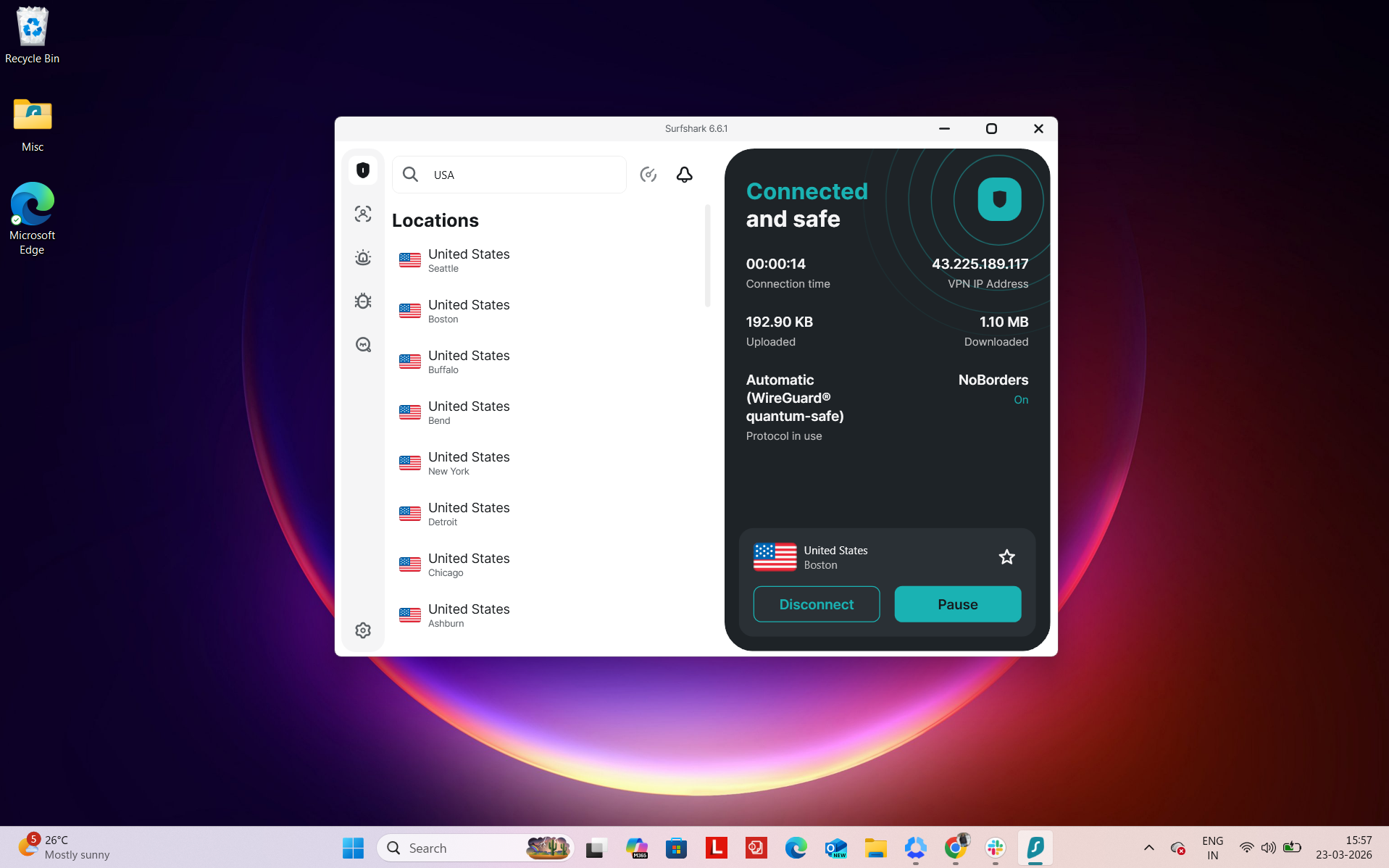
Number of US Cities & States - Surfshark offers servers in 24 cities across 19 states, which places it in a competitive middle ground. While not as extensive as NordVPN, PIA, and ExpressVPN’s reach, it still provides solid nationwide coverage across key regions, ensuring users can typically find a nearby server.
Regional Distribution - To better understand how these servers are spread out, here’s a complete breakdown by region:
Total: around 24 cities across 19 states
Overall, Surfshark’s US presence is fairly well distributed across all three major regions. On the East Coast, it includes major hubs like New York, Boston, Atlanta, and Miami, along with supporting locations such as Buffalo and Charlotte that help spread user load. In the Central region, cities like Chicago, Dallas, Houston, and Denver act as primary connection points. On the West Coast, Surfshark maintains access to key locations including Los Angeles, San Francisco, San Jose, and Seattle, as well as Las Vegas and Bend.
In practical terms, this distribution ensures that users across most parts of the US can find a nearby server, which helps maintain stable speeds and reduces latency. While the network isn’t the largest in terms of city count compared to some competitors, its coverage is still broad enough to support everyday browsing, streaming, and general VPN use effectively.
Physical vs Virtual Servers - Surfshark does not clearly distinguish between physical and virtual servers within its interface or documentation. As a result, users don’t have explicit visibility into which servers are physically located in a given city versus those that are virtually assigned.
Specialty Servers - Surfshark offers several specialized server options that enhance flexibility and privacy, including:
- Static IP servers
- MultiHop (double VPN routing through multiple locations)
- Dedicated IP servers
These features allow users to tailor their connection based on specific needs, whether that’s improved privacy, more stable access to services, or reduced likelihood of IP-based blocking.
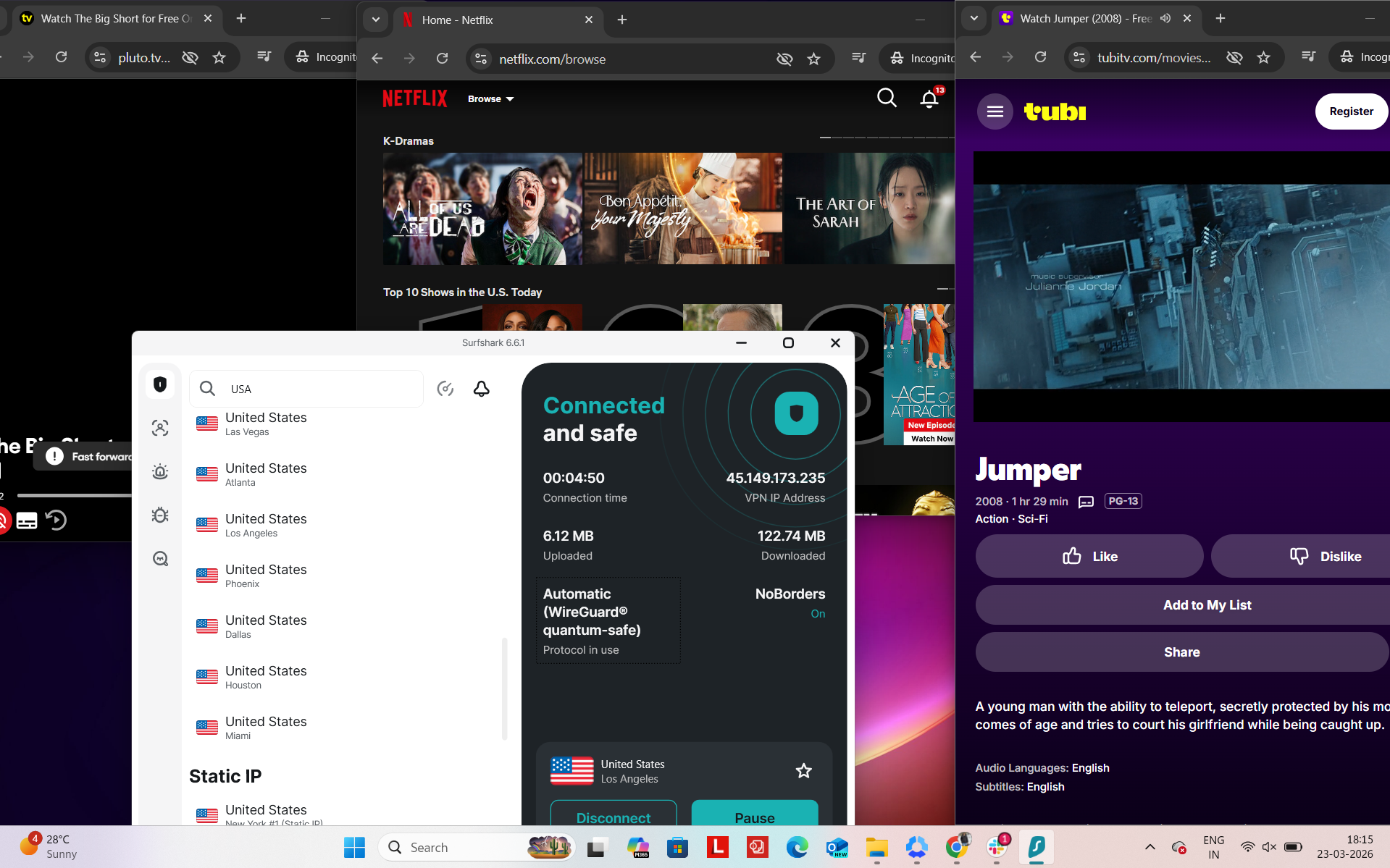
I started my session with Surfshark by connecting to a US server and using it across a mix of streaming and browsing platforms, and the overall experience felt smooth right away with no interruptions while moving between sites.
Across different sites, navigation felt responsive and stable, with pages opening normally and no noticeable delays or disruptions during typical browsing sessions.
Real-World Access Experience
- Netflix - Loaded without any errors and worked as expected
- Tubi TV - Accessible with no interruptions
- Pluto TV - Streamed without restrictions
- Amazon.com - Browsing worked smoothly with no delays
- Google - Worked good. Pages loaded instantly. No delays
- Reddit - Fully accessible with no limitations
Detection & Verification Behavior
- Proxy errors - None encountered
- CAPTCHA prompts - Did not appear during testing
- Service blocking - No issues bypassing major platforms
With Surfshark, performance felt generally strong and more consistent than expected, especially on download speeds, which held up well across most servers. New York stood out as the most balanced option, delivering high download and upload speeds with relatively low jitter compared to the others. Chicago, on the other hand, showed a sharp drop in upload performance and noticeably higher jitter, which could affect more upload-heavy tasks. Los Angeles sat somewhere in the middle, with stable download and upload speeds but still a clear increase in latency across the board. Overall, the experience felt smooth, with solid throughput and only occasional instability depending on the server.
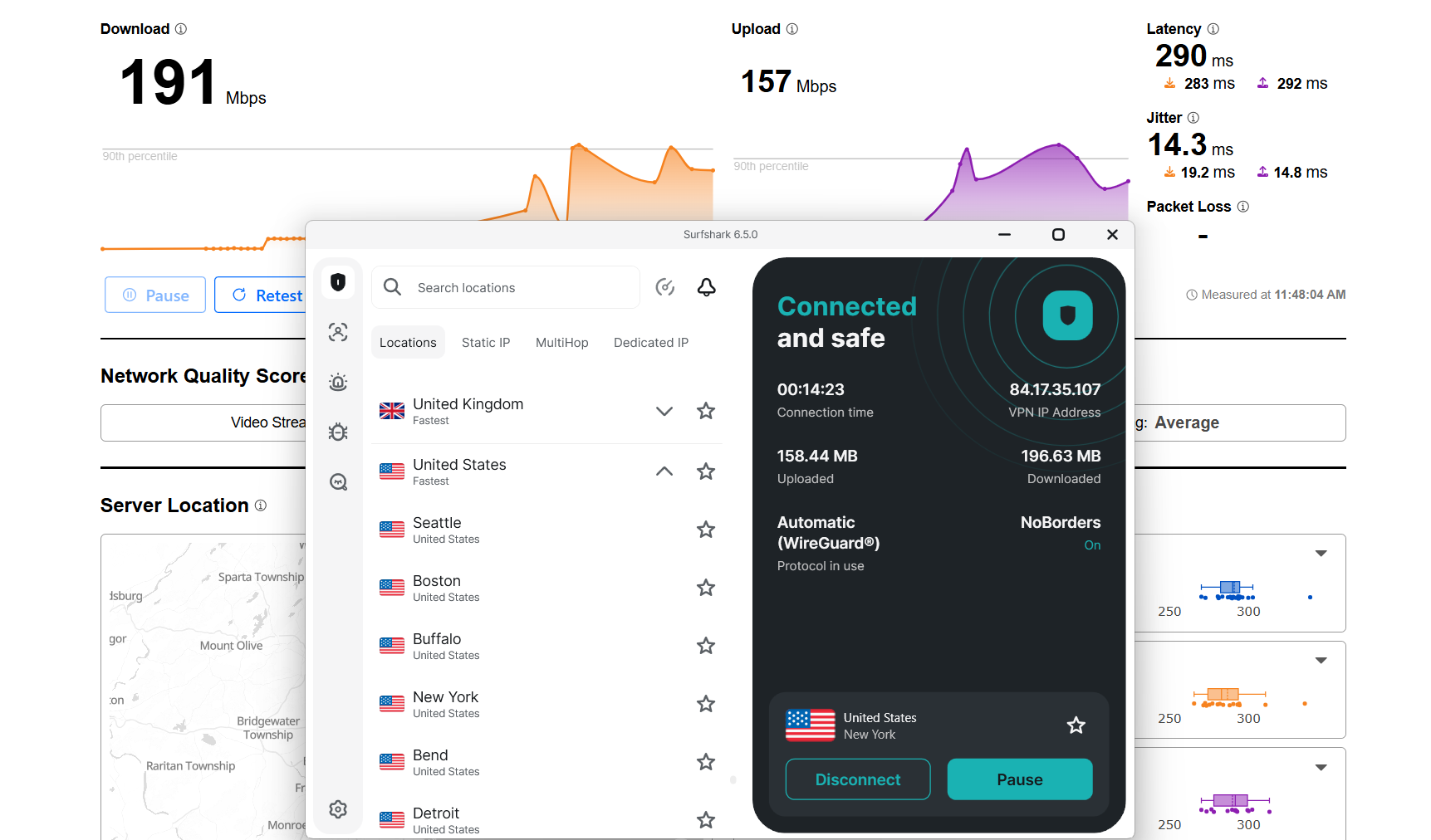
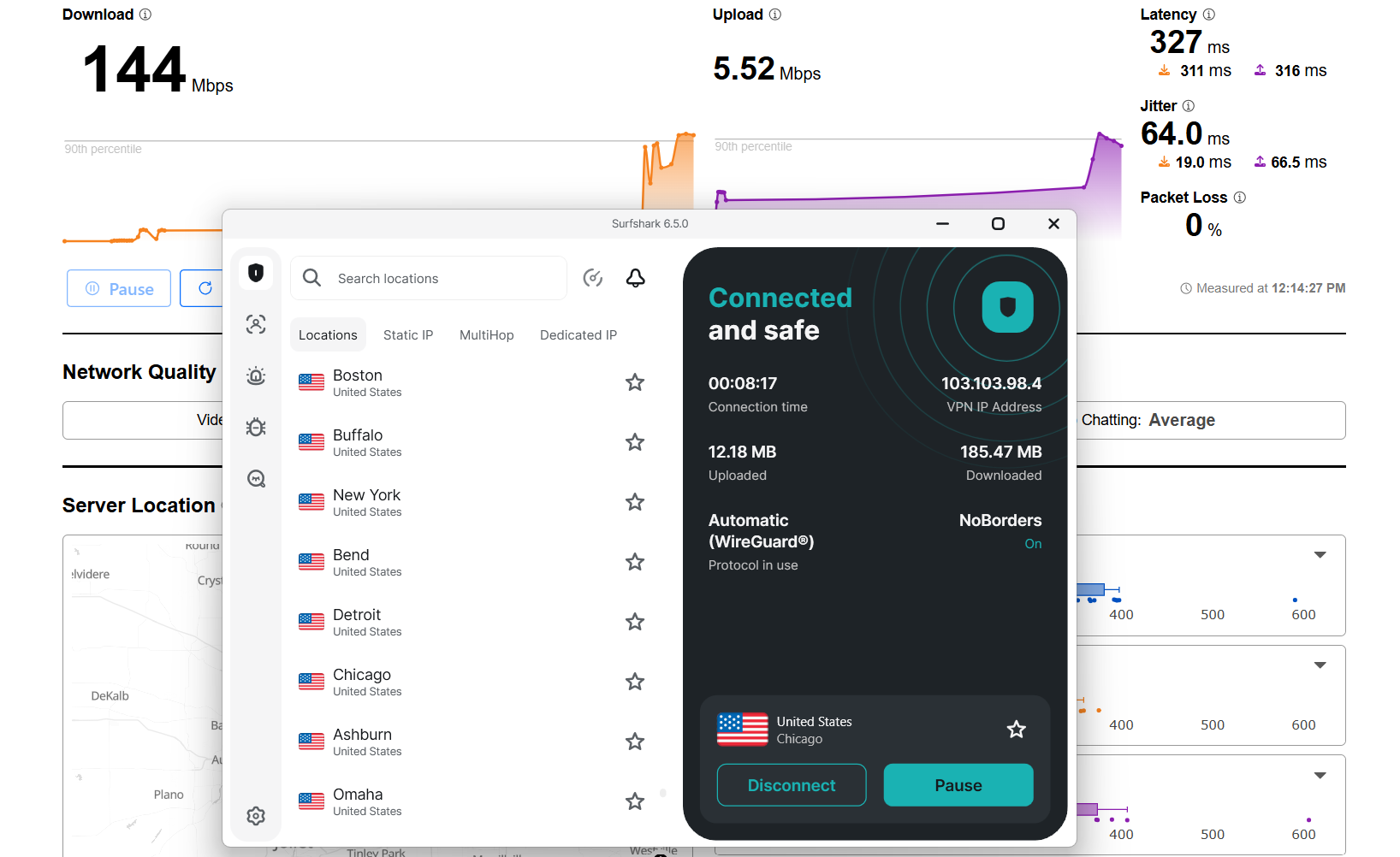
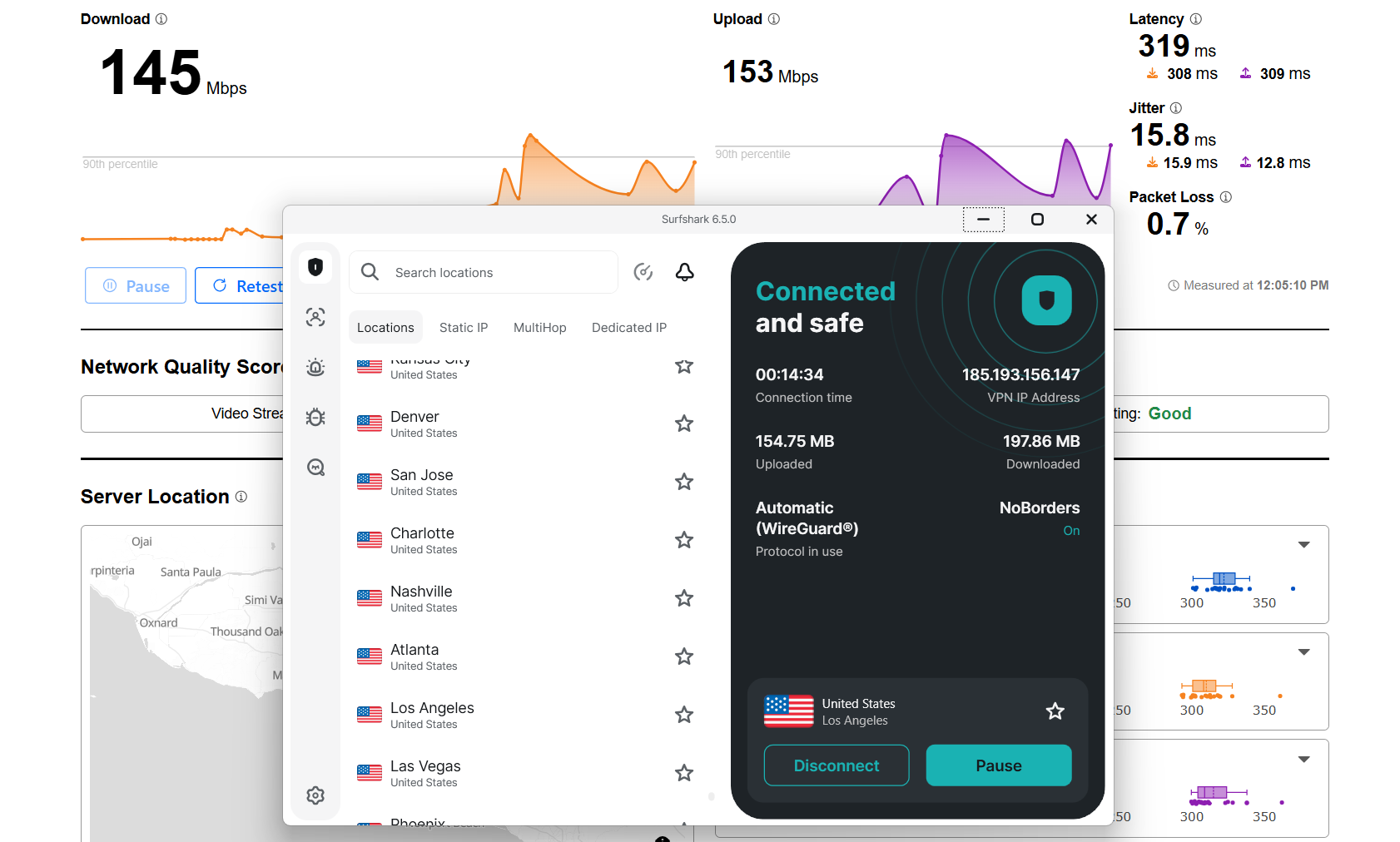
Here are the results against a baseline to understand how much speed was affected in real usage:
Surfshark delivered a generally smooth and stable connection during testing, with no interruptions while staying connected. While the initial loading of content sometimes took a bit longer than expected, the overall experience during playback, even on streaming platforms, was steady and reliable.
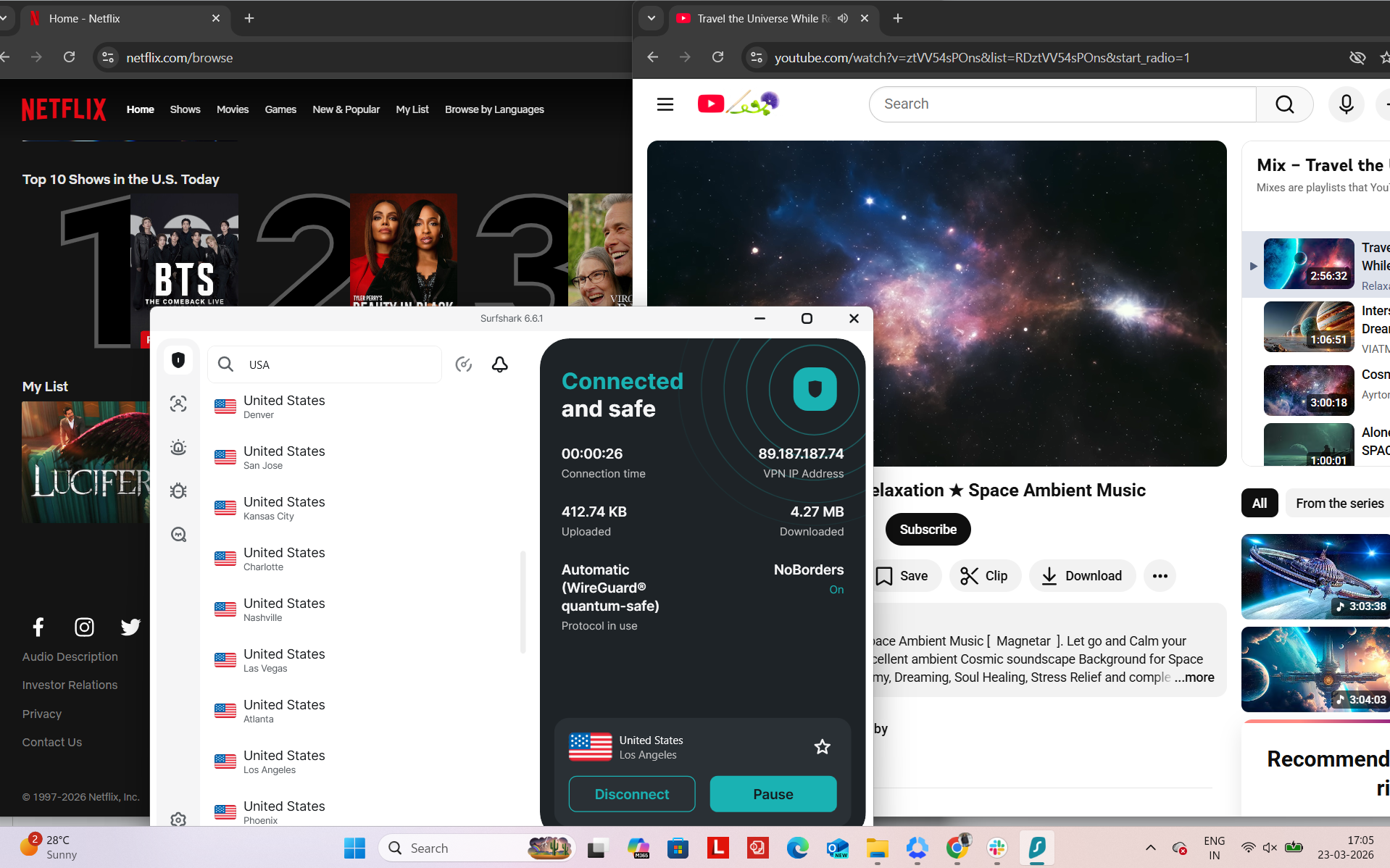
Observed Connection Behavior
- Unexpected disconnects - None observed
- Reconnection attempts - Not required
- Network drops - None during the entire session
- Lag spikes or buffering - Not encountered during YouTube playback, though initial video loading had slight delays
Browsing Performance - Browsing felt stable overall, though certain sites and YouTube videos took a bit longer to begin loading. Once pages and content were loaded, navigation was smooth and responsive without noticeable slowdowns during regular use.
Streaming & Content Handling
- Content typically started after a short delay of around 2–3 seconds on Netflix, but played in good quality right from the beginning without any initial blur
- Video playback remained steady with no buffering or lag during continuous viewing
- Forward seeking introduced a brief moment of slight blur and delay, but the video quickly recovered within about 2–5 seconds and returned to stable quality
- Rewinding also caused a short blur for around 4–5 seconds, after which playback quickly returned to normal clarity
- On YouTube, videos took noticeably longer to load, around 20–25 seconds before starting, but once playback began, the quality improved rapidly to 1080p within 2–3 seconds and remained smooth afterward
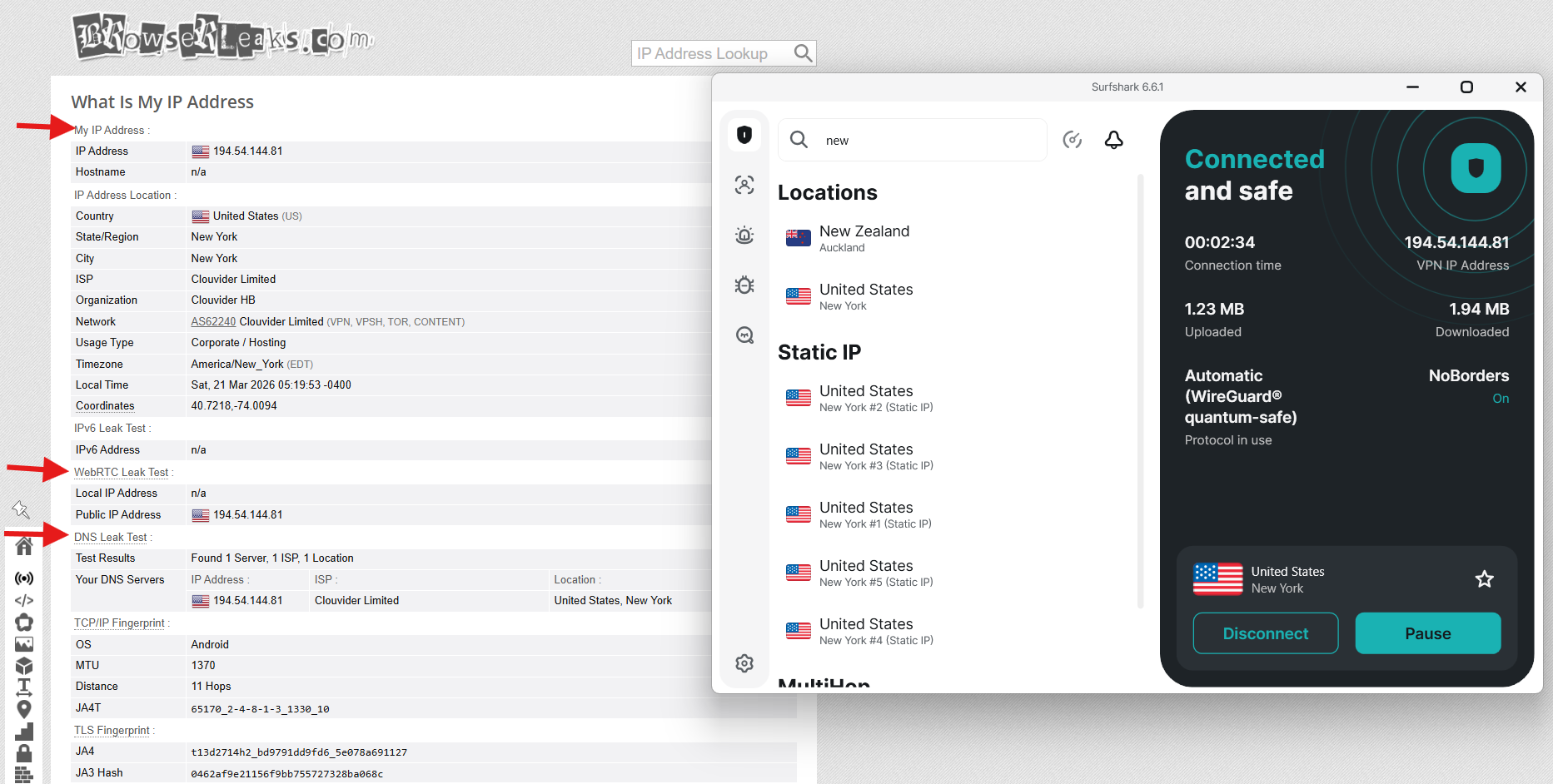
Surfshark handled privacy protection effectively across the session, keeping the visible IP aligned with the active server without any irregularities. No external DNS exposure was observed, as all requests remained within its encrypted handling. WebRTC behavior also stayed clean, with no traces of the original IP appearing.
In terms of connection security, its Kill Switch reacted without delay. Any disruption in connectivity resulted in an immediate halt of internet traffic, ensuring the session never continued outside the VPN tunnel.
PROS
- Solid US coverage across 24 cities in 19 states
- Strong connection reliability with no observed disconnects
- Good speed performance with moderate speed loss
- Excellent leak protection (no IP, DNS, or WebRTC leaks)
- Effective kill switch for added security
- Reliable access to major streaming platforms (Netflix, Amazon, etc.)
- Smooth and stable browsing after initial page load
- Specialty features like MultiHop, Static IP, and Dedicated IP options
- Works consistently across different regions with balanced distribution
CONS
- Occasional delays before video playback starts
- Limited transparency on physical vs virtual servers
- Performance varies by server location
- Slight buffering/quality adjustments during seeking or rewinding videos
4. Private Internet Access - Wide Coverage but Weaker Performance
Starting off with Private Internet Access, what stood out immediately was how easy it was to get connected and start using it without any friction. I didn’t have to spend time figuring things out—just picked a US server and jumped straight into browsing. The overall experience felt simple and consistent, especially for regular day-to-day usage.
Once connected, browsing felt stable and mostly smooth across different sites. Pages loaded without major delays, and moving between tabs or platforms didn’t feel sluggish. Streaming worked fairly well too - videos started within a couple of seconds and played without buffering once they got going. That said, video quality sometimes took a bit longer to fully sharpen, especially on platforms like YouTube, which made the experience feel slightly slower compared to others.
Over longer sessions, the connection stayed reliable with no drops or interruptions, which made it easy to keep using without worrying about stability. However, speeds did take a noticeable hit, especially for downloads and heavier tasks, and that impact was pretty clear during extended use. While it handles basic browsing and streaming fine, it doesn’t feel as fast as top-tier options, so performance-focused users might find it a bit limiting overall.
Performance Testing Results
When it comes to sheer coverage across the United States, Private Internet Access stands out as one of the most geographically diverse VPN providers. Its network is built to prioritize widespread accessibility, reaching far beyond just major metropolitan hubs and into less commonly covered areas.
Number of US Cities & States - PIA offers servers in 47 cities across 44 states plus Washington, DC, making it one of the most expansive US networks available. This level of coverage significantly increases the chances of finding a nearby server no matter where you’re located.
Regional Distribution - To get a better sense of how these servers are spread out, here’s a breakdown by region:
Total: 47 cities across 44 states and DC
What really sets PIA apart is how deep its coverage goes beyond the obvious locations. On the East Coast, it includes not just major hubs like New York and Miami, but also smaller yet strategically useful cities like Trenton, Providence, and Wilmington. The Central region is where the network becomes even more impressive, with a dense spread across states that many VPNs typically overlook. Alongside major cities like Chicago and Houston, you’ll find coverage in places like Fargo, Sioux Falls, and Little Rock, which is relatively rare. On the West Coast, PIA covers all the essential locations including Los Angeles, San Francisco, and Seattle, while also extending as far as Anchorage, something very few VPN providers offer.
In practical terms, this means you’re far less likely to run into overcrowded servers or be forced to connect to a distant location. The wider spread also makes it easier to access highly specific regional content across different US states.
Physical vs Virtual Servers - PIA does not clearly label whether its servers are physical or virtual. This lack of transparency makes it difficult to determine the exact nature of each location, although the network is generally considered stable and performance-oriented.
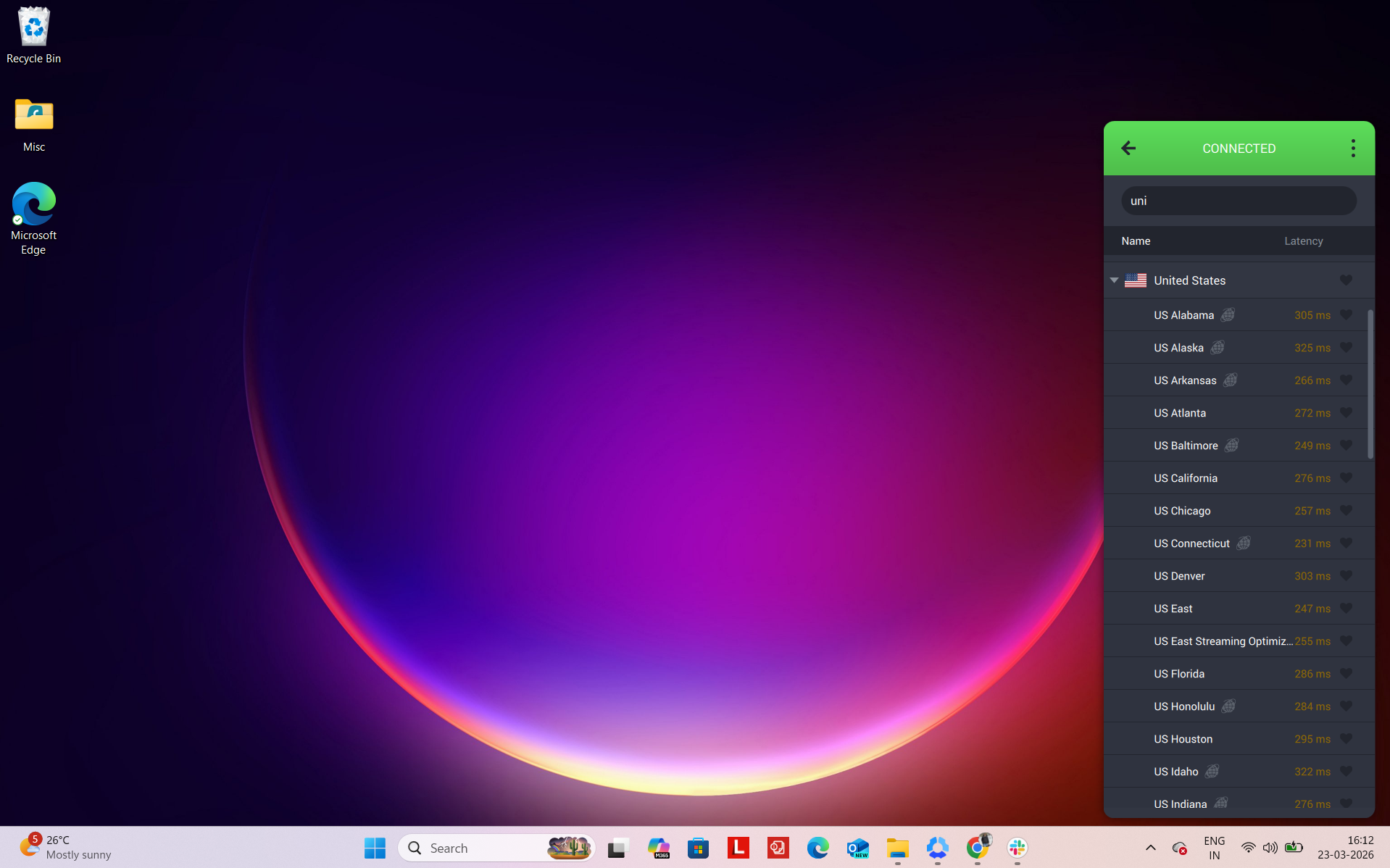
Specialty Servers - PIA does offer specialized functionality, particularly for streaming. While these servers are not always separated into a distinct category, you can locate them by searching for “streaming” within the app. These servers are optimized to improve access to streaming platforms.
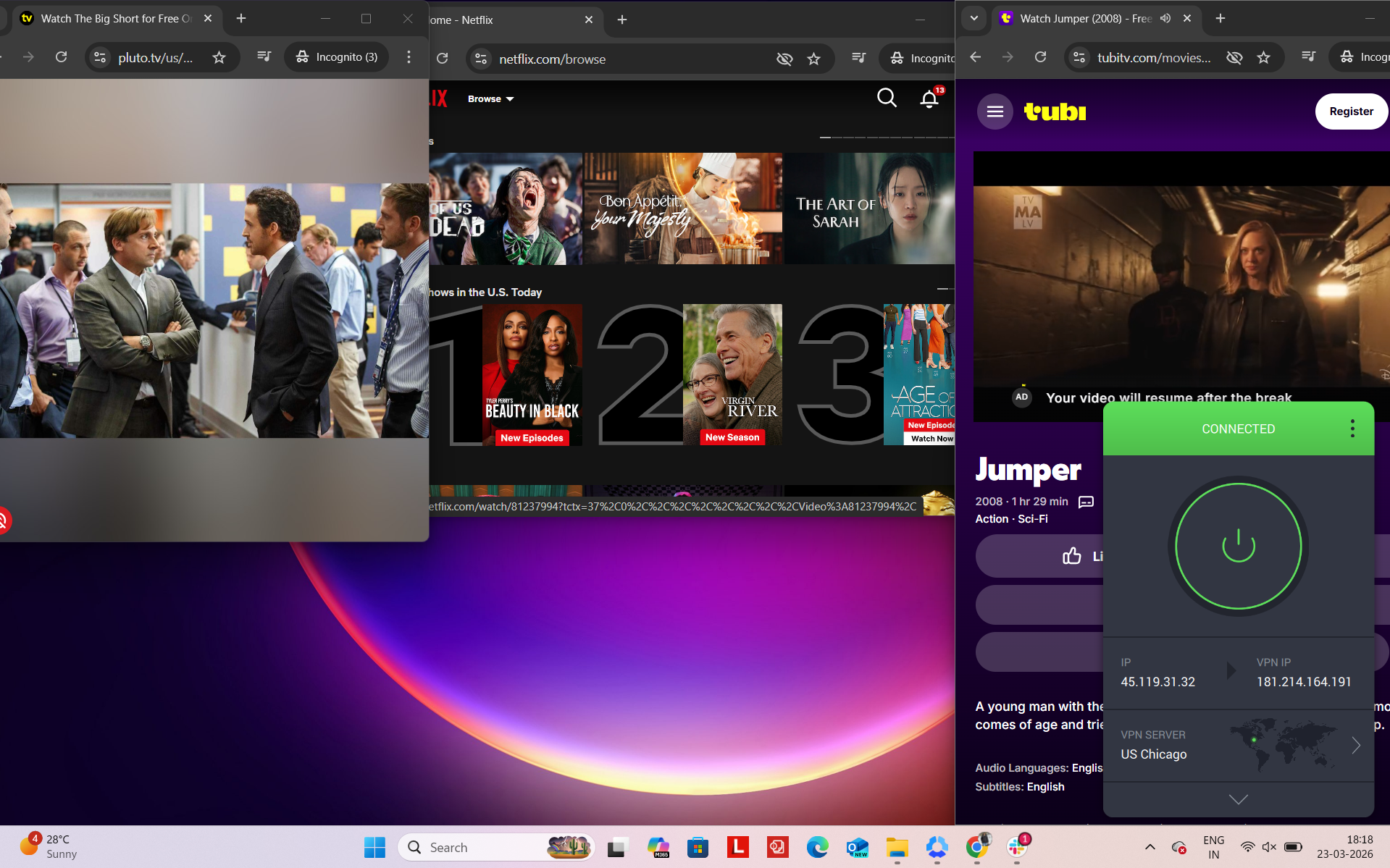
I used Private Internet Access to connect to US servers and tested it across a range of sites, and the overall experience felt smooth with everything loading as expected without any interruptions along the way.
Browsing across platforms felt consistent, and I didn’t notice any unusual slowdowns or access issues, making the session feel stable and close to a regular connection.
Real-World Access Experience
- Netflix - Loaded without any errors and worked as expected
- Tubi TV - Accessible with no interruptions
- Pluto TV - Streamed without restrictions
- Amazon.com - Browsing worked smoothly with no delays
- Google - Worked good. Pages loaded instantly. No delays
- Reddit - Fully accessible with no limitations
Detection & Verification Behavior
- Proxy errors - None encountered
- CAPTCHA prompts - Did not appear during testing
- Service blocking - No issues bypassing major platforms
In my testing, PIA landed somewhere in the middle, not painfully slow, but definitely not close to top-tier performance either. Download speeds dropped quite a bit across all US servers, which was noticeable during streaming and larger downloads. New York and Chicago were fairly close in performance, with Chicago slightly edging ahead on downloads but struggling more with upload speeds. Silicon Valley came in as the slowest overall, especially in terms of download consistency. For casual browsing it held up fine, but anything bandwidth-heavy felt the impact pretty quickly.
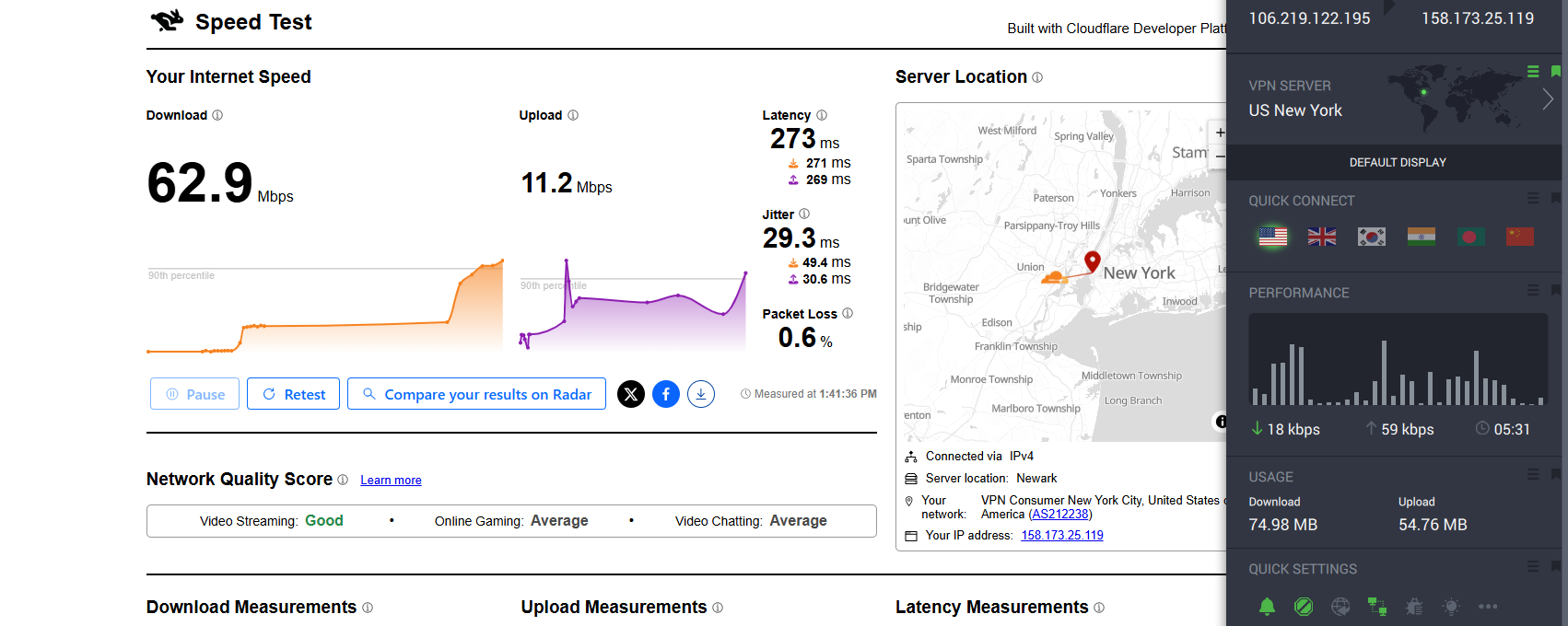
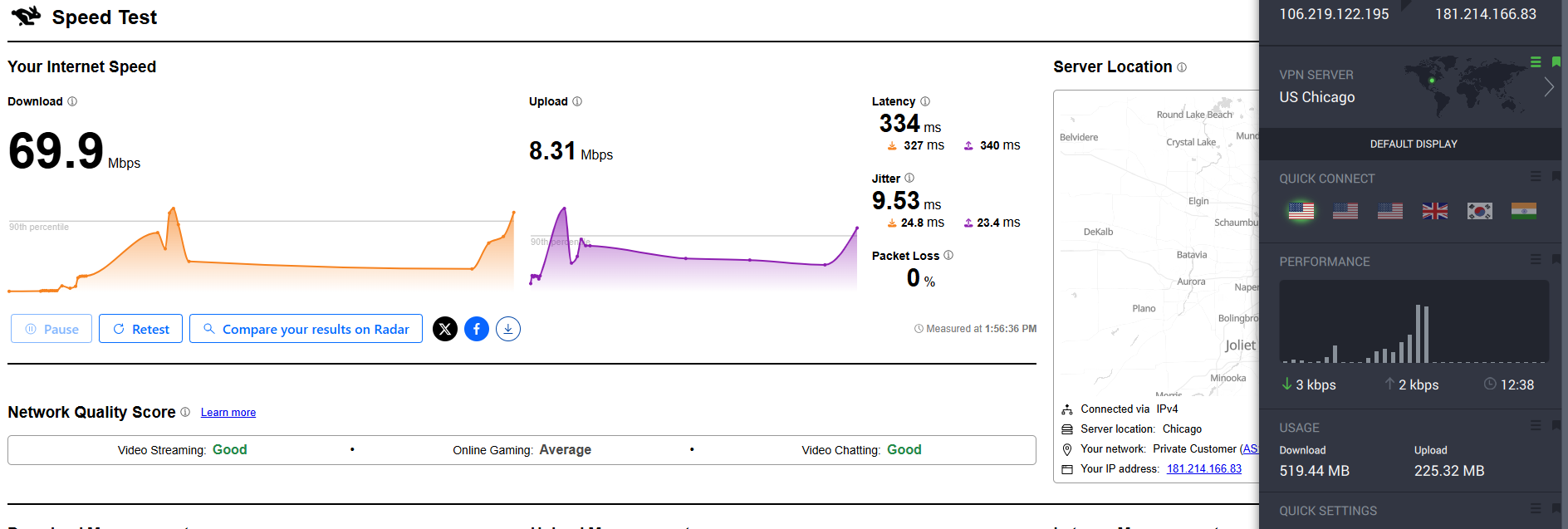
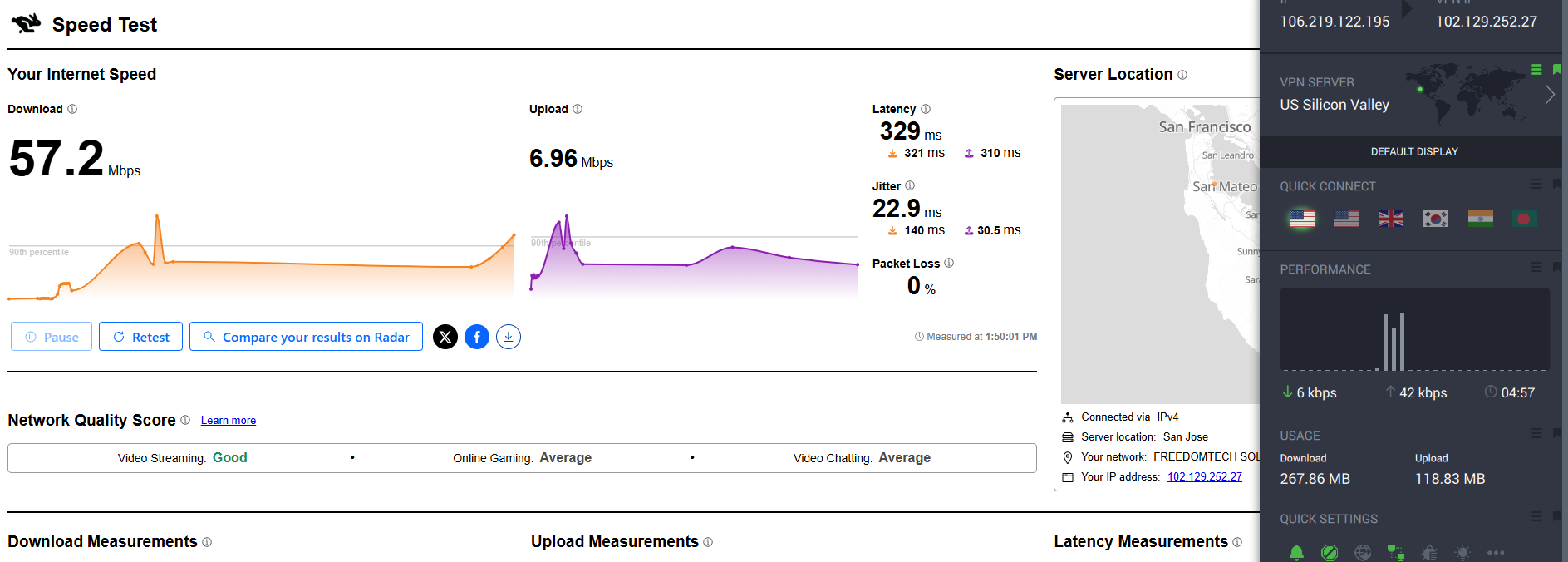
Here are the results against a baseline to understand how much speed was affected in real usage:
Private Internet Access stayed reliably connected throughout testing, with no interruptions or drops during use. The experience felt consistent overall, though there were a few minor performance dips that didn’t significantly impact usability.
Observed Connection Behavior
- Unexpected disconnects - None observed
- Reconnection attempts - Not required
- Network drops - None during the entire session
- Lag spikes or buffering - Occasionally noticed, but minimal
Browsing Performance - Browsing felt smooth and generally responsive. Pages loaded without major delays, and switching between tabs or websites didn’t cause any noticeable slowdowns. The experience stayed stable during everyday use.
Streaming & Content Handling
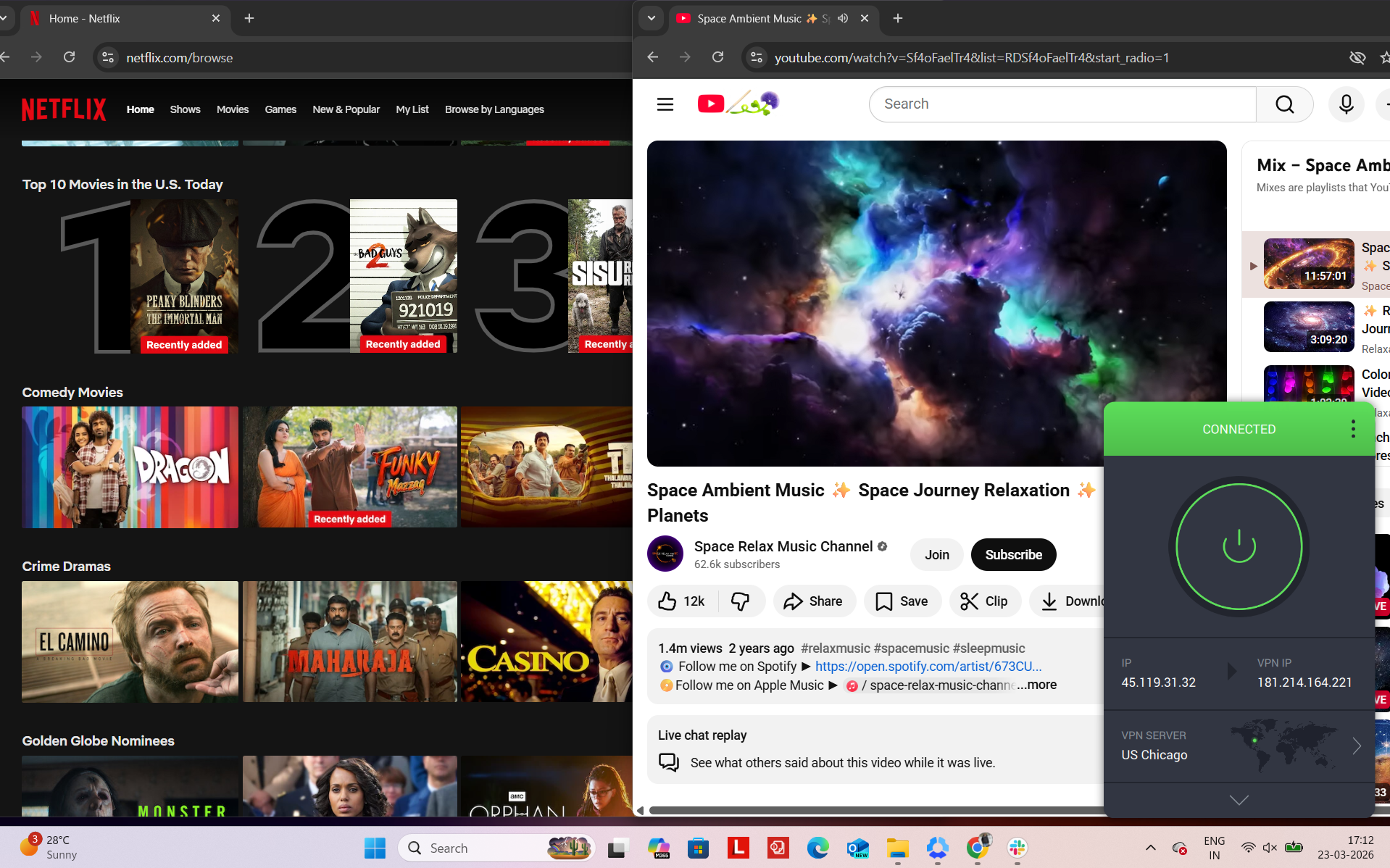
- Content on Netflix typically started within 2–3 seconds, with a slight initial blur before reaching good quality within 3–4 seconds
- Video playback remained stable during continuous viewing (tested for around 15 minutes), with no buffering or lag and clear audio throughout
- Forward seeking worked well, with the video loading in high quality within 1–2 seconds and no noticeable blur
- Rewinding did not introduce any issues, with playback resuming smoothly in high quality
- On YouTube, videos loaded instantly with no buffering or lag, but took more than 10 minutes to reach 1080p despite smooth playback overall
Private Internet Access (PIA) performed well in preserving anonymity across the test. The IP address consistently reflected the VPN endpoint, with no leaks detected. DNS resolution remained within PIA’s secure network, avoiding exposure to third-party resolvers, while WebRTC checks showed no leakage of the real IP.
The Kill Switch mechanism also functioned as expected. When the connection was intentionally broken, internet access was immediately cut off, preventing any unprotected traffic from passing through.
PROS
- Extremely wide US coverage (47 cities across 44 states + DC)
- Strong connection reliability with no disconnects
- Excellent unblocking of major websites and services
- Solid leak protection (no IP, DNS, or WebRTC leaks)
- Effective kill switch for security
- Includes streaming-optimized servers
- Smooth and stable browsing experience
- Stable playback once streaming starts
CONS
- Very high speed loss (~70%+) impacting heavy usage
- Streaming performance inconsistent with buffering and initial blur
- Slower download and upload speeds vs top competitors
- Video quality can take long to reach HD (especially on YouTube)
- Limited transparency on physical vs virtual servers
5. Proton VPN - Slower and Less Consistent Performance
Using Proton VPN felt a bit different from the start, mainly because everything connected without any issues but the overall pace wasn’t as fast as I expected. Getting online was simple enough, and once connected, it didn’t drop or require any manual intervention, which made it reliable in terms of staying connected. The interface felt straightforward, and I was able to start using it right away without spending time adjusting anything.
In everyday use on US servers, basic browsing worked, but the responsiveness wasn’t as smooth as other VPNs. Pages sometimes took a few extra seconds to load, and switching between sites didn’t feel as quick. Streaming did work, but playback started slower and didn’t always reach higher quality quickly, often staying lower for longer periods. While the connection itself remained stable, the experience felt slower overall, especially during tasks that require consistent speed and quick loading.
Even though it maintained a stable connection throughout, the performance dips were noticeable during longer sessions. Speeds were significantly lower than a typical connection, which affected streaming quality and general usability. That said, it did succeed in providing access to US platforms without any blocks or interruptions. Overall, it works reliably at a basic level, but the slower speeds and limited responsiveness can make the experience feel less fluid compared to other options.
Performance Testing Results
Proton VPN approaches its US server network with a clear emphasis on quality over sheer scale. Instead of spreading itself thin across dozens of locations, it prioritizes strategically important cities that can deliver stable performance and reliable connections. While the overall network is smaller than many competitors, it still manages to cover the key regions that matter most for everyday use.
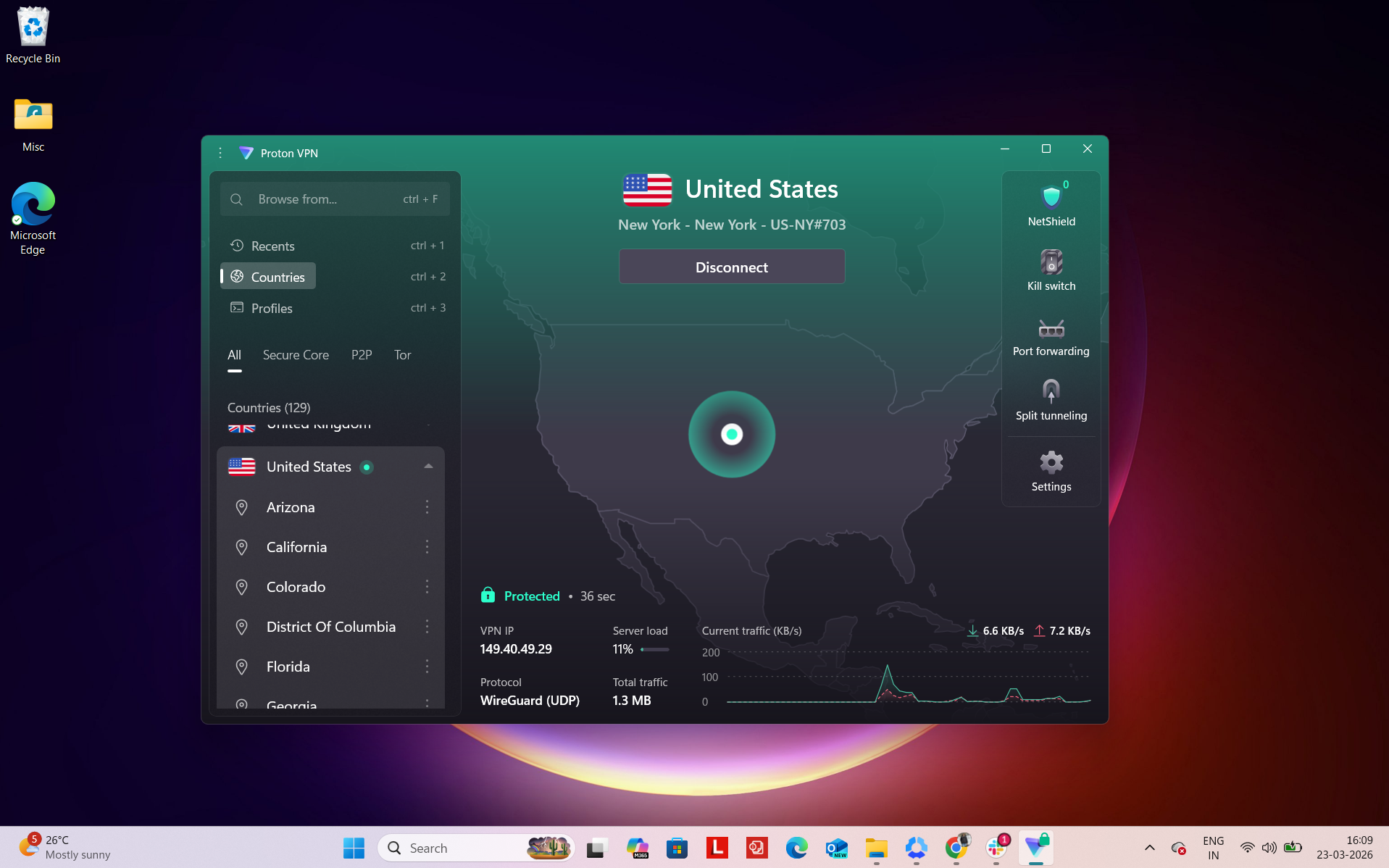
Number of US Cities & States - Proton VPN offers servers in 20 cities across 16 states, which is noticeably lower than top-tier competitors. However, the locations chosen are generally high-demand hubs, which helps maintain reliability and performance despite the smaller network.
Regional Distribution - To get a better sense of how these servers are spread out, here’s a breakdown by region:
Total: around 20 cities across 16 states
What stands out is that even with fewer locations, the distribution still feels fairly balanced. On the East Coast, there’s strong coverage with cities like Atlanta, Boston, Philadelphia, Secaucus, and Washington, DC. In the Central region, the selection is more limited, with key hubs like Dallas, Denver, and Houston carrying most of the load. On the West Coast, Proton VPN covers essential locations such as Los Angeles, San Jose, Seattle, and Phoenix, which ensures decent connectivity for users in that region.
In practical terms, this means you can usually find a reasonably close server in major metropolitan areas, but users in less populated regions may have fewer nearby options compared to larger VPN networks. That said, performance tends to remain stable due to Proton VPN’s focus on quality over quantity.
Physical vs Virtual Servers - Proton VPN is not as transparent in this area as some competitors. It does not clearly label whether servers are physical or virtual within its interface, which makes it harder to distinguish between the two. However, the network is generally perceived as being reliability-focused, even if this specific detail isn’t explicitly disclosed.
Specialty Servers - Proton VPN stands out more in this category, offering several specialized server types, including:
- Secure Core (multi-hop routing through privacy-friendly countries)
- P2P-optimized servers
- Tor over VPN servers
A particularly useful feature is that Proton VPN displays real-time server load, allowing you to choose less crowded servers for better performance. This adds a layer of transparency and control that many other VPN providers don’t offer.
I connected to Proton VPN and started testing US-based services, and while most things worked without any barriers, I did notice that general browsing didn’t feel as fast or responsive as expected, especially when switching between search and loading new pages.
Overall, the connection remained usable across platforms, and I didn’t run into any access restrictions, but the experience varied slightly depending on the site, with some delays noticeable during day-to-day browsing.
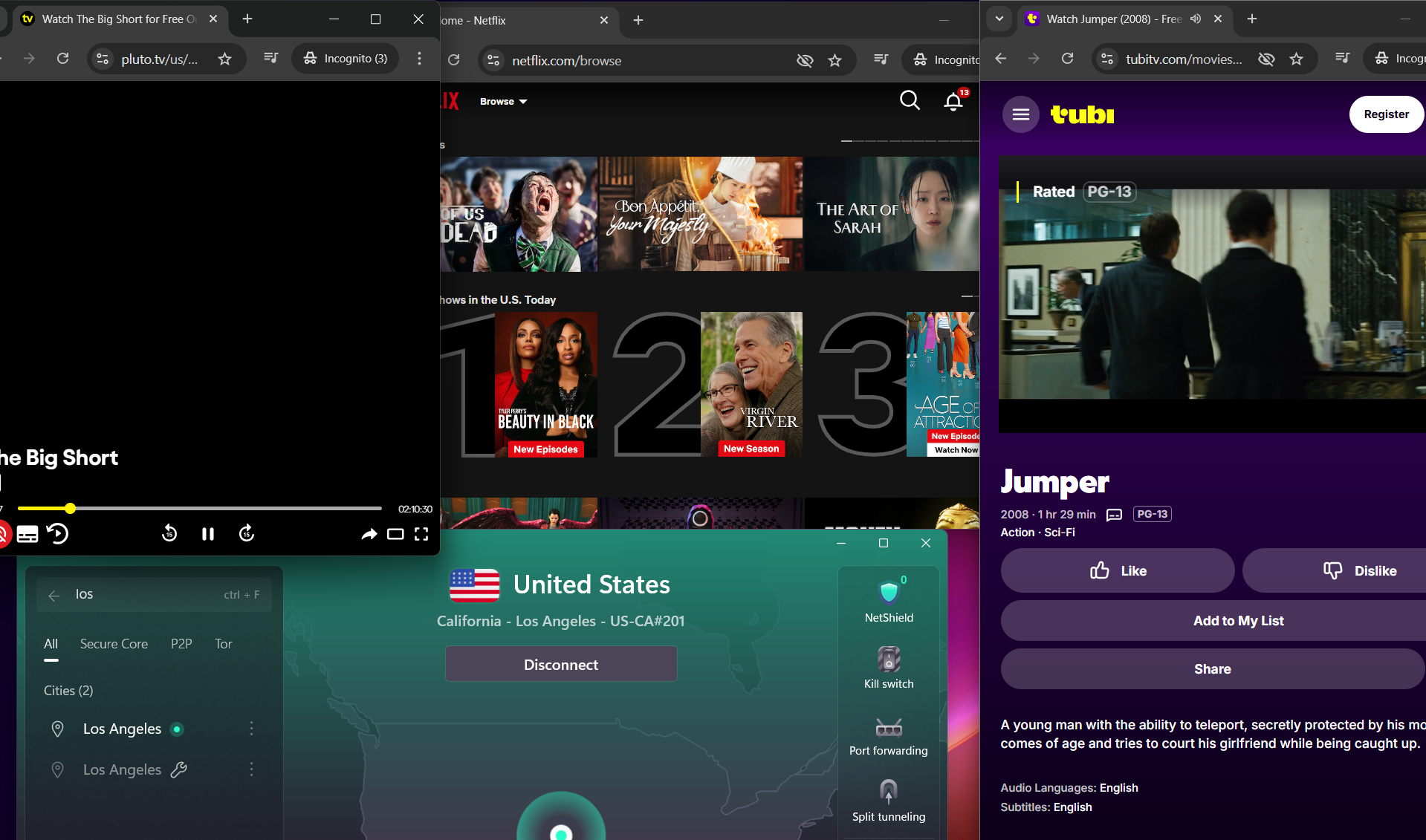
Real-World Access Experience
- Netflix - Loaded without any errors and worked as expected
- Tubi TV - Accessible with no interruptions
- Pluto TV - Streamed without restrictions
- Amazon.com - Browsing worked smoothly with no delays
- Google - Worked below average. The search took time. Pages loading took time around 10-12 seconds delay
- Reddit - Fully accessible with no limitations
Detection & Verification Behavior
- Proxy errors - None encountered
- CAPTCHA prompts - Did not appear during testing
- Service blocking - No issues bypassing major platforms
Using Proton VPN felt noticeably different compared to others. Speeds took a significant hit right away, especially on downloads, which impacted heavier tasks like large file transfers or high-quality streaming. Across all US servers, performance was consistent in the sense that speeds stayed within a similar (but much lower) range. New York and Chicago were particularly slow on downloads, while Los Angeles performed slightly better overall, mainly due to more balanced upload and lower jitter. Latency was high across the board, as expected, but still manageable for basic browsing. Overall, it worked fine for light use, but the drop in speed was very noticeable in real-world scenarios.
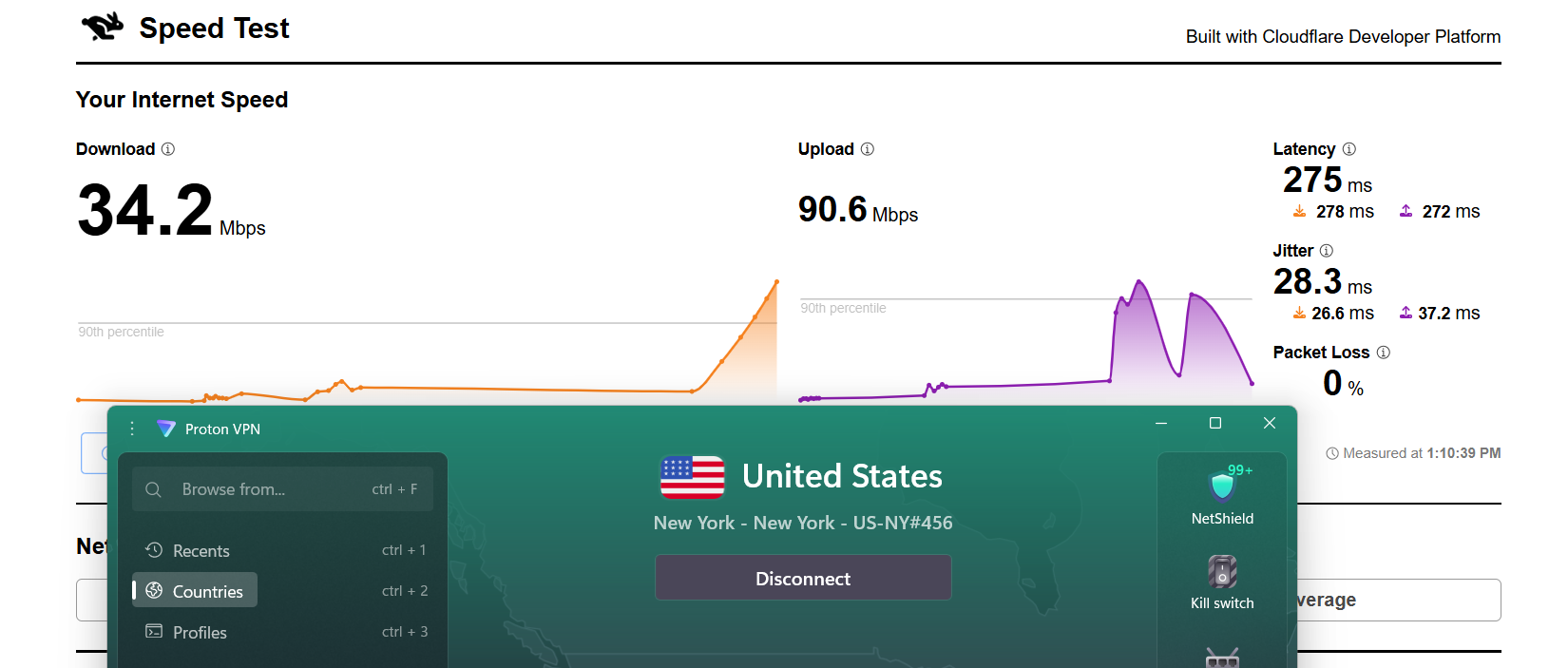
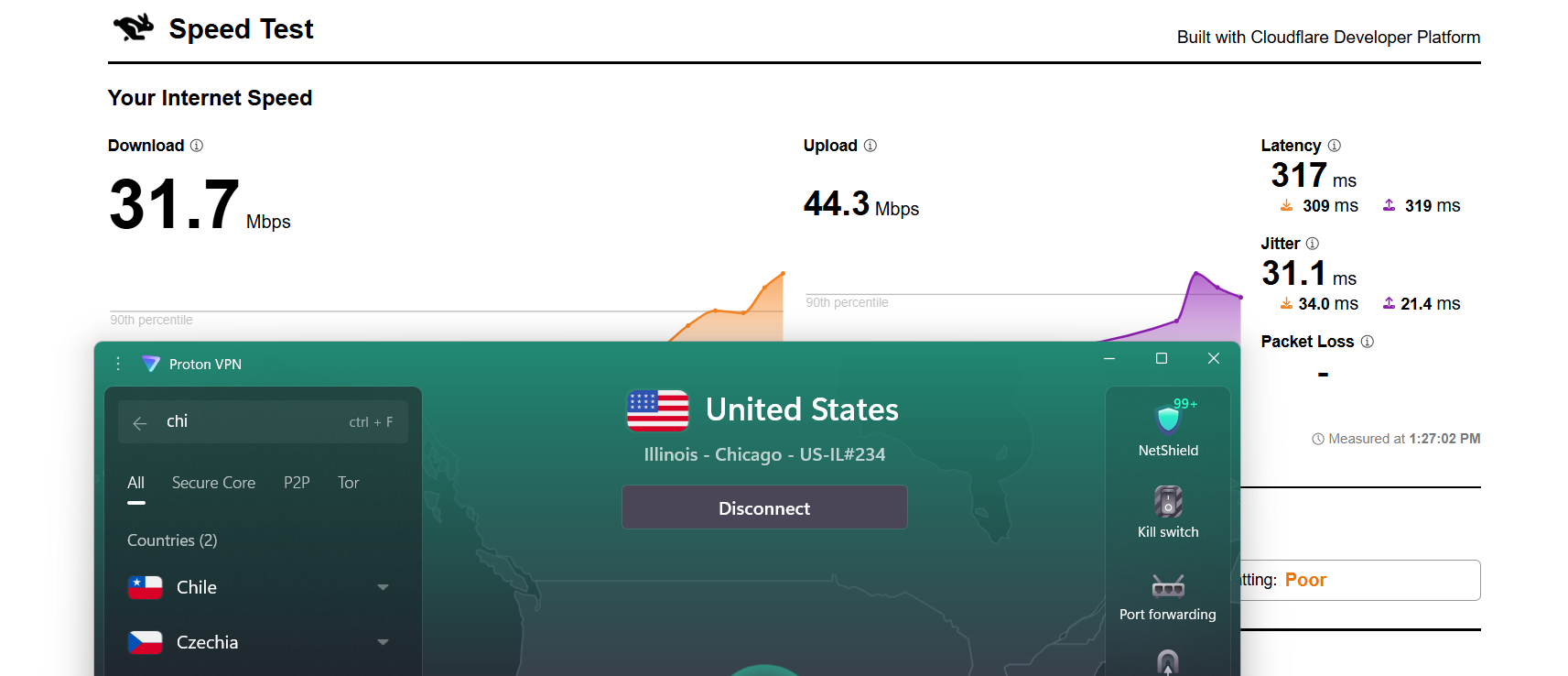
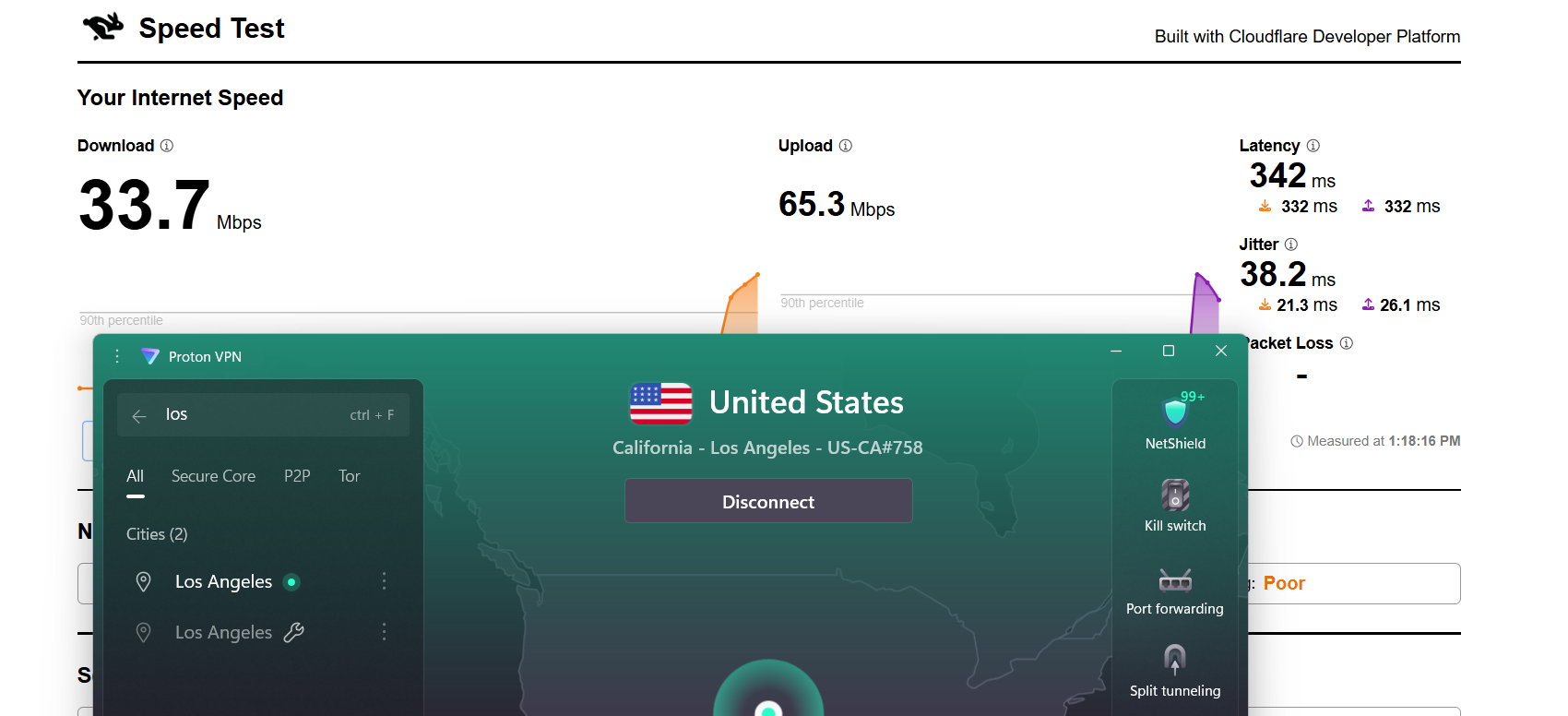
Here are the results against a baseline to understand how much speed was affected in real usage:
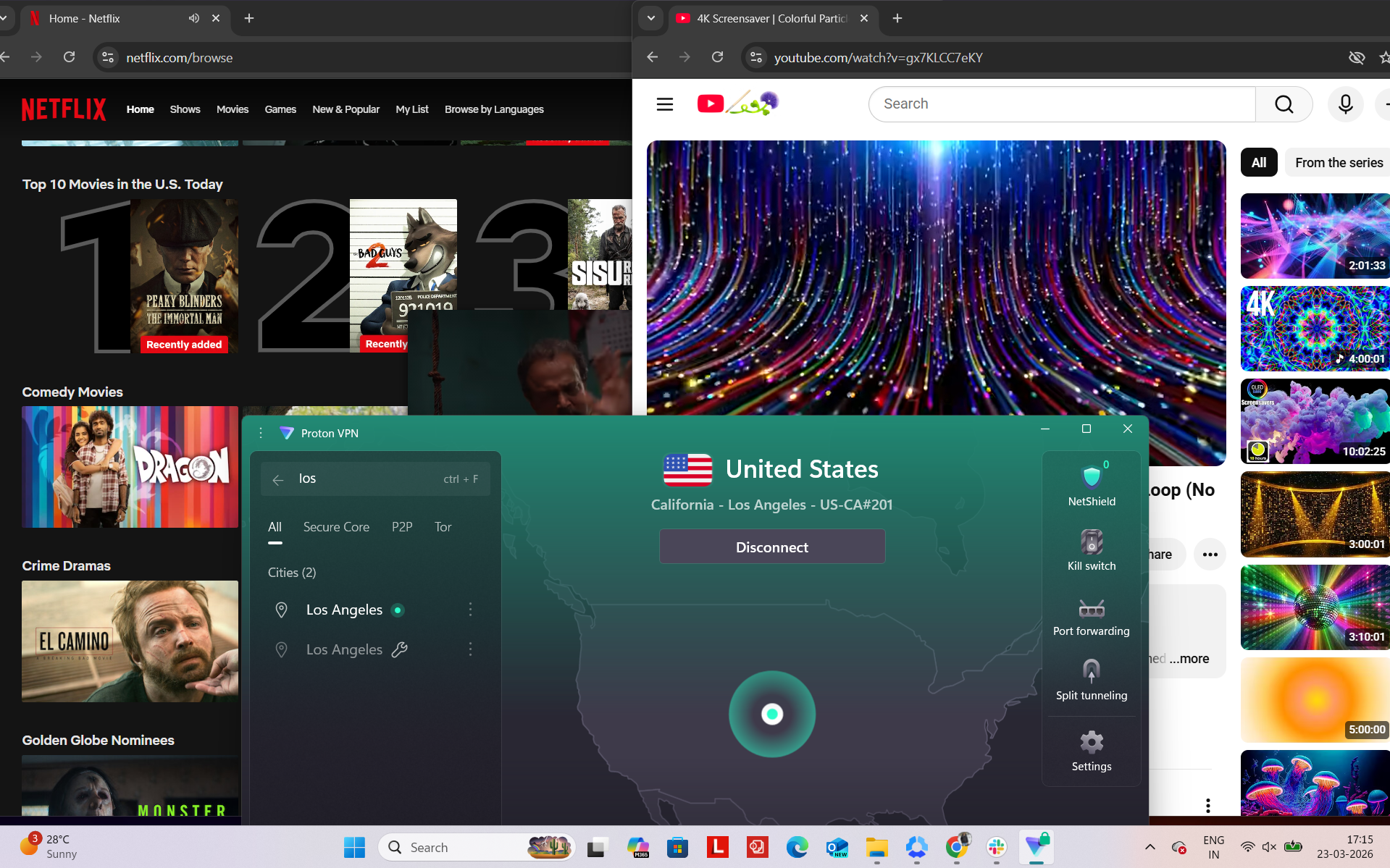
Proton VPN felt stable in terms of staying connected, but the overall experience was noticeably inconsistent once streaming and loading performance came into play. While the connection itself didn’t drop, everyday usage, especially video playback, felt slow and at times frustrating.
Observed Connection Behavior
- Unexpected disconnects - None observed
- Reconnection attempts - Not required
- Network drops - None during the entire session
- Lag spikes or buffering - Frequently encountered during usage
Browsing Performance - Basic browsing worked, but things felt slower than usual. Pages took longer to load at times, and YouTube in particular showed noticeable delays before videos even started. It wasn’t completely unusable, but the experience lacked the smoothness seen with other VPNs.
Streaming & Content Handling
- Content typically took around 3–4 seconds to start and initially loaded in very low, blurry quality
- Video playback remained inconsistent, with frequent buffering and resolution staying low for extended periods (often 5–7 minutes before improving)
- Forward seeking caused the video to drop back to blurry quality again, with even longer recovery times before becoming watchable
- Rewinding made the issue worse, with quality dropping further and in some cases not recovering even after 10 minutes of playback
- On YouTube, videos loaded very slowly and never reached high definition, with the maximum quality observed being around 360p despite waiting, along with repeated buffering and persistent blurriness
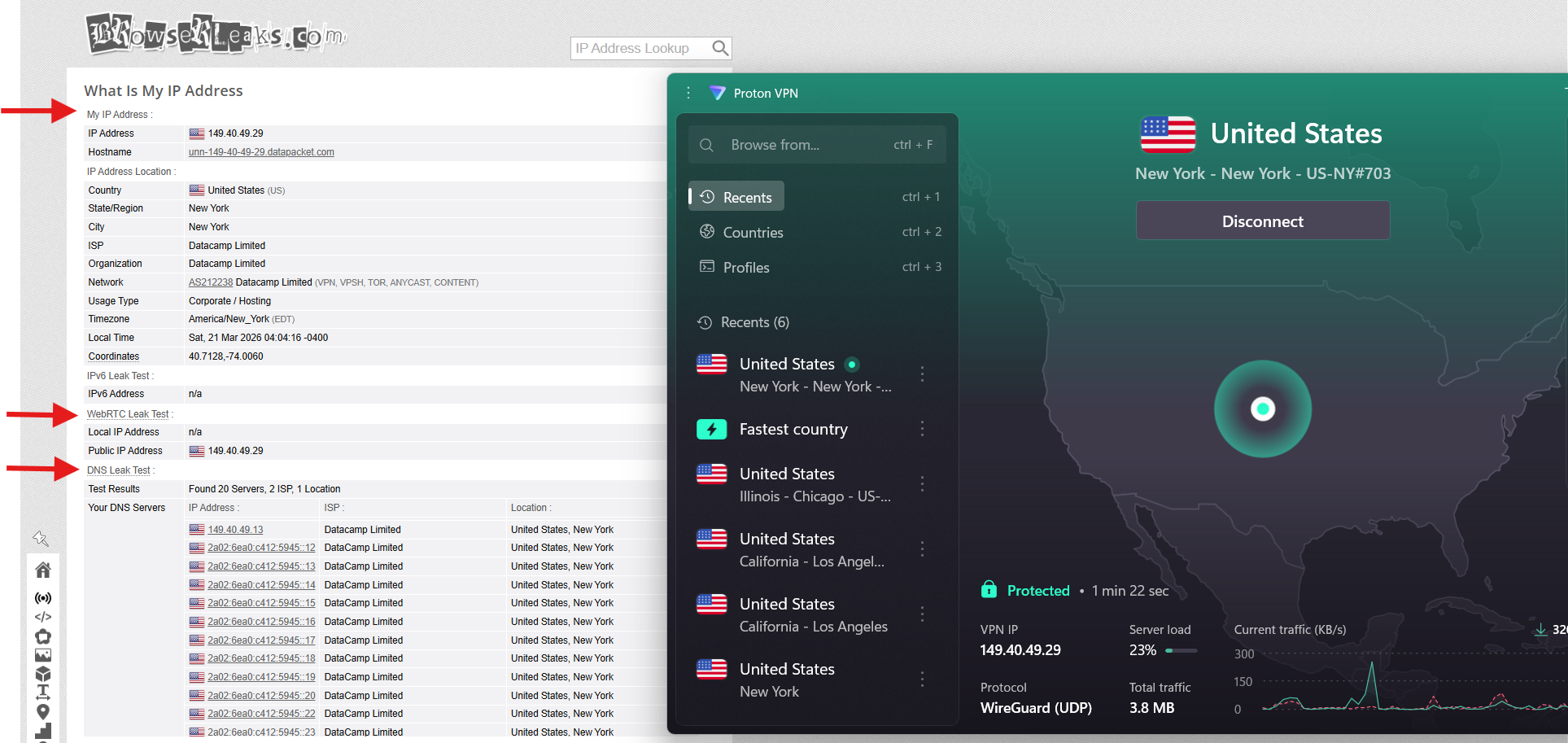
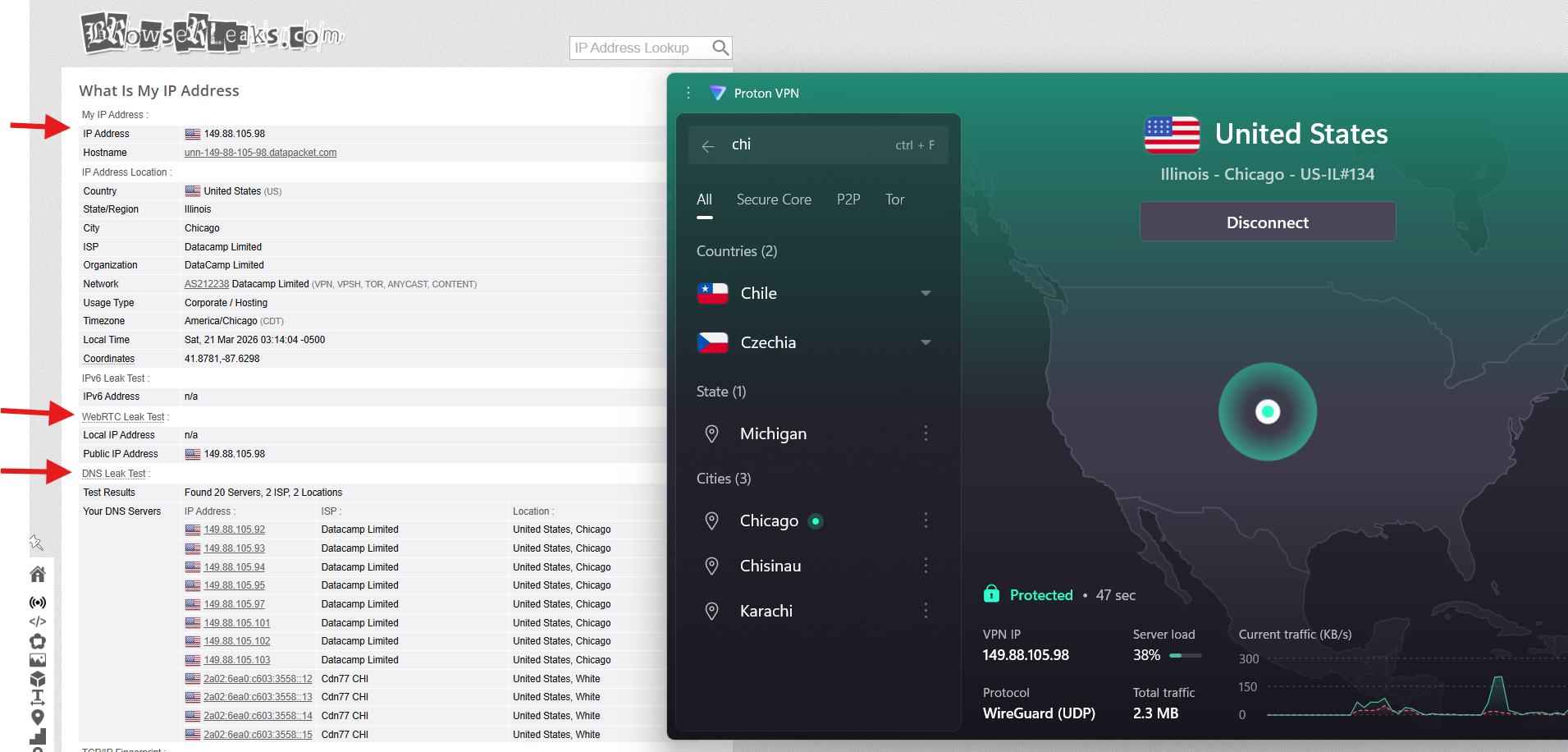
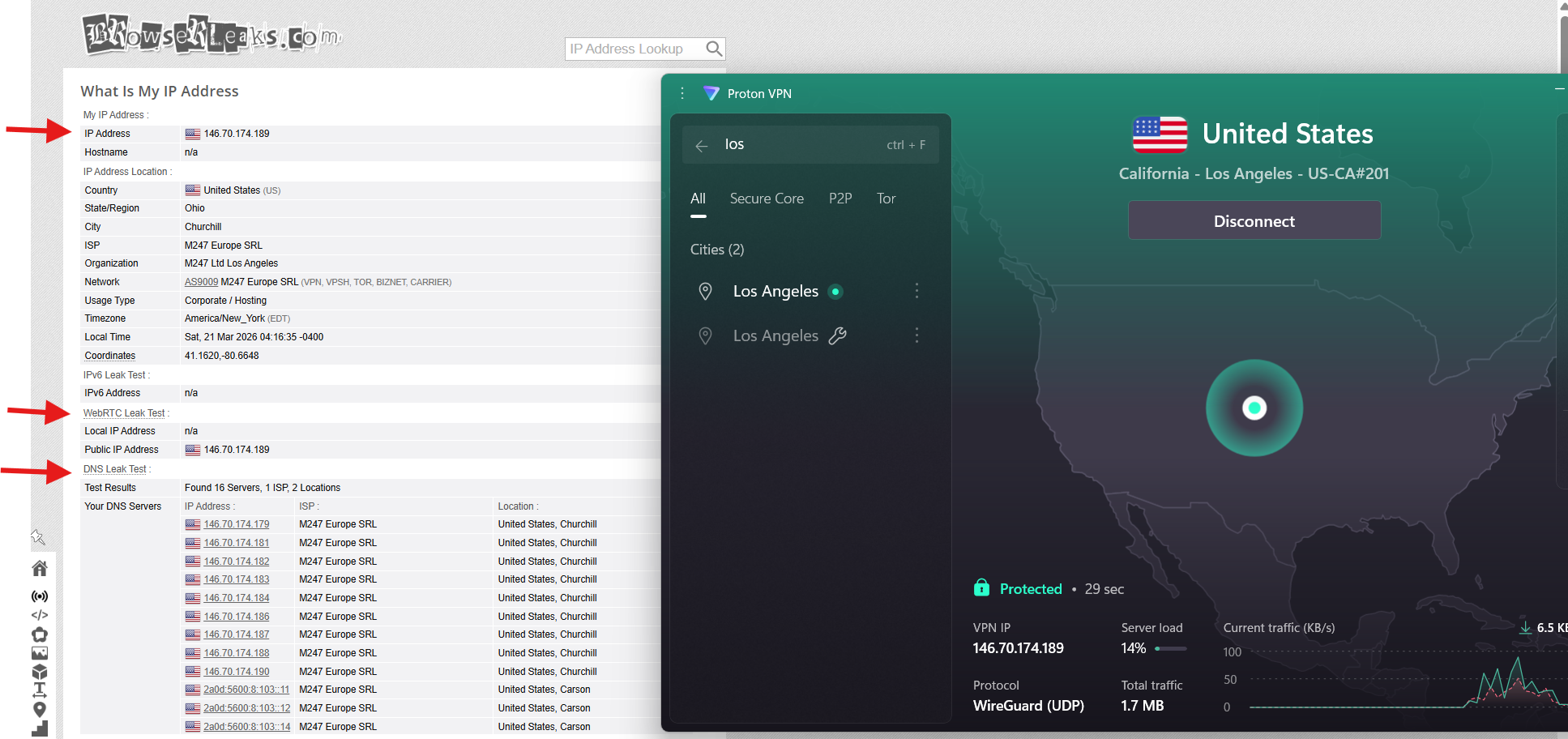
Proton’s results reflected a tightly controlled privacy setup, where the assigned IP consistently matched the VPN endpoint and remained stable throughout. DNS activity did not leave the protected environment, and there were no indications of third-party involvement or leakage. WebRTC checks further supported this by not exposing any real IP details.
The Kill Switch added another layer of reliability by cutting off access the moment the VPN link was interrupted. This prevented any possibility of data flowing outside the encrypted channel during sudden disconnects.
PROS
- Supports advanced specialty servers (Secure Core, P2P, Tor over VPN)
- Real-time server load visibility for choosing optimal servers
- Technical US coverage (20 cities across 16 states)
- Strong connection reliability with no observed disconnects
- Excellent leak protection (no IP, DNS, or WebRTC leaks)
- Effective kill switch for added security
- Good access to US websites and services without detection
CONS
- Lowest number of US cities and states among our top 5
- Very poor speed performance with high speed loss (~70%+)
- High latency across servers affecting responsiveness
- Inconsistent and slow streaming performance with buffering and low resolution
- Slower page load times during everyday browsing
👉 See full Proton VPN review →
How to Get a VPN to Connect to the US
- Subscribe on the VPN’s Official Website: Choose a subscription plan on the official website of your chosen VPN provider. Then, enter your details, and complete the payment. After subscribing, you’ll gain access to your account dashboard (we recommend NordVPN and ExpressVPN).
- Download the VPN app from Your VPN Account Dashboard: After logging in, go to the Downloads section or your account dashboard. From there, you’ll find the option for downloading app as per your device. Click the option that matches with your device.
- Sign In to Your Account: Open the app and log in using the account credentials you created when signing up on the website.
- Activate security essentials: Once you are signed in, turn on the Kill Switch and ad/tracker blocking. Also, select obfuscation. These features keep your activity private and prevent unwanted interruptions.
- Connect to a US server: Pick a US server to get a US IP address in order to stay connected to local websites and services, or switch to an overseas server to unblock geo-restricted platforms.
- Browse, stream, and torrent securely: With your VPN on, you’ll stay private, avoid ISP throttling, and access content freely.
Explore VPNs for Other Needs
If you're using a VPN beyond just US access, it’s worth checking how these services perform across different devices and regions:
By Device
By Region
Final Thoughts
As per extensive and thorough testing for US servers, each VPN delivered strong privacy, leak protection, and reliable access to US-based content, but their real-world performance varied depending on server coverage, speed consistency, and connection stability. The differences became more noticeable when connecting from outside the United States, switching between multiple US regions (New York, Chicago, Los Angeles), and using services like streaming platforms, browsing sites, and long-duration sessions. Some VPNs prioritized extensive server distribution across the US, while others focused on advanced privacy features or specialized routing options.
Key USA VPN Standouts From Our Testing
After evaluating each VPN based on US server availability, speed and latency, streaming performance, reliability, leak protection, and access to US platforms, certain providers stood out in specific areas:
- Best Overall Performance on US Servers: NordVPN and ExpressVPN – delivered consistent speeds, stable connections, and smooth streaming across multiple US locations with minimal interruptions during extended use.
- Most Balanced All-Rounder with Strong Features: NordVPN and ExpressVPN – combines solid speed performance, extensive US server availability, and advanced features.
- Best for Simplicity & Plug-and-Play Use: NordVPN, ExpressVPN and Proton VPN – offers a straightforward experience with easy server selection, making it suitable for users who want quick access without complex setup.
- Best for Specialty Servers & Advanced Routing Options: NordVPN and Proton VPN – NordVPN provides P2P, Double VPN, and Onion over VPN options, while Proton VPN emphasizes Secure Core and Tor over VPN configurations.
- Best US Server Network and Distribution Across Regions: ExpressVPN (servers in all 50 US states plus DC), NordVPN (servers in 50 US states) and Private Internet Access (servers in 44 US states plus DC) – offers one of the widest spreads of US servers across East Coast, Central, and West Coast regions, improving the chances of finding nearby, lower-latency connections.
- Most Stable Performance Over Long Sessions: ExpressVPN and NordVPN – both maintained consistent connections without drops or reconnection issues during extended browsing and streaming sessions.
- Best for Streaming US Content: ExpressVPN and NordVPN – delivered smooth playback with minimal buffering, quick resolution scaling, and reliable access to platforms like Netflix and other US services.
- Best for Power Users & Advanced Controls: Private Internet Access – provides highly customizable settings including protocol selection, encryption options, and manual configuration for users who want deeper control over their connection.
While these VPNs perform well for US servers and access, you can explore our full list of the best VPN services for a broader comparison across different use cases.
That wraps up our guide to choosing the top VPN for the USA. If you have any questions or remarks, leave them in the comment section below. Thanks for reading!