When you purchase through links on our site, we may earn an affiliate commission. Here’s how it works.
VPN Cost Uncovered: The Real Cost, Best Discounts & Savings Strategies for 2026
Last updated November 17, 2025

Key Notes
- VPN prices vary by subscription length – 1-month plans range from $0.99 to $20, 1-year plans $12–$150, 2-year plans $50–$275, 3-year plans $67–$100, and 5-year plans $101–$150. Costs are also influenced by device limits, server network size, security features, and brand reputation.
- Cheapest options for each term – FastVPN is the lowest-priced 1-month and 1-year VPN, PrivadoVPN is the cheapest for 2-year plans, and PureVPN offers the best price for 5-year plans.
- Best balance of cost and quality – For users seeking both affordability and premium features: ProtonVPN is ideal for 1-month, Surfshark for 1-year and 2-year plans, and PureVPN for 5-year plans.
- Long-term plans maximize savings – Choosing multi-year subscriptions can cut your effective monthly cost by up to 90% compared to shorter-term or monthly plans.
- Top-rated VPNs justify higher prices – NordVPN, Surfshark, ExpressVPN, ProtonVPN, and PIA provide verified no-logs policies, fast speeds, advanced security, and reliable support, making them worth the extra cost for users prioritizing performance and privacy.
Wondering what a VPN (virtual private network) really costs in 2026? We’ve done the heavy lifting for you. This blog is entirely based on our comprehensive VPN pricing comparison sheet, where we’ve analyzed and benchmarked 42+ VPN services across every major pricing tier. From monthly rates to long-term discounts, refund policies to seasonal deals, every data point you’ll see here is pulled directly from that sheet.
To create this sheet, we conducted hands-on research across official VPN websites, verified app store listings, and direct support channels. We cross-checked pricing structures, renewal rates, refund policies, free trials, and payment options. We also tracked Black Friday and Cyber Monday deals, ensuring you get the most up-to-date snapshot of active discounts and long-term value.
Each VPN was evaluated using a transparent scoring framework, factoring in:
- Best VPN Plans to Pick: Our editorial picks based on value-for-money and plan flexibility.
- VPN Cost Tiers: Categorized as Very Cheap, Cheap, Moderate, or Very Expensive.
- Overall Score: A composite rating based on pricing transparency, refund clarity, and deal competitiveness.
This blog distills that entire dataset into a clear, actionable breakdown, so you can confidently choose a VPN that fits your budget, usage, and expectations.
Comprehensive VPN Pricing Sheet 2026: Methodology & Key Insights
This section distills all rating, scores, and fine-print details from TechNadu's Pricing Comparison Sheet 2026, so readers can confidently pick a plan and avoid hidden costs.
1. How We Built This Sheet
Let me walk you through exactly how we built this pricing sheet because if you know what went into it, you’ll instantly see why it’s so reliable.
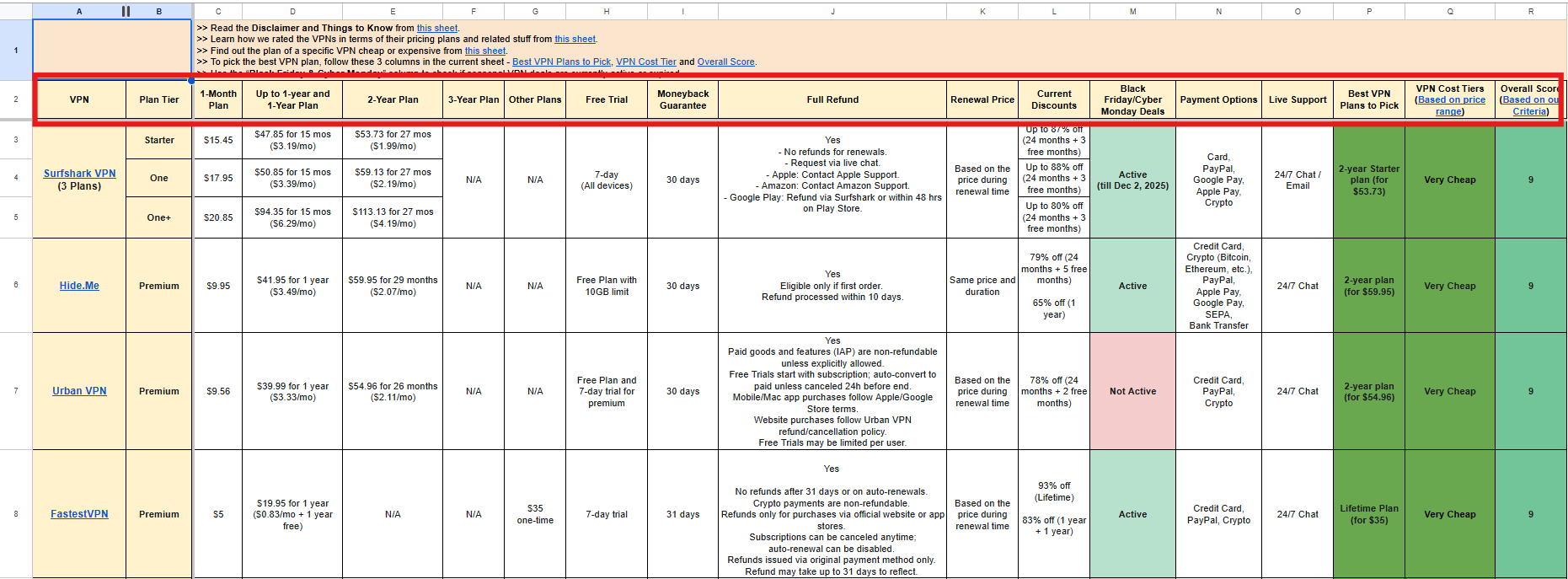
When comparing VPNs, we didn’t just look at the surface-level prices. We broke everything down into real, practical pricing-related factors. These pricing factors are the same things you’d check if you were buying a VPN yourself. Here’s what we looked at:
- The VPN name and its plan tier so you know which package we’re actually talking about.
- 1-Month, 1-Year, 2-Year, and 3-Year plan prices, plus any “other” special plans or bundles.
- Do you get a free trial? (Test them before putting down money)
- Is there a clear money-back guarantee, and will you really get a full refund if things go wrong?
- How does renewal pricing work, including those sneaky post-deal hikes?
- Are there real discounts running right now?
- Apart from that, are there any special discounts like seasonal Black Friday/Cyber Monday offers, or special exclusive deals?
- What payment options do you actually get? (Cards, PayPal, crypto, digital wallets, and more)
- Can you reach live support easily if something goes sideways?
- A curated “Best VPN Plans to Pick” column to highlight the real standouts.
- Clear VPN cost tiers (Very Cheap, Cheap, Moderate, Expensive, Very Expensive) — based purely on pricing.
- And finally, an overall score that ties it all together, balancing affordability, transparency, and trustworthiness.
2. How We Rated Each VPN?
Let me walk you through how we scored every VPN, it’s pretty straightforward. We looked at ten key pricing-related features for each provider. Things like:
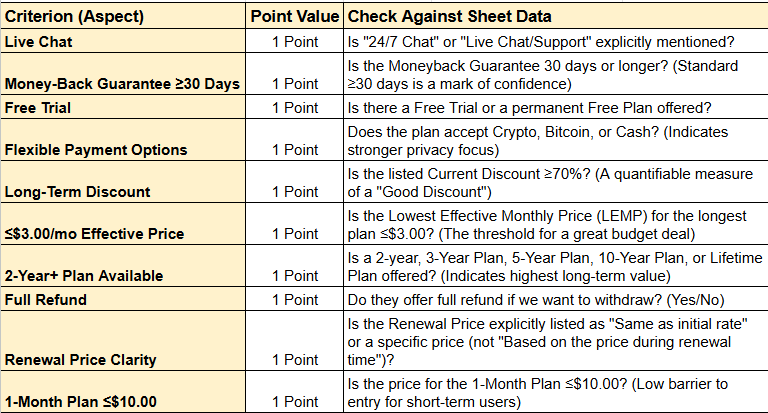
- Can you chat with support live if something goes wrong?
- Is there at least a 30-day money-back guarantee?
- Do they offer free trials so you can test before committing?
- How flexible are their payment options - cards, crypto, digital wallets?
- Are there deep multi-year discounts, like 70% or more?
- Is the pricing effective compared to what you get?
- Are the renewal policies clear, so you won’t get surprises later?
- How affordable is the monthly rate?
- And finally, are the full refund conditions transparent and fair?
Basically, we gave each VPN a score based on all these factors, so you can see not just which is cheap, but which gives you the best value and peace of mind.
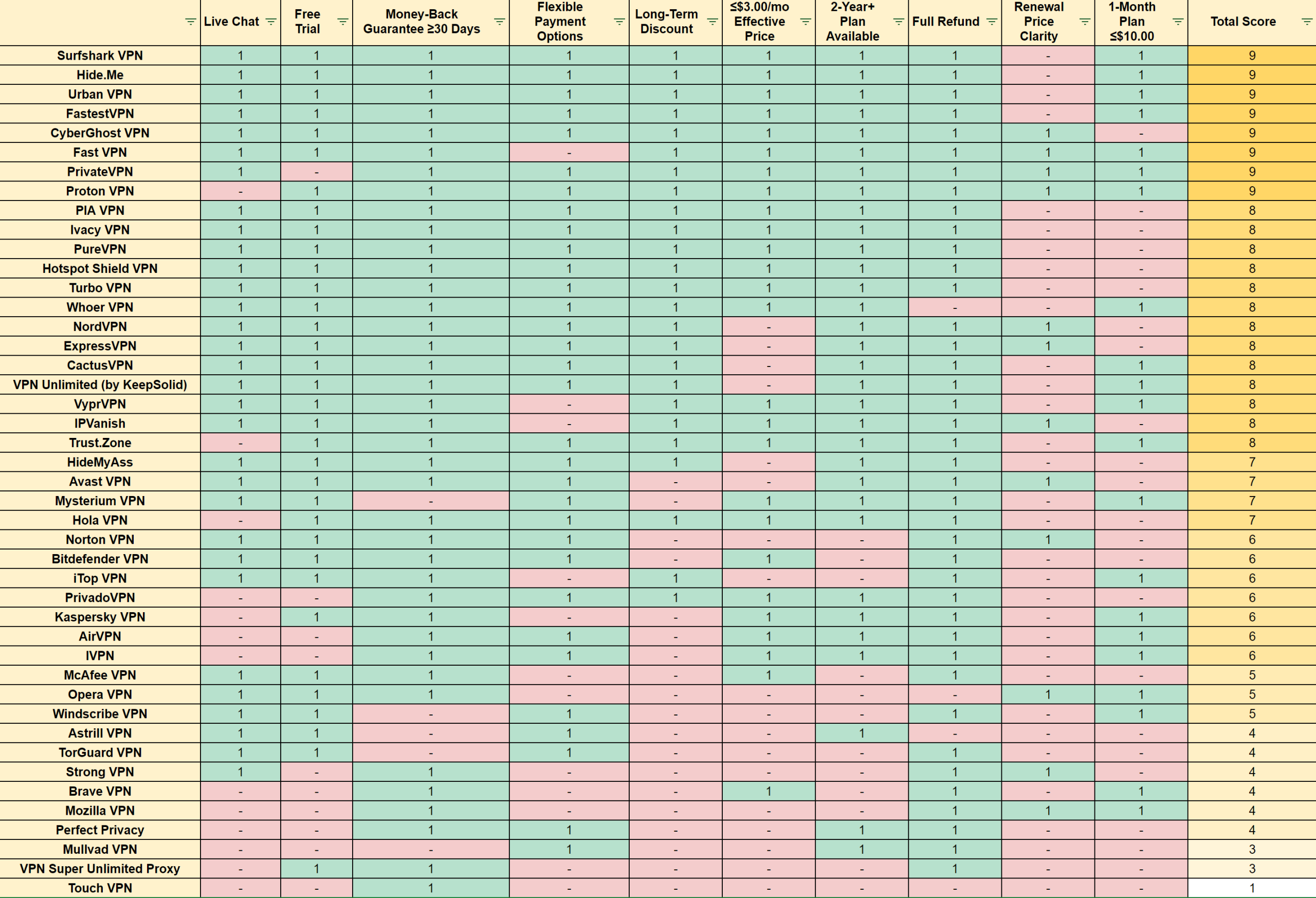
And here’s the best part is that you don’t need to stress about comparing everything yourself. We’ve already done the heavy lifting. Using all those pricing factors we just talked about, we’ve rated each VPN based on its real-world value and not just the sticker price.
Take a look below. These VPNs are arranged from the highest-ranked to the least, so you can instantly spot who’s offering the best bang for your buck.
3. What is Our Cost Tier Classification and Scoring System?
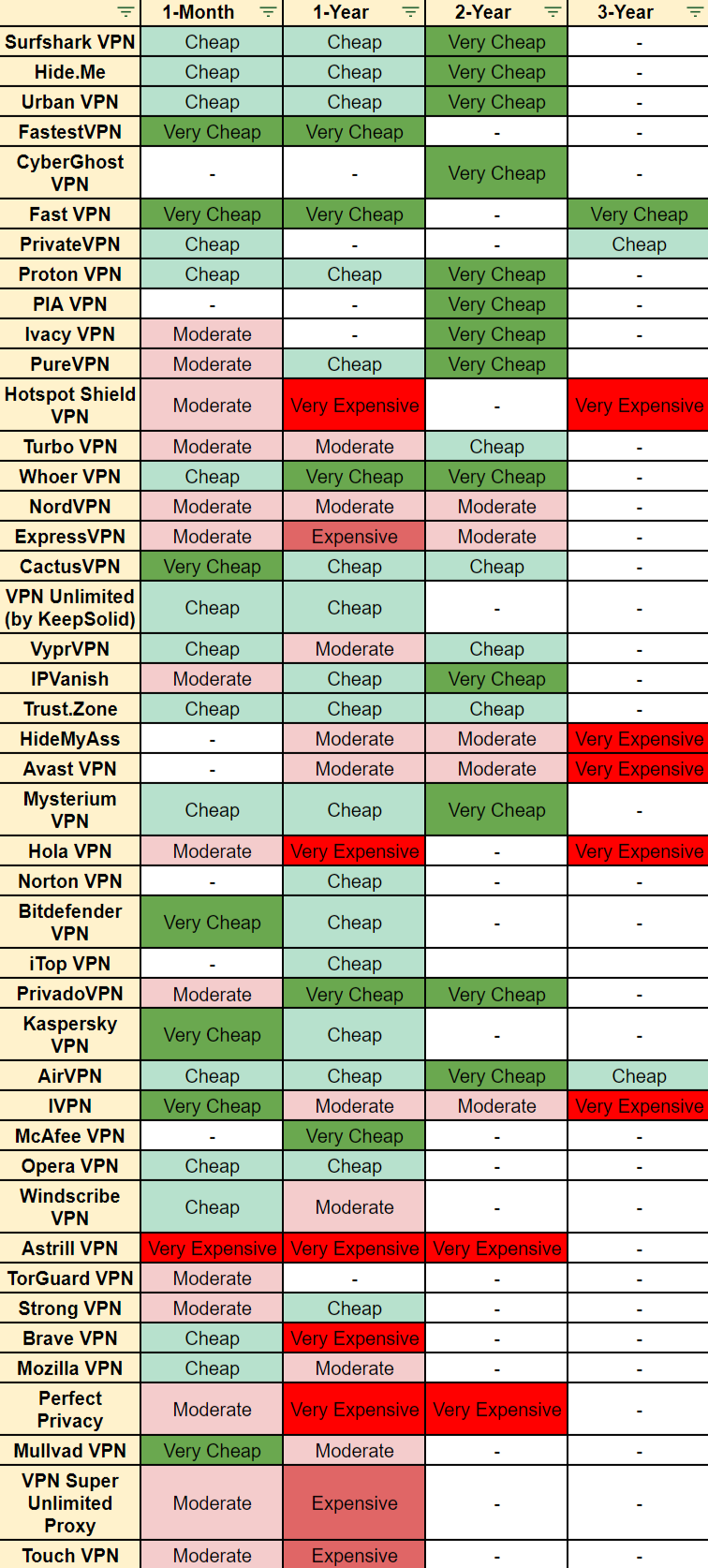
We’ve made it simple to compare VPN plans at a glance. Every plan in our sheet is sorted into five clear cost tiers: Very Cheap, Cheap, Moderate, Expensive, and Very Expensive. These categories are based on the monthly cost equivalent of each plan, so you can instantly see which options are most budget-friendly.

To help you pick the right plan even faster, our sheet includes:
- A “Best VPN Plans to Pick” column highlighting standout deals.
- An overall score that balances price, features, and trustworthiness.
All you have to do is glance at the labels and scores to quickly spot the VPN plans that give you the best value for your money.
4. How to Pick the Best VPN Value in 2026?
Alright, let’s talk VPNs. Choosing one isn’t just about grabbing the cheapest plan. You’ve got to watch out for hidden rules, renewal rates, and tricky fine print. Lucky for you. We have already done the hard work: we analyzed 42 top VPNs (we will constantly be adding more) and put everything into one handy sheet so you can make a smart choice fast.
Here’s how I’d go about it if I were you:
- Step 1: Explore Exclusive Deals
- Start by checking out the current deals and discounts. Some special offers only appear after checkout, so don’t worry if the listed price looks higher at first.
- If you’re purchasing through Apple or Google Play, keep in mind that their refund policies apply, not the VPN provider’s. This is important to avoid surprises later.
- Step 2: Understand Trials, Guarantees, and Renewal Rates
- Before committing, review trial options, money-back guarantees, and renewal rates. Not all VPNs handle these the same way, so knowing the terms upfront can save you from headaches down the line.
- Holiday sales, like Black Friday or Cyber Monday, are also worth keeping an eye on if you want the best deals, but make sure you understand the fine print first.
- Step 3: Plan for the Long Term
- Think beyond the initial purchase. Multi-year plans often offer the best value, but always check the refund policy before committing.
- If you’re paying with crypto, remember it’s usually non-refundable. Also, disable auto-renewal unless you’re okay with being charged the full price when the deal ends. Planning ahead ensures you get the most out of your VPN without unexpected costs.
Most people actually do best with basic or standard plans, you rarely need all the advanced bells and whistles. While you’re in the sheet, use columns like “Best VPN Plans to Pick,” “VPN Cost Tier,” and “Score”. They make it super easy to compare price, features, and trustworthiness at a glance.
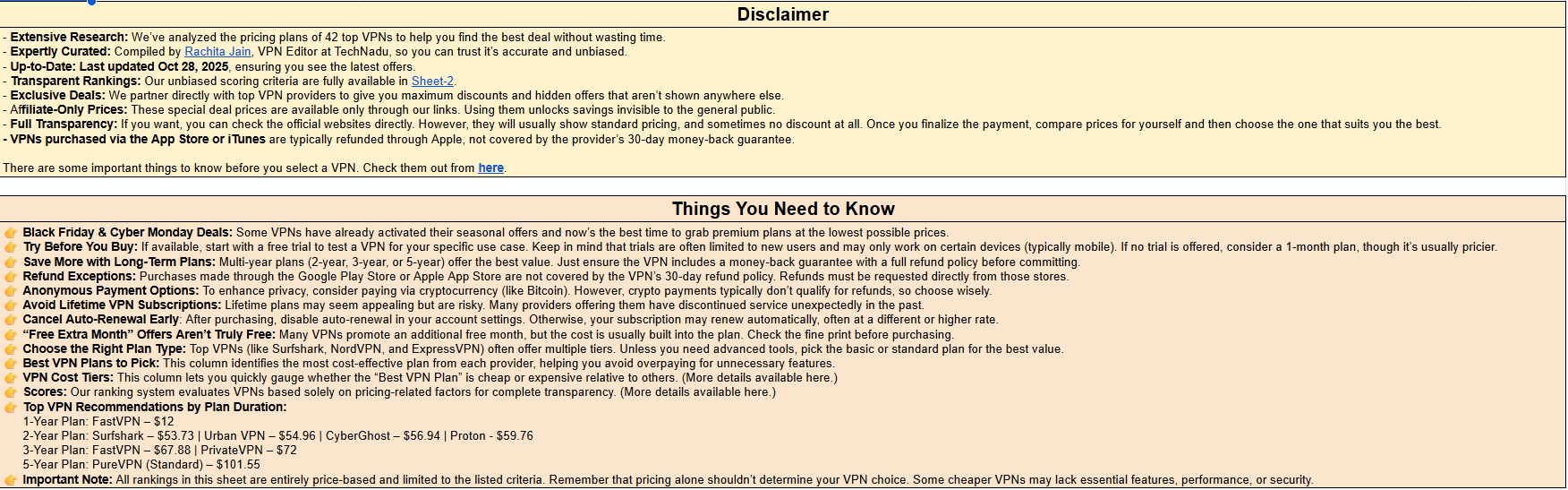
So here’s the game plan: keep this guide handy, check the policies, compare scores, and track seasonal deals. Do that, and you’ll pick a VPN that’s reliable, secure, and gives the best value for your money - no surprises, no stress.
How Much Do VPNs Usually Cost in 2026?
So, here’s the deal with VPN pricing in 2026 - it really depends on the provider, how long you’re signing up for, and what kind of features you’re getting. The overall trend right now is toward more flexible pricing and deeper discounts for longer commitments.
From our analysis of 42 major VPN providers, prices range quite a bit. On the low end, you’ve got ultra-budget options that cost under a dollar a month, and on the high end, some premium plans go over $20 per month if you’re after advanced privacy tools and large global server coverage.
The good news? Here’s a quick look at what average prices look like this year:
Now, here’s the key takeaway - the longer the plan, the better the value. In some cases, you can cut your monthly cost by up to 80% just by choosing a multi-year deal.
For example, while premium providers like ExpressVPN or Astrill VPN can hit around $20 a month, multi-year plans from PureVPN, Surfshark, or FastestVPN drop that down to under $2 per month, and you’re still getting top-tier privacy and performance.
So if you’re thinking long-term, this is where you save big. The simple rule is: the longer you commit, the less you pay per month. Extended subscriptions just make more sense if you want reliable, ongoing protection without constantly worrying about renewals or price jumps.
1. How Much Do 1-Month VPN Plans Cost in 2026?
If you’re new to VPNs or only need coverage for a short period, maybe while traveling, working remotely, or testing a streaming service, a 1-month plan is the easiest entry point.
Prices typically range between $0.99 and $20 for a full month. The lower end usually offers basic protection and limited server access, while higher-end plans come with faster speeds, global server coverage, and advanced security tools.
It’s also worth knowing that some VPNs offer free trials, so you can test their apps and speeds without paying anything upfront. Not all providers include a trial, though. So if you want to test a service that doesn’t offer one, a 1-month plan is the safest, low-commitment option.
Monthly plans are convenient, but they rarely offer the best long-term value. Always double-check renewal terms, since many VPNs automatically switch to full price after the first month.
If you plan to use a VPN regularly, switching to an annual or multi-year plan later can save you a lot more in the long run. Nevertheless, here is our list of 42 VPNs with their one-month plans:
Some providers offer lower rates for their services, but these often come with limitations, such as fewer server locations or slower connection speeds. That being said, it's crucial to consider what you're getting for your money and whether it meets your specific needs.
2. How Much Do 1-Year VPN Plans Cost in 2026?
A 1-year plan is the most balanced choice for most users. Total costs generally range between $12 and $150, which averages out to $1–$12 per month.
These plans often unlock full features, including better server coverage, priority support, and consistent speeds, all without the commitment of multi-year contracts.
What’s nice about annual plans is the flexibility. You get significant savings compared to monthly plans, but you’re not locked in for too long.
What to check before buying:
- Renewal pricing (it often increases after the first year)
- Whether the plan includes a money-back guarantee
- If you can pay with multiple options like cards, wallets, or crypto
- How many devices you can protect at once
If you like a provider after the first year, you can always renew or switch to a longer plan at a better rate.
Here is our list of 42 VPNs with their 1-year plans. We suggest you checkout our sheet as it will give you the true picture.
Basically, think about what’s most important to you: lowest cost, extra security, or trusted performance. Pick your plan based on that, and you’ll get the best value for the year.
3. How Much Do 2–3 Year VPN Plans Cost in 2026?
Multi-year plans are where the real value starts to show up. Prices for 2- to 3-year plans usually fall between $45 and $100 in total, depending on the provider and the extras included.
When you spread that cost over the full term, you’re looking at roughly $1.50 to $3 per month, a massive reduction compared to monthly billing.
Providers offer these long-term deals to reward loyalty, but make sure you still check the details:
- Refund and cancellation policies (especially for longer commitments)
- Automatic renewal settings: turn them off if you don’t want surprises later
- Whether updates, new features, or extra device slots are included over time
- Renewal pricing (it often increases after the first year)
- Whether the plan includes a money-back guarantee
- If you can pay with multiple options like cards, wallets, or crypto
- How many devices you can protect at once
Multi-year plans are best if you know you’ll use a VPN long-term, say, for constant streaming, work security, or maintaining privacy on all your devices.
Below you’ll find our lineup of 42 VPNs with all their 2-3-year plan details. Take a look at the full sheet as it’s the fastest way to see which providers actually deliver the value you want.
4. How Much Do 5-Year (and Lifetime) VPN Plans Cost in 2026?
If you’re the “set it and forget it” type, 5-year and lifetime plans are the ultimate way to lock in savings. Typically, 5-year plans cost between $100 and $150 total, which works out to around $1.50–$2.10 per month.
Some providers even offer “lifetime” options - a one-time payment that covers you for as long as the service operates. These can be incredible deals, but they come with one caveat: they depend entirely on the provider staying active and maintaining service quality.
Before committing to long-term or lifetime plans, check for:
- A clear refund policy and defined “lifetime” terms
- Consistent updates and infrastructure maintenance promises
- Whether data laws in the provider’s region could affect long-term privacy
- Device or connection limits (some cheaper lifetime plans restrict these)
- Automatic renewal settings: turn them off if you don’t want surprises later
- Whether updates, new features, or extra device slots are included over time
- Renewal pricing (it often increases after the first year)
- Whether the plan includes a money-back guarantee
- If you can pay with multiple options like cards, wallets, or crypto
- How many devices you can protect at once
If you know you’ll always need a VPN - for work, travel, or privacy - long-term plans offer unbeatable value. Just make sure to read the fine print before locking in.
Curious about which VPNs actually go beyond 5-year plans? Don't worry, just check it out below:
What is the Cheapest but Also the Best VPN Option in 2026?
Not every cheap VPN is the best VPN. That’s why we’ve filtered out options that are not only affordable but also deliver strong performance and essential features.
What is the Cheapest but Best VPN in 2026? Here’s a straightforward breakdown based on our latest VPN comparison sheet, highlighting plans that offer the best value for your money without compromising on security, features, or support. Choose the right option based on how long you're ready to commit.
This ensures you get the most cost-effective VPN that meets your needs with confidence.
1. What Is The Cheapest But Also the Best 1-Month VPN Plan?
Let’s walk through this step by step.
We started by going through our internal comparison sheet and pulled out every VPN that offers a true month-to-month plan. From there, we sorted them strictly by price, from lowest to highest. After filtering and cleaning everything up, we ended up with the top 10 cheapest 1-month VPN plans available right now.
Here’s the list exactly as it came out of our sheet:
Once we had these ten, we asked two simple questions:
- Which one is the absolute cheapest?
- Which one is the best overall value among these ten, meaning not just affordable, but genuinely good?
Let’s break those down.
Cheapest: FastVPN ($0.99/month)
If your goal is to spend as little as possible for short-term privacy, FastVPN is the absolute cheapest at just $0.99/month. It’s barebones by design, so it's great for quick travel or basic online protection when price is your #1 priority.
Best Overall: Proton VPN ($9.99/month)
But if you ask me what’s not just cheap, but also the best in terms of pure value, Proton VPN at $9.99/month is hands-down the top pick in my sheet. Here’s why I rate it highest:
Why Have We Picked Proton over FastVPN
- It’s based in Switzerland, so you’re under strong privacy laws.
- They have a strict no‑logs policy (independent audit verified) so what you do isn’t tracked.
- Advanced features that most cheap VPNs ignore:
- “Secure Core” which routes your traffic through multiple servers for extra protection.
- “NetShield” ad/malware filter built‑in.
- 10 simultaneous device connections, so you can use it on phone, laptop, maybe tablet.
- Streaming + P2P friendly: good if you’re abroad and want Netflix / your shows.
- Easy month‑to‑month flexibility.
The Bottom Line: If you prioritize cost alone for very short-term use, FastVPN fits the bill. But for a more secure, feature-rich, and flexible VPN experience, Proton VPN is the smarter choice at a reasonable price. With Proton VPN, you’re getting a premium, full-featured VPN that’s reliable, secure, and ridiculously easy to use for a single month. It’s not just “cheap”, it’s the smart choice if you care about quality over gimmicks.
2. What Is The Cheapest But Also the Best 1-Year VPN Plan?
Now let’s shift from month-to-month flexibility to something a lot of people prefer: a solid, budget-friendly VPN you can rely on for a full year.
Just like before, we pulled data from our internal comparison sheet and filtered it down to every VPN offering a 1-year plan. Then we sorted them by total yearly price and calculated each plan’s effective monthly cost, so you can instantly see what you’re really paying.
Here are the top 10 cheapest 1-year VPN plans from our sheet:
Once we had this list, we evaluated two things again - the cheapest and the best overall value among the affordable options.
Cheapest: FastVPN ($12/year, just $1/month)
This is your absolute rock-bottom option for basic protection, a great pick if you only need minimal coverage or have a tight budget.
Best Overall: Surfshark VPN ($47.85/year, $3.13/month)
Surfshark leads the pack with exceptional value, robust security features, and unlimited device support. Its reliable performance, strong streaming capabilities, and user-friendly interface make it the top choice for a 1-year VPN plan in 2026.
The Bottom Line: Surfshark combines affordability with premium features, giving you comprehensive online privacy and security without compromise. This makes it the “best” 1-year plan if you want real coverage and peace of mind for 2026.
3. What Is The Cheapest But Also the Best 2-Year VPN Plan?
If you want the maximum savings and you’re ready to commit long-term, 2-year plans offer the lowest prices you’ll ever get on a premium VPN. So, just like we did for the monthly and yearly plans, we pulled up our VPN pricing comparison sheet and filtered out every provider offering a 24-month subscription.
Then we sorted them by the total 2-year price and broke everything down into an effective monthly cost so you can instantly see where your money goes.
Here are the top 10 cheapest 2-year VPN plans based on our sheet:
Once again, we evaluated two things:
- Which one is the cheapest option?
- Which one delivers the best long-term value for the money?
Cheapest: PrivadoVPN ($30 for 2 years, $1.11/month)
This is the absolute lowest cost-per-month for true long-term privacy. It is great if you’re all about the bottom line and just want reliable, basic protection for as cheap as it gets.
Best Overall: Surfshark ($53.73 for 2 years, $1.99/month)
Here’s why Surfshark is the best long-term play, hands down:
- Get unlimited simultaneous connections, so protect your whole family or every gadget you own, no extra fees.
- 4,500+ servers in 100 countries, so you get blazing speed and access practically anywhere.
- CleanWeb (ad/malware/tracker blocker), MultiHop (double VPN for extra privacy), and rotating IP, all included.
- Super-friendly apps and 24/7 live chat support if you ever get stuck.
- Always up-to-date with new features (WireGuard, streaming unlocks, and more) for no extra cost.
- 30-day money-back guarantee, so you can try it totally risk-free.
The Bottom Line: Why Surfshark is our top pick: I’ve checked the sheet for every multi-year plan - Surfshark consistently hits the sweet spot of affordability, features, and reliability. It’s perfect for streaming, public Wi-Fi, and everyday online privacy.
4. What Is The Cheapest But Also the Best 5-Year VPN Plan?
If you’re the kind of person who wants to “set it and forget it” for the long haul, 5-year (and even 10-year) VPN plans offer the lowest prices you’ll ever pay in the VPN world. These deep-discount, ultra-long subscriptions are perfect if you want long-term privacy without worrying about monthly or yearly renewals.
Just like before, we pulled everything from our VPN pricing comparison sheet and filtered it down to only multi-year plans lasting 5 years or more. Then we broke down each plan’s price into an easy-to-understand monthly equivalent.
Here are the top long-term deals from our sheet:
Now, we focused on two things that matter most for such a long commitment: who offers the lowest price and who delivers the most reliable long-term value. And interestingly, both of those paths lead to the same pair of VPNs.
Cheapest and Best Overall: PureVPN and Ivacy VPN ($101.55 for 5 years, $1.69/month)
Yes, PureVPN and Ivacy VPN are both the cheapest as well as the best VPNs in the 5-year and above category. Who to choose between the two? We suggest PureVPN. Why? PureVPN has acquired Ivacy VPN, so these two services are now operated under the same ownership. As a result, PureVPN is your go-to option here since both are effectively the same service now.
The Bottom Line: PureVPN (including Ivacy as part of its network) ranks highly for long-term value, making it a smart choice if you want peace of mind with one of the most budget-friendly extended plans on the market.
Top 5 VPNs We Recommend (Overall)
When it comes to choosing a VPN, we always recommend focusing on quality, reliability, and long-term value rather than just price. The VPNs listed below are the ones we personally trust and suggest to anyone who wants top-tier protection and performance. Why do we trust them? Because we have thoroughly reviewed each and every VPN we have recommended.
Yes, they may fall on the slightly pricier side but there’s a good reason for that. These services consistently deliver industry-leading security features, proven no-logs policies, their constant updates and exceptional user ratings across independent reviews. If your budget allows, choosing one of these premium VPNs will give you peace of mind, better speeds, and the strongest privacy protections available today.
Below are the VPNs I highly recommend if you want the absolute best experience:
1. NordVPN
Why we recommend it: NordVPN is widely recognized for its strong security and fast performance. It is perfect for users who prioritize privacy without compromising speed. For a complete breakdown of NordVPN’s plans and prices, take a look at our NordVPN pricing guide as it covers everything from monthly to long-term subscriptions.
Key Features & Benefits:
- Servers - 8,900+ servers in 129 countries
- Protocols - NordLynx (WireGuard-based), OpenVPN, IKEv2/IPsec, and NordWhisper
- Encryption - AES-256-GCM, ChaCha20, and Post-Quantum Encryption (NordLynx Protocol)
- Advanced security: Offers Kill Switch, Obfuscation, Double VPN (routes traffic through two servers) and Onion over VPN for maximum anonymity.
- CyberSec feature: Blocks malware, phishing sites, and annoying ads automatically.
- Streaming-friendly: Works with Netflix, Disney+, Hulu, BBC iPlayer and with almost all other streaming platforms.
- No-logs policy: Operates under a strict no-logs policy audited by third parties.
- Best for: Streaming, torrenting, gaming, privacy-focused users.
2. Surfshark VPN
Why we recommend it: Surfshark combines top-notch security features with an incredibly user-friendly and affordable experience. It’s ideal for families or users with multiple devices.
Key Features & Benefits:
- Servers - 4,500+ servers in 100 countries
- Protocols - WireGuard, IKEv2, OpenVPN, and Dausos
- Encryption - AES-256-GCM (OpenVPN and IKEv2), ChaCha20 (WireGuard), and Post-Quantum Encryption (WireGuard + Dausos)
- Unlimited simultaneous connections: Protect all your devices with a single account.
- CleanWeb feature: Blocks ads, trackers, and malware for safer browsing.
- Camouflage & NoBorders mode: Hides VPN usage, even from your ISP, and works in restrictive countries.
- Fast and reliable speeds: Excellent for HD streaming, gaming, and downloading large files.
- Strict no-logs policy: Privacy-focused with independent audits.
- Best for: Multiple devices, budget-conscious users, those in restrictive regions.
3. ExpressVPN
Why we recommend it: ExpressVPN is the go-to choice for users who want a combination of lightning-fast speeds, robust security, and a polished user experience. If you are confused regarding its pricing structure (which ExpressVPN has changed recently), then don't worry. Our ExpressVPN cost guide is a helpful resource that covers every plan, price, and feature, making it easy to decide which plan fits your needs.
Key Features & Benefits:
- Servers - undisclosed number of servers in 105 countries
- Protocols - OpenVPN, Lightway, and IKEv2
- Encryption - AES-256 and ChaCha20/Poly1305
- Wide global coverage: undisclosed number of servers in 105 countries for consistent performance anywhere. It now has servers in the entire US.
- TrustedServer technology: Servers run on RAM-only, ensuring no data is ever stored long-term.
- Split tunneling: Lets you route some apps through VPN while others use your regular connection.
- Reliable streaming and torrenting: Easily bypasses geo-restrictions for Netflix, Hulu, and more.
- Best for: Frequent travelers, streamers, torrenting, online gaming, and high-speed internet users.
4. Proton VPN
Why we recommend it: Proton VPN is built by the same team behind ProtonMail and is focused on privacy, security, and transparency. It’s a standout for users who care deeply about keeping their data out of prying hands.
Key Features & Benefits:
- Servers - 17,276 servers in 127 countries (130 secure core in 67 countries)
- Protocols - WireGuard, OpenVPN, IKEv2, and Stealth
- Encryption - AES-256 and ChaCha20
- Secure Core servers: Routes traffic through multiple countries for extra protection.
- No-logs policy: Based in Switzerland, a country with strong privacy laws.
- P2P support: Great for torrenting and secure file sharing.
- Best for: Privacy advocates, tech-savvy users, and those wanting a trustworthy VPN option.
5. Private Internet Access (PIA)
Why we recommend it: PIA is a veteran in the VPN space, known for its transparency, customizability, and massive server network. It’s highly flexible and ideal for advanced users.
Key Features & Benefits:
- Servers - undisclosed number of servers in 91 countries
- Protocols - WireGuard, OpenVPN, and IPsec (IKEv2)
- Encryption - AES-128-GCM, AES-256-GCM, AES-128-CBC, AES-256-CBC, and ChaCha20
- Customizable security: Adjustable encryption levels, kill switch, and split tunneling.
- No-logs policy: Independently verified to ensure your activity isn’t tracked.
- Torrenting support: Excellent for P2P and secure downloads.
- Ad-blocking and malware protection: Protects devices with built-in features.
- Best for: Tech-savvy users, torrenting, users who want complete control over security settings.
Should I Trust a Low-Cost VPN Or Is It Worth Paying More?
Let’s be honest. A low price tag is tempting. Who doesn’t want to save a few bucks? But when it comes to VPNs, “cheap” can sometimes cost you more in the long run - in the form of weaker privacy, slower speeds, or unreliable connections.
That doesn’t mean all affordable VPNs are bad. Some genuinely offer great value; it’s just about knowing where to draw the line between “budget-friendly” and “too good to be true.”
Here’s how I usually break it down for people who ask me this:
How to Choose?
A low-cost VPN isn’t automatically bad. But you do need to check:
- Does it have a money-back guarantee?
- Is the refund policy clear and fair?
- Are there hidden renewal fees or auto-renew traps?
- Does it support the platforms you use (Windows, iOS, Android, etc.)?
- Is there live chat support if something goes wrong?
If the answer to most of those is yes, and your needs are simple, a budget VPN might be perfect for you.
But if you care deeply about privacy, speed, and long-term reliability. Don’t just chase the lowest price. Go for a VPN that’s proven, transparent, and built to last.
And here’s a tip: Try before you commit. Many good VPNs, including but not limited to NordVPN, ExpressVPN, Proton VPN, and more, offer money-back guarantees or short-term plans. You can always start small, test the service for a month, and then upgrade or cancel once you know it fits your needs.
How to Save Money on VPN Subscription Plans?
The best way to save money on VPN subscriptions is to do your research before you hit the buy button. Often, VPNs offer various deals, discounts, and coupons on their website that can lower your costs. Also, choosing a longer-term plan also lets you save in the long term.
Here are our best tips to help you save money on VPN subscription plans.
- Choose Long-Term Subscription Plans: Most VPNs offer different subscription plans, including monthly, semi-annual, annual, and even biennial options. Generally, the longer the subscription period, the lower the cost per month. This is because VPNs incentivize long-term commitments by offering significant discounts.
- Use Deals, Discounts, and Coupons: If you're hunting for discounts, don’t miss the latest Black Friday & Cyber Monday VPN deals or the top Christmas VPN promotions. And if budget is your top concern, here’s a guide to the best cheap VPNs that offer great value without compromising on quality.
- Use Free Trials: Many VPN providers offer free trials, allowing you to test their services before committing to a paid plan. The best VPN free trial should not have limitations like speed caps. Instead, it should let you fully experience the VPN’s capabilities. It can help you decide whether that VPN meets your needs before committing for the long term.
- Buy During Major Shopping Events: VPN providers often run their biggest discounts during Black Friday, Cyber Monday, or New Year sales. We recommend you bookmark our deals page to be updated regarding the best VPN deals.
- Use Referral Programs: Many VPN providers reward loyal users through referral programs. By inviting friends or family to sign up using your referral link, you can often earn account credit, discounts, or even free months of service.
- Compare Features vs. Price: Not all VPNs are created equal, and you shouldn’t pay extra for features you won’t use. For example, if you’re primarily using a VPN for streaming or browsing, there's no need to pay for advanced tools like dedicated IPs unless those are essential to your needs. The key is to match the feature set to your specific use case, so you're not overspending on bells and whistles you won’t actually need.
- Use Money-Back Guarantee to Get a Refund: Most reputable VPNs offer a money-back guarantee, allowing you to request a refund if you're not satisfied with their service. This means you can use their services risk-free for up to a month and request a refund if you're not happy with the service.
- Avoid Plans with Extra Add-Ons: Some VPNs offer additional features or add-ons at an extra cost, such as dedicated IP addresses, additional device connections, or enhanced security features. While these add-ons can provide added benefits, they can also significantly increase the cost of your VPN subscription.
What Are the Factors That Affect the Cost of VPNs?
The cost of a VPN depends on several key factors that affect both value and performance. Understanding these helps you decide what’s worth paying for:
- Subscription Length: Longer plans like annual or multi-year subscriptions usually cost less per month. Short-term plans are more expensive but offer flexibility.
- Device Limit: More simultaneous connections often mean higher costs. Some VPNs with multiple device compatibility are priced relatively higher.
- Server Network & Location: Larger, globally distributed servers improve speed, reliability, and access to region-locked content, such as streaming platforms in the US, UK, or Canada.
- Features & Security: Advanced features like split tunneling, multi-hop, Tor support, and no-logs policies may increase cost but ensure privacy. Furthermore, strong encryption, protocols, kill switches, obfuscation, double VPN, and leak protection raise infrastructure costs and prices.
- Speed & Performance: VPNs optimized for streaming, gaming, or large downloads can be pricier.
- Brand Reputation & Reliability: Top-tier VPNs like ExpressVPN, NordVPN, and Proton VPN often charge more for their long-term plans. This premium reflects their audited no-log policies, consistent service quality, and established trust in the privacy space.
- Jurisdiction & Privacy Laws: VPNs headquartered in privacy-forward countries,such as Switzerland (Proton VPN) or Panama (NordVPN), may carry slightly higher price tags. These jurisdictions enforce strict data protection laws, which can increase operational costs but also enhance user privacy.
- Promotions, Bundles & Seasonal Deals: Seasonal offers, especially Black Friday and Cyber Monday deals, can drastically reduce long-term costs. For instance, FastestVPN’s lifetime plan drops to $35, while Surfshark and CyberGhost offer 2-year plans with 3 free months at steep discounts.
- Platform Compatibility & Extras: Support across multiple devices, 24/7 customer service or dedicated IPs may add to the price. Some VPNs bundle in extra features like password managers or malware blockers, which may raise the base price but increase overall value.
Does the Cost of VPN Increase on Renewal?
Yes, most VPNs increase their prices when your plan renews. Think of it like a first-term discount - the low introductory price is designed to attract new customers, and once that term ends, you’re charged the regular rate. This usually kicks in right after your initial plan expires, unless you cancel beforehand.
The table below shows how the introductory price compares to the renewal price for each provider, helping you understand their pricing practices:
As we can see, VPN renewal prices often double or triple for some VPNs, including ExpressVPN, IPVanish, CyberGhost, and Proton VPN. Let's have a look at some of the examples, and then we will explain why VPNs follow this strategy:
- ExpressVPN sells its 2-year plan at $97.72 ($3.49/mo), but renewal jumps to $199.90 ($8.32/mo), more than double.
- IPVanish starts at $52.56 for 2 years ($2.19/mo), then renews at $179.98 ($8.57/mo), nearly 4x higher.
- CyberGhost goes from $56.94 for 2 years ($2.19/mo) to $113.88 ($4.74/mo) on renewal.
- Proton VPN Plus jumps from $59.76 for 2 years ($2.49/mo) to $159.90 ($6.66/mo).
These big jumps exist because the initial price is intentionally discounted. Providers follow a model similar to streaming services or web hosts: cheap to join, full price to stay.
Renewal increases also reflect real operational costs, such as server maintenance, security audits, and new feature development. Combined with marketing strategies, this pricing model balances a low entry cost to attract new users with higher renewal rates to maintain profitability.
Not all VPNs raise prices after the first term. Some keep the renewal fee the same, which can be a major advantage for long-term users. For instance:
- Hide.me – 2-year plan stays $59.95 ($2.07/mo) on renewal.
- Hotspot Shield – 1-year plan stays $95.99 ($7.99/mo) every year.
Here’s a simple snapshot of how popular VPNs compare, showing the difference between intro and renewal prices:
Pro tip: If the VPN doesn’t clearly spell out renewal prices, ask their support. No answer? Go ahead with the plan you want, but turn off auto-renewal. That way, you lock in the intro price without any surprise hikes.
Are Coupons, Promo Codes, or Seasonal Discounts Available for VPNs?
Absolutely! Most VPN providers run coupons, promo codes, and seasonal discounts to attract new users or promote longer-term plans. These deals can slash prices by 50–70% on multi-year subscriptions - so it’s definitely worth hunting for them.
When to Watch for the Biggest Deals on VPNs?
The largest discounts usually appear around Black Friday, Cyber Monday, New Year, and other major holidays. Some providers even run flash sales during anniversaries, special events, or back-to-school seasons. So either you must stay up to date with their pricing, or you can just follow our one sheet where we have answers to all your questions.
How to Get the Best Discount on VPNs?
Use affiliate links or partner sites when purchasing - they often provide the best deals because affiliates negotiate special rates directly with the VPN provider. Combine this with seasonal promotions, and you can grab a long-term VPN plan at a fraction of the regular price.
Are There Hidden or Extra Costs Apart from the VPN Subscription?
Generally, the subscription fee covers your VPN service. However, additional costs may occur depending on your location, payment method, and optional features:
- Taxes: Regional currency differences and local taxes (GST in Australia, VAT in UK, HST/GST in Canada) can make list prices vary by region, even if USD conversion suggests parity.
- Currency conversion fees: Your bank or payment provider may apply a fee if you pay in a different currency.
- Optional add-ons: Features like dedicated IP addresses, extra device connections, or premium servers may come at an extra cost.
- Renewal Rate Increases: After the initial term, the renewal price often rises to the standard rate.
- Promotional limitations: Some discounts may require longer-term commitments, so canceling early could incur fees.
Tip: Always check the final price at checkout to see all applicable charges before completing your purchase. Make sure to read the fine print in order to get clarity on the prices.
Refund Policies: What You Should Know
Before you subscribe to any VPN, let us give you a quick heads-up on refund policies. Most providers say they offer a money-back guarantee, but the details can be sneaky. In most cases, refunds only apply to your first purchase, not renewals. And if you pay through Apple, Google Play, or Amazon, you’ll have to request your refund from them, not the VPN itself. Also, crypto and gift card payments are usually non-refundable.
A Few Common Refund Traps
I’ve seen people get stuck in annoying situations, so here are the things you should watch out for:
- Auto-renewals that aren’t refundable. We recommend you keep auto-renewal off.
- Refunds denied if you’ve used too much data. So make sure you keep that in mind.
- VPNs forcing long troubleshooting before approving a refund. We highly recommend that you ask for a refund at least one week before in order to avoid any such issues.
- No renewal reminders, leading to accidental charges. Best? Set reminders.
So just take a minute to skim the refund policy before you buy. It’s a small step that can save you a lot of irritation later. In our sheet, we have mentioned everything you need to consider in the refund policies. So you can easily check it from there.
VPN Pricing Models: Free vs. Subscription-Based Services
VPNs offer a variety of pricing models to cater to different user needs, and they are generally divided into two categories: free VPN services and subscription-based VPNs. Let's have a side-by-side comparison and check which one is better and why.
As shown in the comparison, while free VPNs may be suitable for casual users with minimal needs, subscription-based VPNs clearly offer better performance, security, and support. For those who value privacy and a seamless online experience, investing in a paid VPN is the smarter long-term choice.
How Much Do Business VPNs Cost?
Business VPN pricing in 2026 typically depends on the feature set, number of users, and subscription model. However, most plans fall within the following ranges:
What Drives the Price?
- Number of users – More users or devices under one plan usually increase the total cost.
- Features – Advanced tools like stronger encryption, dedicated IPs, team management, and compliance integrations (e.g., SSO, 2FA) add to the price.
- Support quality & deployment type – 24/7 premium support, onboarding assistance, or private server deployment can raise costs.
- Server network & bandwidth – Wider global server coverage and higher data throughput mean higher operating expenses.
- Billing cycle – Monthly plans cost more than annual or multi-year subscriptions.
- Customization & scalability – Tailored enterprise setups or the ability to scale quickly often come with premium pricing.
How Are Business VPNs Different from Personal VPNs?
Business VPNs and personal VPNs differ mainly in purpose, scale, and features. Apart from this, there are several other factors to consider too. Let's have a look at them:
- Scalability: Business VPNs are built to handle teams of all sizes, while personal ones focus on individual use.
- Pricing: Business VPNs usually cost more due to added features and enterprise support.
- User Management: Business VPNs let admins create, manage, or revoke multiple user accounts under one dashboard. Personal VPNs serve one user or family.
- Advanced Features: Access controls, audit logs, team management, and compliance tools are included in Business VPNs, but not in Personal ones.
- Device & Access Policies: Admins can control which devices or networks employees connect from — personal VPNs don’t offer this level of oversight.
- Support & Reliability: Dedicated customer support, SLAs, and priority troubleshooting are standard.
If your organization needs secure connections for multiple employees, global access, or regulatory compliance, a business VPN offers better control, security, and reliability compared to a personal VPN plan.
Should You Go for a Lifetime or One-Time Payment VPN Plan?
Offers like FastestVPN ($35 lifetime) and VPN Unlimited ($159.99 lifetime) often pop up when we talk about lifetime or one-time payment plans. But honestly, you shouldn’t buy a lifetime VPN plan. The idea of paying once and staying protected forever sounds great, until you realize it rarely works out that way.
Here’s why lifetime VPNs are risky:
- “Lifetime” isn’t really your lifetime. It means “as long as the company or service exists,” which could end anytime.
- No sustainable income = lower quality. VPNs need continuous funding to pay for servers, updates, and security maintenance. One-time payments don’t cover that.
- Frequent service shutdowns or cancellations. Real cases prove it - BulletVPN shut down and canceled all lifetime plans, and VPNSecure did the same, angering paying users.
- Poor long-term reliability. Lifetime users often end up with fewer server options, slower speeds, and delayed updates as companies prioritize paying subscribers.
- No accountability. Once they have your one-time payment, there’s little incentive to maintain service quality or improve privacy protections.
- Harder refunds or recourse. When the service collapses, you’re left with nothing, and no refund policy will save you.
Bottom line: Lifetime VPNs are cheap for a reason. They’re unsustainable and unreliable. If you want a long-term deal, go for 5-year or 10-year plans instead, like PureVPN and Ivacy’s 5-year offers or Mullvad’s 10-year plan. They strike a balance between value and long-term stability without the false promise of “forever.”
Final Thoughts
We’ve explored how VPN pricing works in 2026, and the takeaway is simple: the best VPN for you depends on what you need and how much you’re willing to invest. Short-term plans give you quick flexibility, but long-term subscriptions almost always deliver the best value, lower monthly costs, better features, and stronger overall performance.
Our comprehensive sheet breaks down 42 VPNs by pricing-style and shows you exactly what they cost at every common subscription length, from 1-month all the way to long-term 5-year deals (and lifetime options). Plus, it ranks them by actual value factors like renewal transparency, refunds, and live support and not just sticker prices.
If you’re stuck choosing between the cheapest option and the smartest option, remember this: low-cost VPNs are fine for basic or short-term needs, but if privacy, speed, and reliability matter to you, a trusted and well-rated provider is absolutely worth the extra couple of dollars each month. To make things easier, here are the best overall VPN picks in one line each:
- FastVPN – The absolute cheapest short-term option for quick, basic protection.
- Proton VPN – The best 1-month VPN for real security and premium features.
- Surfshark VPN – The best 1-year and 2-year plan with unbeatable value for money.
- PureVPN – The best 5-year plan for ultra-low long-term pricing and consistent features.
No matter what your budget looks like, our comparisons and pricing sheet give you everything you need to make a confident and informed decision. And if you still feel unsure or want a personalized recommendation, don’t hesitate to reach out. Drop a comment anytime, and we’ll be happy to guide you.
We hope we were able to answer all your questions about the pricing of VPNs and helped you find an affordable one for your needs. If you have anything to share or if you still have any doubt, please use the comments section below. Thanks for reading!
Related