


No Legal Requests at All: PureVPN’s Q1 2026 Report Explained Simply
Published on May 4, 2026

Key Takeaways
- PureVPN Q1 Transparency Report Key Finding: Zero subpoenas, court orders, and warrants recorded during Q1 2026 reporting period
- Decline in Legal Requests Explained: Gradual shift from frequent subpoenas to none after repeated lack of usable data
- Operational Activity Snapshot: High automated threats logged, including malware, DDoS attempts, and limited emergency disclosures
PureVPN has published its transparency report for the first quarter of 2026, highlighting that it did not receive any subpoenas, court orders, or search warrants during this period. The update comes amid growing scrutiny on digital platforms to not only respond to legal demands but also retain user data in advance.
The company’s latest report reflects a notable shift compared to previous years, suggesting a broader change in how authorities approach data requests.
A Gradual Shift Toward Zero Requests
The drop to zero legal requests did not happen suddenly. Instead, it followed a multi-phase pattern observed over recent years.
Between 2023 and 2024, authorities regularly issued subpoenas, typically seeking basic user details such as email addresses, names, and IP logs. However, in early 2025, there was a shift. Legal efforts intensified, with an increase in court orders and search warrants aimed at accessing deeper information through formal judicial approvals.
By late 2025, this trend began to reverse. Requests declined significantly, with only one court order recorded in December 2025. That decline continued into Q1 2026, where all categories of legal requests dropped to zero.
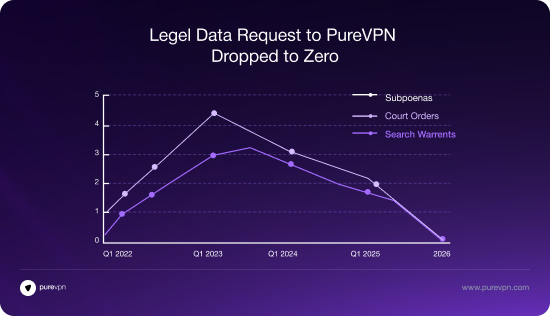
According to the report, the counts for the quarter stand as follows:
- Subpoenas: 0
- Court Orders: 0
- Search Warrants: 0
Why Legal Requests Declined
The company attributes this trend to its infrastructure design, which follows a strict “privacy by design” approach. This includes:
- No activity logs
- No connection logs
- No identifiable user records
- Only minimal operational data required to run the service
Because such data is not stored, there is effectively nothing to share when legal requests are made. Over time, repeated attempts yielding no useful data appear to have influenced the volume of future requests.
Operational Activity During Q1 2026
Beyond legal requests, the report also outlines the type and volume of activity handled across the network between January and March 2026.
Key figures include:
- Intellectual property takedown notices (P2P-related): 23,434
- Malware-related activity (botnets, scanning): 254
- DDoS attack attempts: 179
- Spam complaints: 87
- Phishing reports: 40
- Unauthorized access attempts (SSH/RDP): 27
- Emergency disclosure cases: 2
The company notes that most of this activity is automated, with bots and scanning systems continuously probing infrastructure. Reported DDoS and malware incidents were categorized as attempts rather than successful breaches.
Emergency disclosures were limited to two cases, both involving situations described as immediate threats to human life.
Handling of Complaints and Requests
The report also addresses how different types of complaints are managed:
- Intellectual property claims: These typically involve copyright or DMCA-related notices. The company states it has not acted on such requests due to the absence of user activity logs.
- Court orders: A historical total of 12 such requests has been recorded since 2021, with none fulfilled due to lack of stored data.
- Spam complaints: These relate to misuse of network IPs for sending unsolicited emails. No user data has been shared in response.
- Hack attempt reports: Similar to spam complaints, these involve misuse of infrastructure, but no user identification is possible under the current system.
Across all categories, the company maintains that its no-log policy prevents linking any activity to individual users.
What PureVPN Q1 Transparency Report Means for Users
While the zero-request figure stands out, the report notes that such outcomes are not guaranteed in future quarters. Legal environments and enforcement strategies can evolve, potentially affecting future data request volumes.
However, the Q1 2026 data serves as a benchmark, offering a snapshot of current conditions. It also reflects how system design, particularly the absence of stored user data, can influence external legal and regulatory behavior over time.
The report emphasizes that its goal is not to make long-term claims, but to present clear, periodic updates. For this quarter, the absence of legal requests remains a key highlight.
Related



Get expert insights on threats, breaches, scams, and security trends — delivered every Monday.
Most Popular





Get expert insights on threats, breaches, scams, and security trends — delivered every Monday.
Most Popular