How a Cline Vulnerability Exposed a Growing AI Agent Security Gap
Published on May 29, 2026

Question: Oasis described a browser-to-localhost-to-AI-agent exploit path in the Cline issue. How could attackers practically exploit that chain, and does it reveal a broader security problem with AI agents that rely on localhost services and trusted integrations?
Sagi Layani, Solutions Architect at Oasis Security:
The Cline exploit chain is built from old parts. Cross-origin WebSocket hijacking has been around for years. Localhost services without authentication, even longer. What's new is the sheer amount of power the "actor" at the end of the wire now possesses.
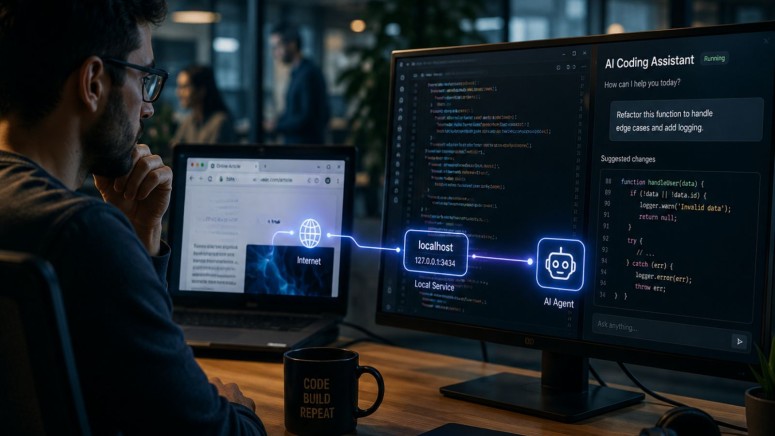
In the Cline issue, the design rested on a dangerous assumption: that only the local UI would ever connect to the local server. Because there was no Origin validation or session token, an attacker can bridge the gap from the public web to the developer's machine using the browser as a proxy.
- An attacker places a malicious script on a common developer destination, a Stack Overflow thread, a documentation clone, or even a Discord embed.
- When a developer visits that page, JavaScript opens a WebSocket to 127.0.0.1:3484.
- Since browsers don’t enforce CORS on WebSockets, the connection is established instantly.
- The server leaks the entire workspace: paths, repos, and full chat history.
- From there, the attacker simply waits for the developer to interact with the agent and injects a command into the terminal channel with a carriage return.
Because the agent has effective user-level access to the shell, a simple "missing check" on a local port becomes a full environment compromise. This reveals a massive structural problem: the erosion of the workstation perimeter.
AI coding tools are moving from isolated CLI workflows into browser-accessible local runtimes, making every "localhost trust" assumption a liability. Most organizations are currently blind to this risk.
These tools are adopted "bottom-up" by developers faster than security teams can inventory them. Once an attacker lands on an agent, the playbook is straightforward:
- exfiltrate cloud credentials
- establish persistence via a malicious MCP component, or
- modify the agent’s state to act as a permanent C&C beacon
The industry response is currently suffering from a severe asymmetry. A single researcher can find a flaw like this in hours, but remediation requires every developer to update their tools and every vendor to audit their IPC patterns. We are losing this race because we treat agents as simple IDE plugins rather than high-privilege actors.
Remediation requires more than a patch:
- It requires a structural shift in how we manage agentic identity
- Organizations must first inventory their agent footprint
- Most teams are currently blind to the high-privilege tools their developers have already installed
- We need to move toward a model where agents are strictly sandboxed and the "localhost is safe" myth is retired.
- Every local listener must require unique, ephemeral tokens, and access to sensitive resources must be gated by intent-based authorization.
- Instead of agents holding standing, long-lived credentials, they should be granted just-in-time access only when their specific intent matches a verified.
- Finally, every destructive action must be brokered through a non-bypassable "human-in-the-loop" gate.
We have to stop treating these tools as helpful assistants and start treating them as the high-privilege, autonomous actors they’ve become.
Related