



Axios Supply Chain Attack Linked to North Korea-Affiliated Hackers UNC1069 by Google
Published

Key Takeaways
- Attribution confirmed: Google Threat Intelligence Group attributes the Axios supply chain attack to North Korea-linked hackers, specifically the threat actor UNC1069.
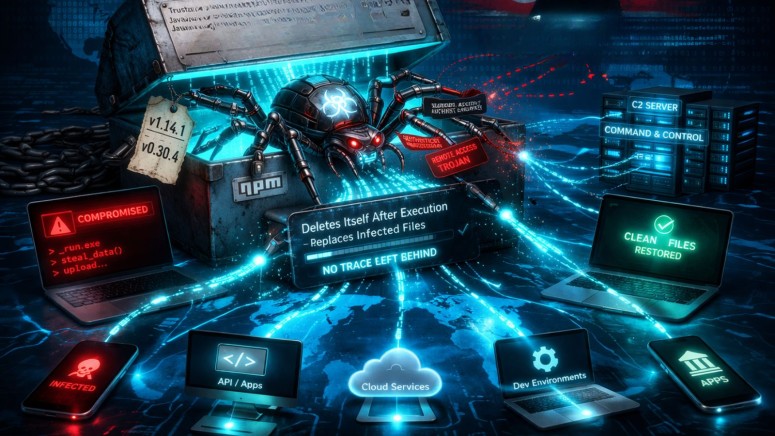
- Account hijacked: An npm compromise of the lead maintainer's account allowed attackers to inject a malicious dependency delivering a remote access trojan.
- Evasion tactics: The deployed malware automatically deletes itself after execution, replacing compromised files to evade detection and escalate global cybersecurity risks.
The Axios supply chain attack was formally attributed by Google Threat Intelligence Group (GTIG) to North Korea-linked hackers tracked as UNC1069. This highly sophisticated intrusion targeted the Node Package Manager (npm) ecosystem, compromising one of the most widely utilized JavaScript HTTP client libraries in the global software supply chain.
GTIG attributed this activity to UNC1069, a financially motivated North Korea-nexus threat actor tracked by Mandiant since 2018. Analysis of infrastructure artifacts used in this attack shows overlaps with infrastructure used by UNC1069 in past activities, including the use of WAVESHAPER.V2, an updated version of WAVESHAPER previously used by this threat actor.
Axios npm Compromise
The Axios breach occurred on March 31, 2026, when a compromised npm account injected the malicious plain-crypto-js package into Axios versions 1.14.1 and 0.30.4. This dependency functioned as a multi-stage payload, installing a remote access trojan (RAT) capable of executing arbitrary commands and exfiltrating system data across Windows, macOS, and Linux environments.
The core component, SILKBELL, in setup.js, dynamically checks the operating system to deliver platform-specific payloads that ultimately deploy variants of a C++ backdoor tracked by GTIG as WAVESHAPER.V2 targeting macOS, along with additional variants written in PowerShell and Python to target diverse environments.
The backdoor targeting macOS collects system information, enumerates directories, executes additional payloads, and connects to the C2 provided via command-line arguments, GTIG identified. WAVESHAPER.V2 acts as a fully functional RAT with the following capabilities:
- Reconnaissance: Extracts system telemetry, including hostname, username, boot time, time zone, OS version, and detailed lists of running processes.
- Command Execution: Supports multiple execution methods, including in-memory Portable Executable (PE) injection and arbitrary shell commands.
- File System Enumeration: Returns detailed metadata for the requested target directories by recursively traversing the file system.
Escalating Global Cybersecurity Risks
With Axios recording approximately 100 million weekly downloads, this incident severely amplifies global cybersecurity risks. Demonstrating advanced evasion capabilities, the malware was engineered to delete itself post-execution and replace the infected files with a clean version of the tool, effectively masking the intrusion.
TeamPCP (also known as UNC6780) recently poisoned GitHub Actions and PyPI packages associated with projects like Trivy, Checkmarx, and LiteLLM to deploy the SANDCLOCK credential stealer and facilitate extortion operations.
Hundreds of thousands of stolen secrets could potentially be circulating as a result of these recent attacks, said GTIG, adding that this could “enable further software supply chain attacks, software as a service (SaaS) environment compromises (leading to downstream customer compromises), ransomware and extortion events, and cryptocurrency theft over the near term.”
Software developers and network administrators must immediately audit their dependency trees, isolate affected hosts, and rotate any potentially exposed secrets or credentials to mitigate the risk of this severe network compromise, and then enforce strict version pinning and enhanced supply-chain monitoring.
In other recent news, a Mercor AI cyberattack was linked to the LiteLLM compromise, with Lapsus$ claiming the breach.
Related






Get expert insights on threats, breaches, scams, and security trends — delivered every Monday.
Most Popular

Get expert insights on threats, breaches, scams, and security trends — delivered every Monday.
Most Popular