
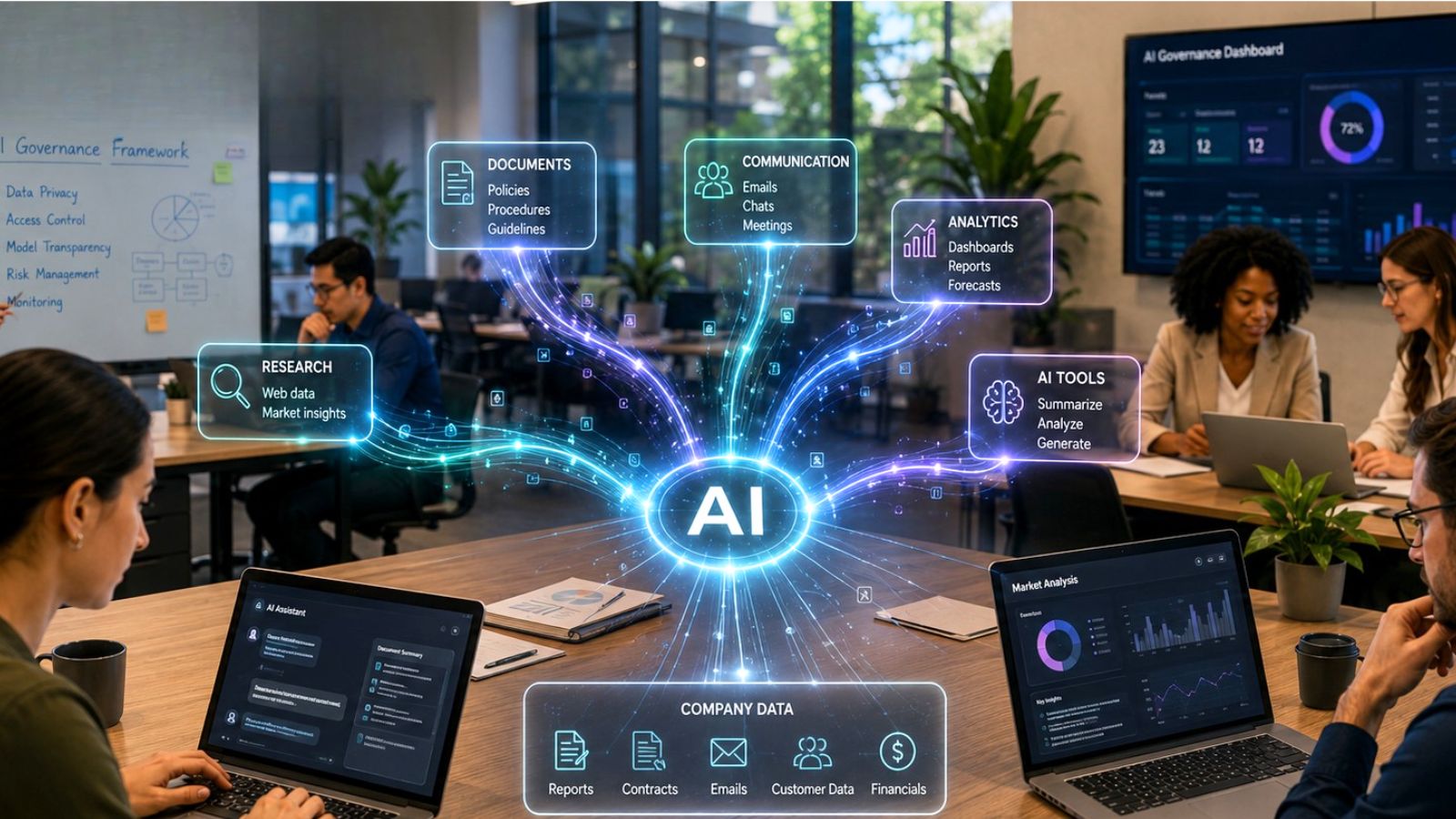
AI vs. AI: How Defensive Intelligence is Keeping Pace with AI-Powered Cyber Threats
Published


Artificial intelligence has changed the speed of cyber conflict. Attackers can now write convincing phishing emails in seconds, generate malicious code, identify vulnerable systems, and adapt their tactics in real time. What once took a criminal organisation weeks of planning can now be assembled in minutes, often by a single actor with no specialised skill.
The instinctive response from the security industry has been to frame this as an arms race: if attackers are using AI, defenders need better AI. Faster detection, faster correlation, faster response. And that instinct isn't wrong, exactly, but it's incomplete. It quietly accepts a premise that deserves more scrutiny: that resilience is primarily a question of who has the faster AI.
It isn't. Speed changes how quickly an attack unfolds. It doesn't change what determines whether that attack actually succeeds. That still comes down to fundamentals: how data is protected, how systems are architected, and how much an attacker gains even when detection fails. An organisation that wins the AI race but hasn't got those fundamentals right is still exposed. One that has them right can afford to lose the race occasionally and still hold the line.
AI Has Compressed the Timeline, Not the Stakes
Cyberattacks have evolved from isolated incidents into highly automated operations. AI lets adversaries conduct reconnaissance, personalise phishing campaigns, and probe enterprise networks continuously, without needing constant human input. Instead of broad, indiscriminate attacks, threat actors increasingly build campaigns tailored to a specific organisation, using publicly available information combined with generative AI to produce communications that read like legitimate business correspondence.
The bigger shift is speed of iteration. AI lets attackers modify malware, bypass static detection, and test multiple attack paths until one works, all within a timeframe that used to take days. Security teams relying on predefined rules or historical signatures are often left responding only after an attack has already progressed.
This is a real and serious change. But it's a change in tempo, not in the underlying nature of the problem. The vulnerabilities that get exploited (weak key management, flat network architectures, over-permissioned identities, unencrypted or poorly encrypted data) are largely the same vulnerabilities that existed before AI. AI just finds and exploits them faster.
Why "Better AI" Isn't a Strategy on Its Own
AI-native security platforms are genuinely useful. They continuously learn what normal behaviour looks like across users, devices, and networks, and flag the deviations that suggest credential misuse, lateral movement, or a previously unseen technique, correlating signals across thousands of events that would be invisible to a human analyst working alert by alert. In many cases, they can automate the first steps of response: isolating an endpoint, restricting an identity, blocking traffic, all before a person has finished reading the alert.
The problem is what this buys you: time, not immunity. Detection-and-response, however fast, is still a reactive posture: it operates in the gap between compromise and containment. AI can shrink that gap dramatically, but it can't close it to zero, and an attacker only needs the gap to be non-zero once. Treating faster detection as the finish line encourages organisations to keep pouring investment into the race itself, rather than asking a more useful question: what happens if the attacker gets through anyway?
Resilience Is Built Underneath the Race, Not Inside It
That question is where fundamentals come back in, and where I think the industry conversation has gone quiet, because it's a less exciting story than "AI versus AI."
Take encryption. Most detection tools are built to catch an attacker in the act: moving laterally, exfiltrating data, escalating privileges. But if the underlying data is protected by strong, well-implemented encryption, a lot of that activity becomes worthless to the attacker even when it succeeds. Static keys and predictable key-exchange protocols are exactly the kind of fixed, discoverable target that AI-driven reconnaissance is good at finding. A real-time, keyless approach, where a unique key is generated per packet, with nothing persistent to intercept or reverse-engineer, removes that target altogether. It doesn't matter how fast the attacker's tooling is if there's no reusable key sitting at the end of the trail.
The same logic applies more broadly. Zero-trust architecture, minimised attack surface, secure-by-design systems, rigorous identity and access controls: none of this is new or fashionable, and none of it depends on machine learning. But it determines the ceiling on how much damage a fast, AI-assisted attacker can actually do once they're inside. Detection buys time. Fundamentals determine what that time is protecting.
Enterprise environments have also become far more complex (cloud platforms, remote workforces, IoT and OT deployments, interconnected supply chains), and every connected device, application, and API expands the attack surface. AI-driven detection helps organisations cope with the resulting volume of telemetry. It does nothing to reduce the size of that surface in the first place. That's an architecture problem, not a speed problem, and no amount of faster AI solves it.
Putting the Two Together
None of this is an argument against AI-powered defence. Used well, it is a genuine force multiplier: it compresses the window attackers can operate in, reduces the burden on human analysts, and lets security teams focus on judgement calls instead of triage. Human expertise still matters enormously: understanding business context, investigating complex incidents, and countering the social engineering that AI can't fully replicate.
But AI-driven detection should be understood as a layer that sits on top of a resilient architecture, not a substitute for one. The organisations that will hold up best against AI-powered attackers aren't necessarily the ones with the fastest detection stack. They're the ones that have paired that speed with the fundamentals that determine what an attacker actually gets if they win a given round: strong encryption, minimised attack surface, and systems designed to fail safely rather than catastrophically.
The AI arms race will keep accelerating, and defenders have to keep pace with it. But resilience was never really about winning that race. It's about making sure that even losing a round doesn't cost you very much.
Disclaimer: This article is part of the TechNadu Contributor Network and was written by an external expert. The views, opinions, and analysis expressed are solely those of the author and do not necessarily reflect the position of TechNadu or the author's affiliated organization. The author is responsible for the accuracy of facts, citations, and claims made in this article. No compensation was exchanged for publication. TechNadu reviews submissions for clarity, neutrality, and editorial standards. Learn more about contributing.
Related






Get expert insights on threats, breaches, scams, and security trends — delivered every Monday.
Most Popular


Get expert insights on threats, breaches, scams, and security trends — delivered every Monday.
Most Popular