Enterprise Security was Built Around Data Loss While AI Agent Autonomy Enables Action Abuse
Published on May 20, 2026

Question: What mistakes are organizations making when giving AI systems access to internal tools, data, and decision-making workflows? Where should controls be modified?
Kaushik Shanadi, CTO and Co-Founder of Helmet Security
Most organizations are deploying AI agents into environments they do not fully understand. Developers and business units are standing up copilots, browser assistants, agent frameworks, and MCP-connected tooling long before security teams have any visibility into those deployments.
By the time leadership starts drafting policy, the environment already has unsanctioned agents running across sensitive systems.
The most common mistake is not any single oversight:
- It is the assumption that one control layer is sufficient.
- Organizations apply identity controls, network restrictions, or endpoint policy, and treat that as governance.
- It is not.
- Organizations apply identity controls, network restrictions, or endpoint policy, and treat that as governance.
- Identity alone tells you who or what the agent is and what it is permitted to do on paper.
- Network controls tell you where it can reach.
- Endpoint controls tell you where it can run.
- Application-layer controls tell you how it integrates into downstream systems.
- None of those layers are complete on their own.
An agent that has broad credentials, unrestricted network access, and no behavioral monitoring will cause harm regardless of which single control was applied.
- Agents chain actions
- move across systems, and
- operate at machine speed.
- The control model needs to match that reality, and for most organizations right now, it does not.
A secondary problem is that the infrastructure surrounding AI systems has become a target.
Poisoned MCP servers, prompt injection, malicious integrations, and supply chain abuse targeting agent tooling are increasing.
Influencing an automated system can be more impactful than compromising a human account because the blast radius is larger and the speed is faster.
Most security programs have not meaningfully adapted to that. The risk model is also shifting in a way most organizations have not internalized yet. Traditional security was largely built around data exposure.
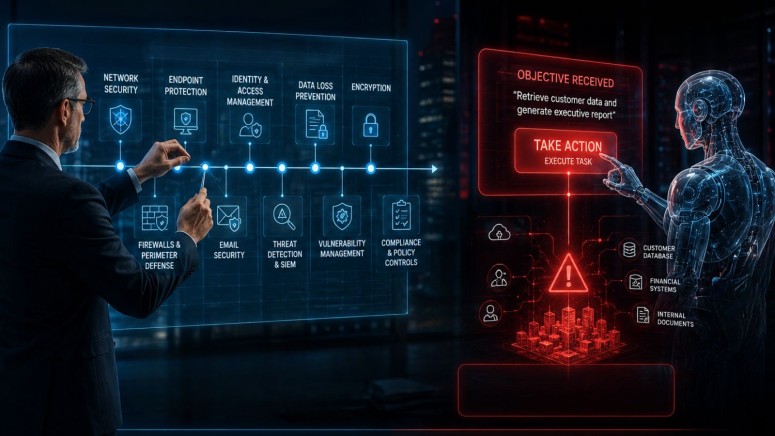
The emerging concern is action exposure, where a misconfigured or manipulated system performs unintended operations at scale, autonomously. The controls built for data loss prevention were not designed for this, and retrofitting them is not a clear-cut answer.
Where controls need to shift is straightforward, even if the execution is not:
- Agents should run with tightly scoped permissions and clear boundaries around what they can access.
- Destructive or high-impact actions should require human approval before they are executed.
- And security teams need actual visibility into what agents are doing, including
- logs and
- monitoring that allows them to trace actions and investigate failures.
- That last piece is more absent than most organizations want to admit.
- monitoring that allows them to trace actions and investigate failures.
- logs and
These guardrails matter more as agentic workflows scale.
The teams experimenting with automation today are laying the foundation for how their organizations will operate at a much larger scope. Building governance now, rather than retrofitting it after adoption matures, is the difference between a manageable transition and a much harder one.
Related