


Inside the Innovation-First Mindset That Gives Attackers the Speed to Leave Static Defenses Behind
Published on December 8, 2025

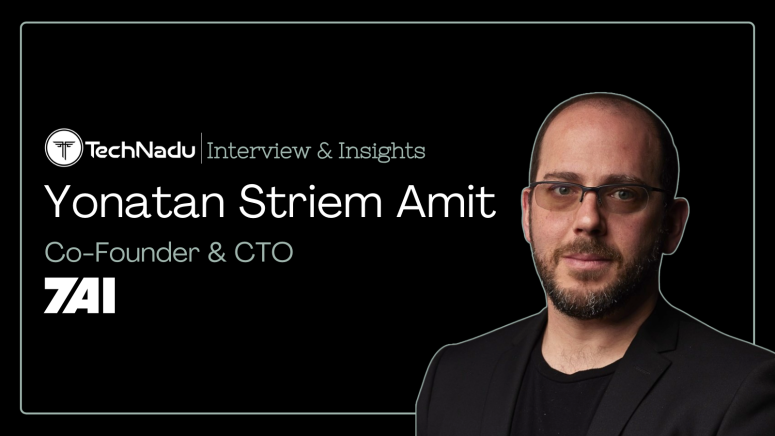
Yonatan Striem Amit, Co-Founder and CTO at 7AI, shares how attackers outthink defenses by exploiting system behavior and rapid learning loops. He explains why agentic AI impacts detection, response, and threat evolution.
Amit brings deep technical and leadership experience shaped by years of building Cybereason’s architecture, leading engineering at Gita Technologies, and serving in an elite IDF unit.
His insights frame a sharper view of today’s offensive landscape and warn that attackers aren’t just breaking in because the systems are weak. Attackers have adopted an innovation-first mentality.
Vishwa: Attackers often breach systems that defenders spend years developing. From your perspective, what does this say about how attackers understand functionality?
Yonatan: Attackers aren’t just breaking in because the systems are weak. They’re really good at reverse-engineering defensive architectures to find unintended behaviors or overlooked paths.
The truth is, both sides—attackers and defenders—do best when they drop the checklists and just get curious.
Dynamic reasoning and a willingness to chase anomalies make all the difference. That creativity leads attackers to discover hidden vulnerabilities, and defenders who work the same way can spot threats that no rulebook would catch.
The key is transforming security into a proactive discipline, where adaptation and problem-solving are central for both sides of the cyber equation.
Vishwa: What does the speed with which attackers adapt to new defensive technologies reveal about their learning loops? How can defenders shorten that gap?
Yonatan: The agility of attackers in bypassing new defenses highlights the rapid learning such advanced hacking organizations undertake. New tools and exploits are picked up, shared, and tested across their communities almost overnight.
Defenders, OTOH tend to be much more static, often taking years to adapt their tools and move away from static checklist style approaches.
Closing the gap requires a mindshift change: Using agentic AI platforms that actually learn from every encounter and focus only on real threats.
Security shouldn’t just follow scripts but be able to react and adapt as fast as the challenges evolve. That’s what lets defenders work on real problems, not just grind through routine manual tasks.
Vishwa: Where are attackers acquiring the knowledge and technical fluency needed to exploit cutting-edge systems so quickly, according to your observation? What incentives drive that level of continuous learning?
If you put those ingredients together, you get a pace of experimentation and improvement that’s hard for traditional security teams who are stuck in alert fatigue, compliance or process to match.
This is clearly evident by the speed in which attackers are adopting the latest AI development.
Vishwa: From your perspective, how has AI evolved in the past two to three years, both in its capability to defend and in ways organizations can use it?
Yonatan: AI in security has moved way past simple automation. Today, our agentic systems actually investigate, triage, and handle threats from start to finish, without needing a human to step in at every stage.
What makes this work is having teams of AI agents that can collaborate, pull data from all kinds of environments, and get smarter with every decision. It’s nothing like the old rule-based detection and response.
Modern platforms are built on context, dynamic reasoning, and always learning from what’s happening right now. That’s what lets security teams solve the tough problems and create strategies that keep up with real-world threats.
Vishwa: As AI becomes embedded in every stage of detection and response, can it move beyond filtering alerts to transforming the decision-making process in the SOC? What does that evolution look like to you?
Yonatan: AI agents today are handling a lot more than just cleaning up basic alert noise. They’re automatically remediating threats, making real recommendations, investigating what’s behind suspicious activity, and automating contextual decisions—all without overwhelming analysts with a flood of needless alerts.
The difference is that agentic platforms now run dynamic analyses and make conclusions with clear explanations in exponentially less time.
This is a huge win for defenders who can now chase down leads and follow signals instead of living inside rigid playbooks. That shift lets the SOC move from manual grind to smarter, high-level orchestration where complex problem-solving makes a real impact.
Vishwa: Many data pipelines are optimized for volume rather than relevance. What do you think about it, and what needs to change in how security teams collect and filter data for AI systems?
Yonatan: Legacy security architecture is focused on data centralization, using an age-old assumption that our analysts need all the data at our disposal, normalized and centralized, in order to drive detection and response.
This narrative has served the security industry well; as log volume increased so did the costs of SIEMs, leading many security teams to ask to cut data volumes. In contrast, AI systems can natively speak with all the complex data systems, log sources, and security controls an enterprise has.
This means that for an AI-native SOC, a federated data approach can allow an AI agent to “go to the data” and allow security teams to put the data where it’s most cost-effective. That shift is what lets defenders stay on top of the real threats and make better decisions using all the data at their disposal.
Vishwa: Agentic AI is becoming a major conversation in cybersecurity. What new forms of autonomy or risk will define the next generation of defensive AI?
Yonatan: The next wave is defined by proactive learning and autonomous action—agentic AI operates independently, making decisions and addressing threats without human prompts.
This radical autonomy means defenders shift from operators to “AI shepherds,” guiding and supervising agent intelligence. However, risks include erroneous escalation, adaptation to adversarial input, and ensuring transparent governance so that AI systems remain accountable and safe.
Ultimately, agentic AI will expand the creative and strategic space for defenders, but continuous oversight and environment-specific reasoning will be key to mitigating new risks.
The next wave is defined by proactive learning and autonomous action. We need platforms that cut out distractions and find the real risks, bring those to the front, and let everything else go.
Progress means dropping old batch processing and moving to live, connected views that track what’s happening right now across every system. That’s the way defenders stay sharp and make decisions that move the needle.
Related



Get expert insights on threats, breaches, scams, and security trends — delivered every Monday.
Most Popular




Get expert insights on threats, breaches, scams, and security trends — delivered every Monday.
Most Popular