When you purchase through links on our site, we may earn an affiliate commission. Here’s how it works.
5 Best VPNs Outside 5 Eyes, 9 Eyes, and 14 Eyes Countries in 2026


Our experts have reviewed 53 VPN providers, which were put through extensive rounds of testing. To learn more about that process, here’s how we review VPNs, where we explain our criteria and our policy of being fully transparent.
The 5/9/14 Eyes Alliance is a group of countries that openly share surveillance data with each other in the name of “national security,” which usually means bulk collection of people’s online activity. If a VPN is based in one of these countries, it can be pressured to log data or hand over whatever it has.
Just being “outside 14 Eyes” doesn’t automatically mean a VPN is safe, nor does being inside automatically make it unsafe; what truly matters is a combination of factors: the jurisdiction the VPN operates under, the ownership and transparency of the provider, whether the VPN’s no-logs claims have been independently audited, and any past incidents or confirmed data sharing that reveal the provider’s real-world privacy practices.
This comprehensive view is essential to judge a VPN’s trustworthiness beyond just its geographic or legal status. Independent audits and a clean privacy track record provide stronger confidence in a VPN’s ability to protect user data.
In this guide, you’ll see the best VPNs that sit outside the 14‑Eyes countries and also look good in our sheet, plus a few “honest exceptions” that are technically in 5/9/14 Eyes but backed by strong no‑logs evidence. You’ll also learn how to read the sheet so you can quickly check your current VPN, avoid the noisy marketing claims, and pick something that actually fits your threat model.
Why and How We Built This Sheet (And Why You Can Trust It)
We made this sheet to help you easily compare privacy and security info for more than 40 VPNs. Instead of hunting through complicated websites or ads, you get all the important facts lined up in clear columns. Each column tells you something important about the VPN, so you can quickly see if it’s safe or risky.
Here’s what some of the key columns mean:
- Country of Incorporation: This is just the country where the VPN company is officially registered. It matters because the laws there decide how much a government can spy on your VPN usage or force the company to share your data.
- Member of 5/9/14 Eyes Alliance: Some countries are part of groups that share intelligence info with each other (like 5 Eyes, 9 Eyes, or 14 Eyes). If your VPN is in one of these countries, your data might be more exposed to those governments.
- Parent Company: Many VPN brands are owned by bigger companies. Knowing who owns them is important because sometimes these parent companies might have other products or histories that affect your privacy.
- Independent No-Logs Audit: This shows whether a trusted third party checked if the VPN really doesn’t keep logs of your online activity, which is key if you want real privacy.
- Number of Audits and Auditors: How many times a VPN was tested and by which companies (like PwC or Deloitte) so you know the tests aren’t just one-time marketing stunts.
- Confirmed Data Sharing? Incident Details: If a VPN has ever handed over user data to authorities or in investigations, we note that too, so you get the full picture.
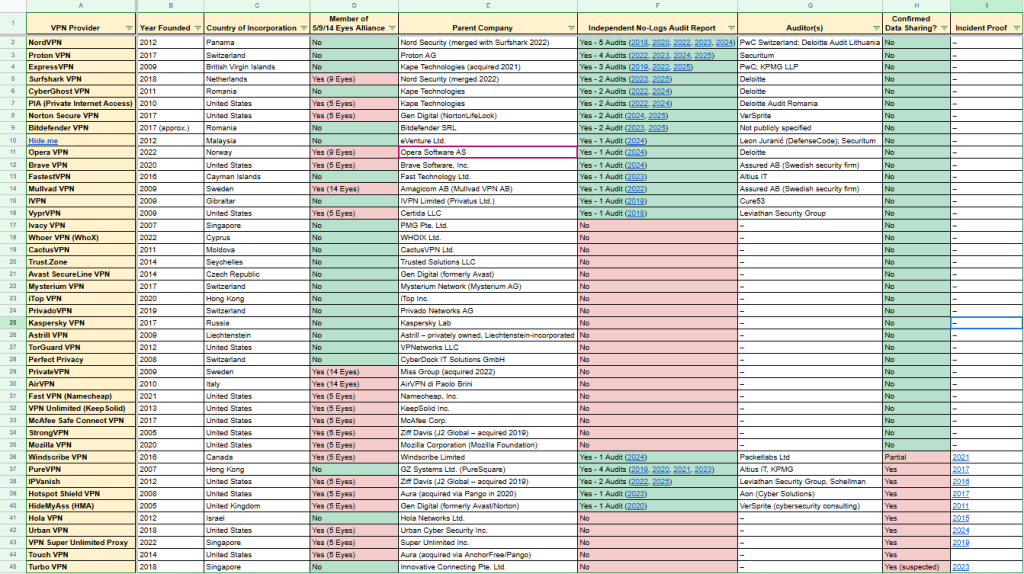
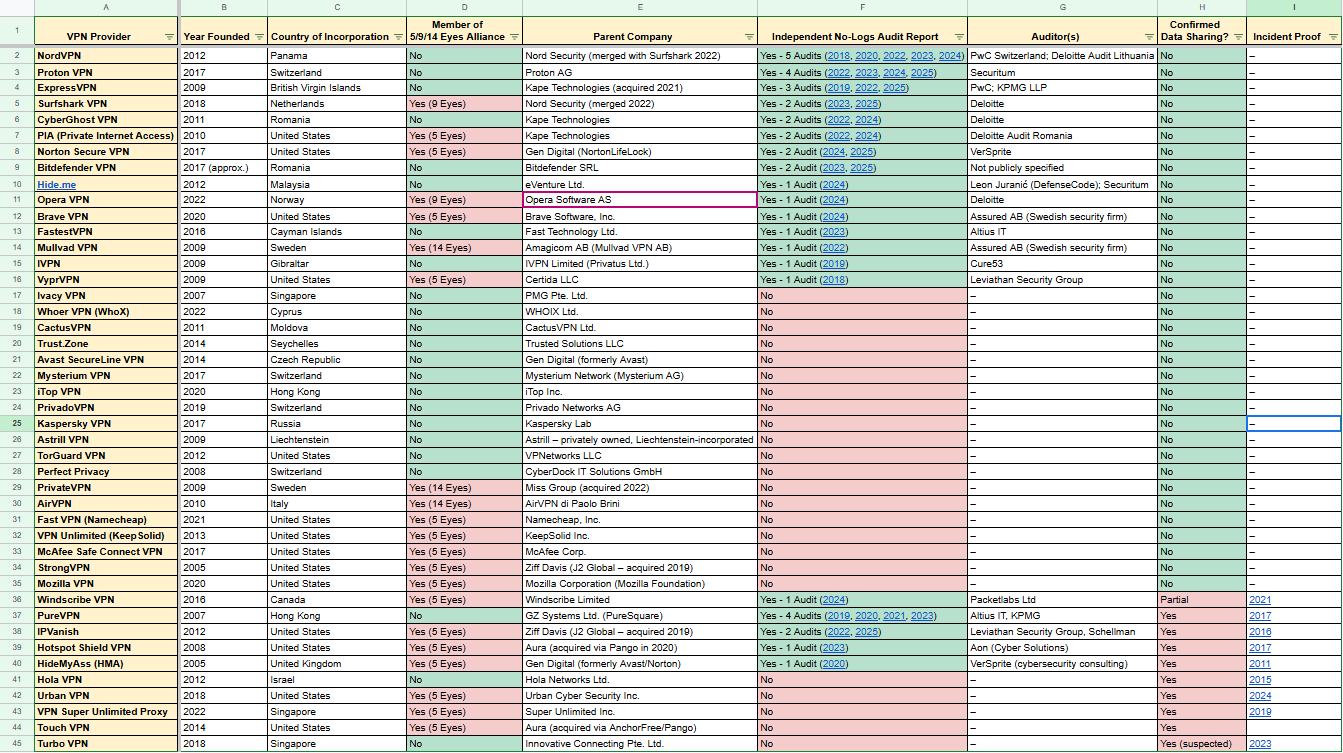
We put all this info together by carefully checking official documents, audit reports, and VPN websites. So when you look at this sheet, you’re seeing real, verifiable facts that help you decide which VPN you can trust.
Oh, and one more thing about the sheet, you’ll see different colors in the columns. Those colors aren’t just decoration; they actually mean something important, but the meaning changes depending on which column you’re looking at. Let's understand it:
- For the Member of 5/9/14 Eyes Alliance column:
- Green means the VPN’s country is not part of these spy alliances (marked “No”). This is better for privacy.
- Red means the VPN’s country is part of these alliances (marked “Yes”), which can mean higher surveillance risk.
- For Independent No-Logs Audit Report column:
- Green means the VPN has an independent audit proving it doesn’t keep logs (marked “Yes”), with audit years and links shown for transparency.
- Red means the VPN has no independent audit to back its no-logs claim (marked “No”), so you have to take their word for it.
- For Confirmed Data Sharing? column:
- Green means the VPN has never shared user data with authorities or others (marked “No”), which is good for privacy.
- Red means the VPN has shared user data before (marked “Yes”), which is a strong warning sign.
These colors act like a quick traffic light system so you can instantly see which VPNs are safer choices and which ones might put your privacy at risk. Green is good, red is bad, and this gives you confidence to quickly pick a VPN that fits your privacy needs.
Understanding the 5, 9, and 14 Eyes Alliances – What You Need to Know
The 5, 9, and 14 Eyes are closely related intelligence-sharing alliances. They started as secret partnerships during and after World War II and evolved over decades into powerful global surveillance networks. Each alliance groups a set of countries that legally agree to collect, share, and exchange signals intelligence (SIGINT) and communications data, often bypassing individual privacy protections by outsourcing surveillance to partner countries.
Here’s what makes each alliance unique, along with their privacy downfalls:
Think of the 5, 9, and 14 Eyes not as completely separate entities, but as layers in a growing surveillance network. Each time more countries join (from 5 to 9 to 14), the scope of intelligence sharing and cooperation widens.
This means if your VPN is based in a 14 Eyes country, it’s potentially subject to all the surveillance laws and agreements in the 5 Eyes and 9 Eyes countries too, since these alliances regularly exchange data with each other. So, your data could be exposed in multiple jurisdictions, even if your VPN tries to promise privacy.
That’s why, in our VPN sheet, we not only mark alliance membership but also include details like independent no-logs audits and parent company ownership. These elements help you judge whether a VPN based in an Eyes country still offers strong privacy protections, or whether you should look elsewhere.
Bottom line? The 5, 9, and 14 Eyes alliances form a growing global surveillance network. More countries mean more places where your online activity could be monitored or data collected. If your VPN is based in one of these countries, your privacy may be at risk despite promises. That’s why our sheet also checks independent no-logs audits and parent company ownership, so you can see which VPNs truly protect your privacy and which ones might not. This helps you make an informed choice instead of relying on marketing claims.
No-Logs VPNs in Eyes Countries: Why Audits Matter (and What to Watch Out For)
Now that we understand the privacy risks posed by the 5, 9, and 14 Eyes alliances individually and cumulatively, let’s clarify a big question many of you have asked:
If a VPN is based in one of these alliances but has an independently audited no-logs policy, can you trust it? And is the flip side true - are VPNs outside these alliances automatically safer if they don’t have audits?
What Does “No-Logs” Actually Mean?
No-logs VPN provider doesn’t store any data that links your online activity back to you. This includes IP addresses, browsing history, connection timestamps, and more. When a VPN says it has a no-logs policy, it’s a big deal, but it’s easy to claim and hard to prove without external checks.
The Role of Independent Audits
The best VPNs go beyond words and invite reputable third-party security firms to audit their no-log claims. These audits involve inspectors reviewing server setups, software, and operational practices to confirm no user data is retained or available for government insiders. Regular audits from companies like PwC, Deloitte, or Cure53 add real credibility to a VPN’s privacy promises.
No-Logs in 5/9/14 Eyes: Does Jurisdiction Override Audits?
It doesn’t have to. If a VPN:
- Publishes its audit reports transparently
- Has multiple, recent audits showing zero data retention
- Uses technical measures like RAM-only servers to erase data quickly
- Demonstrates real-world resistance to government data requests (via court outcomes or transparency reports)
then being in an Eyes country doesn’t automatically mean your privacy is compromised. These audits essentially act as a watchdog against unlawful data handing.
What About Non-Eyes VPNs Without Audits?
Being outside an Eyes jurisdiction sounds safer, right? Sometimes, but not always. Many VPNs outside these alliances skip audits and quietly log connection data, sell usage stats, or share data behind the scenes. No audits mean no proof, which is a risk by itself. Our sheet highlights these details so you’re not left guessing.
- No-logs audits are your best evidence that a VPN keeps your data private, even if it’s based in a surveillance-heavy alliance.
- Jurisdiction is important but only one piece of the puzzle alongside parent company, logging practices, and technical setup.
- Always check the combined picture in our sheet including jurisdiction, audit history, and logging behaviour to pick a VPN that actually matches your privacy needs in 2025.
This understanding is crucial for making smart decisions and shouting louder than marketing hype.
How to Use Our VPN Sheet Like a Pro (A Clear, Step-by-Step Breakdown)
When you first open the sheet, it can feel like information overload - jurisdictions, audits, parent companies, logging matrices, founding years, and more. But once you know how to read it strategically, the entire sheet becomes extremely easy to navigate.
To help you understand the logic behind every column and how to interpret it, we’ve broken down the process using two deliberately chosen VPNs: NordVPN and PrivateVPN.
Why these two? Because they represent sharp opposites. By comparing extremes, you’ll instantly understand how the sheet highlights strengths and weaknesses, and how you can use the same approach for any VPN listed.
Let’s walk through the sheet column-by-column using these two VPNs as examples.
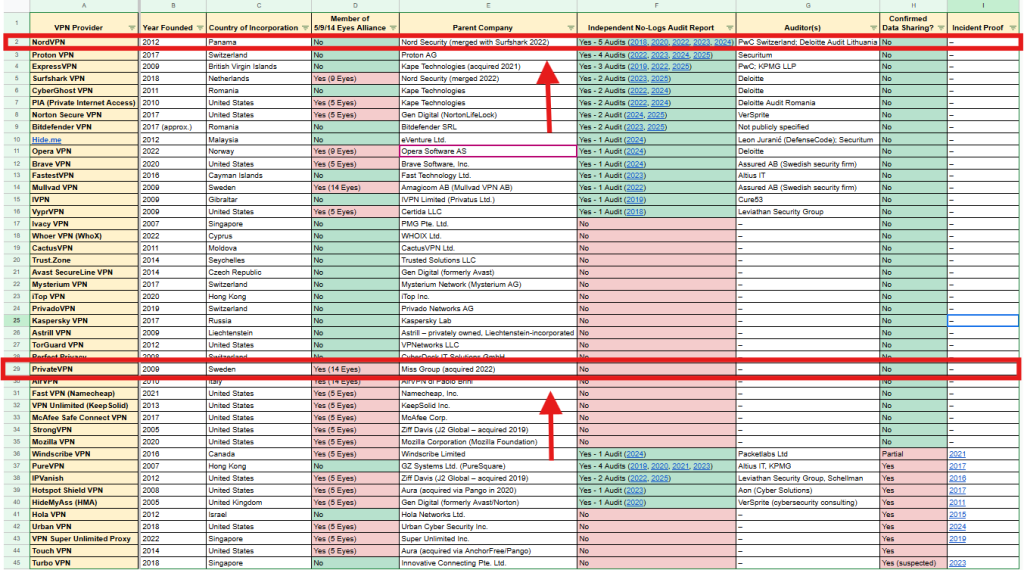
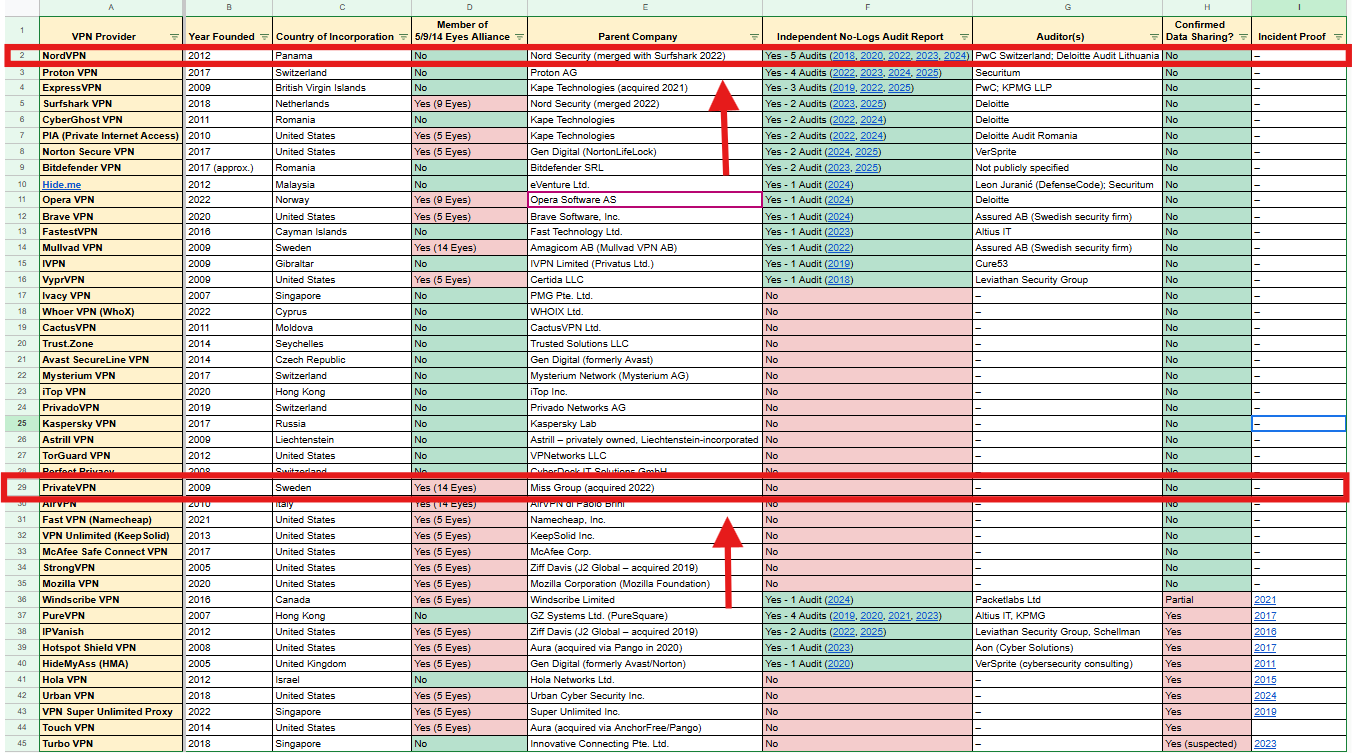
Step 1: Jurisdiction (Country of Incorporation & Member of 5/9/14 Eyes Alliance)
The first thing the sheet reveals is where the VPN is legally headquartered. This matters because the country determines what laws apply, including:
- data-retention requirements
- intelligence-sharing participation
- whether VPNs can be forced to log user data
- whether gag orders can hide these demands
What this teaches you: NordVPN has an upper hand over here since it is based in a privacy-focused jurisdiction, unlike PrivateVPN, which is from a country that is a part of an alliance. Therefore, always check where your VPN is based before anything else, jurisdiction sets the tone for everything that follows.
Step 2: Check the Parent Company
The sheet lists the parent company because ownership affects:
- transparency
- corporate ethics
- potential data monetization
- overall accountability
NordVPN’s parent company is well-known, transparent, and privacy-focused, whereas PrivateVPN’s owner, Miss Group, lacks the same clarity and specialization. This shows why it’s crucial to know who actually runs the VPN. Ownership affects trust just as much as the product itself.
Step 3: Independent No-Logs Audit & Auditor
Audits are one of the most important parts of the sheet. This column shows:
- whether a VPN has been audited
- how many times
- when
- by which security firms
NordVPN offers multiple verified audits from top-tier firms, while PrivateVPN has none. This clearly shows that audits are your only real proof that a VPN’s “no-logs” claim is true. If a VPN has no audits, your privacy depends entirely on blind trust, something you should avoid.
Step 4: Past incident of Sharing Data
In this part, we researched whether there has been a past episode where the VPN company might have shared the information/data logs with other companies. Let’s have a look:
Both NordVPN and PrivateVPN have a clear chit here. Neither of them has ever reported any incidents related to the leak of data. This is an absolute good thing.
Step 5: Put Everything Together
Using the sheet properly means evaluating all factors at once, not in isolation.
- NordVPN Summary
✔ Privacy-friendly jurisdiction
✔ Multiple strong audits
✔ Transparent, privacy-focused parent company
✔ Minimal logs in matrix
✔ No incident of data sharing in the past
👉 Result: A strong, well-verified VPN with low privacy risk.
- PrivateVPN Summary
✘ Located in a 14 Eyes country
✘ No independent audits
✘ Parent company lacks privacy specialization
✘ Shows potential logs
✔ No incident of data sharing in the past
👉 Result: Higher privacy risks with weaker assurances.
Bottom Line: NordVPN excels across jurisdiction, audits, ownership, and logging transparency, while PrivateVPN repeatedly falls on the riskier side of each category. This makes it clear that no single factor determines VPN safety. You must look at all elements together to get the full privacy picture.
Best VPNs Outside 14 Eyes Alliance - Based on Our Sheet
When people ask "what's the best VPN outside 14 eyes alliance," the answer is NordVPN, ProtonVPN, ExpressVPN, Surfshark, and CyberGhost, the strongest performers on our sheet by strict criteria like jurisdiction, audits, ownership, and no data-sharing incidents.
But before looking at the VPNs, it’s important to understand why these specific providers appear in this section. We didn’t choose them because they are popular, heavily marketed, or “top-rated” elsewhere. We selected them for one simple reason:
They are the strongest performers on our sheet when filtered through strict, measurable criteria, nothing more.
To avoid bias or guesswork, we applied the same filters across all VPNs in our jurisdiction sheet:
Let's have a look at the top 5 picks:
- NordVPN – Founded in 2012 and based in Panama (outside 14 Eyes) • Has 5 independent no-logs audits (2018, 2020, 2022, 2023, 2024) by PwC Switzerland and Deloitte Audit Lithuania • Owned by Nord Security (merged with Surfshark in 2022) • No confirmed data sharing.
- ProtonVPN – Founded in 2017 and based in Switzerland (outside 14 Eyes) • Has 4 independent no-logs audits (2022, 2023, 2024, 2025) by Securitum • Owned by Proton AG • No confirmed data sharing.
- ExpressVPN – Founded in 2009 and based in the British Virgin Islands (outside 14 Eyes) • Has 3 independent no-logs audits (2019, 2022, 2025) by PwC and KPMG LLP • Owned by Kape Technologies (acquired 2021) • No confirmed data sharing.
- Surfshark – Founded in 2018 and based in the Netherlands (9 Eyes jurisdiction) • Has 2 independent no-logs audits (2023, 2025) by Deloitte • Owned by Nord Security (merged 2022) • No confirmed data sharing.
- Cyberghost – Founded in 2011 and based in Romania (outside 14 Eyes) • Has 2 independent no-logs audits (2022, 2024) by Deloitte • Owned by Kape Technologies • No confirmed data sharing.
1. NordVPN
NordVPN is pretty much a crowd favorite, and it’s no surprise why when you dig into its privacy pedigree, operating from Panama with five independent no-logs audits and RAM-only servers..
- Is NordVPN part of the 5/9/14 Eyes Alliance? No. NordVPN operates from Panama, a country fully outside the 5, 9, and 14 Eyes surveillance networks. Panama has no mandatory data retention laws and no intelligence-sharing pacts, making it one of the safest jurisdictions for a privacy service.
- Who owns NordVPN, and is the ownership privacy-safe? NordVPN is owned by Nord Security, a transparent and privacy-focused company now headquartered in the Netherlands. Nord Security merged with Surfshark in 2022 and acquired AtlasVPN, forming one of the most security-oriented VPN groups while keeping both brands independent.
- How many independent no-logs audits has NordVPN undergone? Five independent audits (2018, 2020, 2022, 2023, 2024) by PwC Switzerland and Deloitte Audit Lithuania.
- Who conducted the audits and what were the key findings?
- 2018 & 2020 PwC Audits: Confirmed NordVPN’s strict no-logs policy, verifying no IP addresses, connection timestamps, or traffic data were stored.
- 2022 Deloitte Audit: Examined multiple server types (standard, Double VPN, Onion over VPN, P2P) and confirmed the VPN’s configuration aligned with its no-logs claims.
- 2023 Deloitte Audit: Included detailed interviews and infrastructure inspection, reaffirming no logs were stored or accessible.
- 2024 Deloitte Audit: The latest comprehensive review again verified that servers do not store any logs and data privacy controls are correctly implemented.
- What do the audits conclude? The audits confirm NordVPN keeps no user connection logs, including IP addresses and timestamps, verifying its strict no-logs policy.
- Are there any past incidents affecting NordVPN’s privacy trust? In 2019, NordVPN disclosed a security breach involving a third-party data center; however, no user activity or logs were exposed due to the no-logs infrastructure and RAM-only servers.
- Does NordVPN use RAM-only servers? Yes, it uses RAM-based servers, which means data is not stored physically and is wiped on reboot for better privacy.
To explore its features, pricing, and more, visit our detailed NordVPN review page.
PROS
- Based in Panama, outside 5/9/14 Eyes alliances.
- Five independent no-logs audits confirming privacy.
- Transparent, privacy-focused ownership by Nord Security.
- Uses RAM-only servers to wipe data on reboot.
CONS
- None.
2. ProtonVPN
ProtonVPN rolls from the privacy-loving country of Switzerland, widely respected for its strong privacy protections and a total “no friends” policy with the Five, Nine, and Fourteen Eyes alliances.
- Is ProtonVPN part of the 5/9/14 Eyes Alliance? No. ProtonVPN is headquartered in Switzerland, which is outside the 5, 9, and 14 Eyes alliances. Switzerland has some of the world’s strongest privacy protections, giving ProtonVPN a solid legal foundation for user privacy.
- Who owns ProtonVPN, and is the ownership privacy-safe? ProtonVPN is operated by Proton AG, which is majority-owned by the nonprofit Proton Foundation. This nonprofit ownership ensures that privacy and transparency remain the top priorities, rather than profit-driven motives.
- How many independent no-logs audits has ProtonVPN undergone? Four independent audits were performed in 2022, 2023, 2024, and 2025 by the security firm Securitum.
- Who conducted the audits and what were the key findings?
- 2022 Securitum Audit: Confirmed no user activity logging or metadata storage. Verified strong administrative and technical controls reinforcing no-logs compliance.
- 2023 Securitum Audit: Included detailed server and infrastructure reviews plus staff interviews. Maintained full compliance with no-logs policies despite recent changes and added features.
- 2024 Securitum Audit: Verified no logging on VPN servers, effective privacy management, and no evidence of data retention. Recommended continued annual audits to sustain privacy standards.
- 2025 Securitum Audit: Confirmed ongoing full compliance with no-logs policy under the most current product configuration, validating user privacy protections.
- Do these audits guarantee permanent privacy? The audits certify compliance during assessment periods, but continuous operation requires ongoing controls beyond audits. Some rented servers may have full disk encryption for added protection.
- Does ProtonVPN use RAM-only servers? No, ProtonVPN does not use RAM-based servers. It believes full-disk encryption achieves the same security benefits as RAM-only servers.
ProtonVPN’s legal foundation and audit track record make it a solid choice for privacy-conscious users. For more about its features and pricing, check out our in-depth Proton VPN review.
PROS
- Switzerland-based, outside Eyes alliances with strong privacy laws.
- Four independent audits affirming the no-logs policy.
- Nonprofit ownership prioritizes privacy over profit.
CONS
- Does not use RAM-Only servers
3. ExpressVPN
ExpressVPN is has long been a heavyweight in the VPN world, and a big reason for that is its blend of privacy and transparency.
- Is ExpressVPN part of the 5/9/14 Eyes Alliance? No. ExpressVPN is headquartered in the British Virgin Islands (BVI), a privacy-friendly jurisdiction outside the 5, 9, and 14 Eyes alliances. This location helps protect user data from mandatory logging or intelligence-sharing requirements.
- Who owns ExpressVPN, and is the ownership privacy-safe? ExpressVPN has been owned by Kape Technologies since 2021. Despite being part of a larger parent company, ExpressVPN continues to operate independently and maintains strict privacy standards to safeguard users.
- How many independent no-logs audits has ExpressVPN undergone? Three independent audits performed in 2019, 2022, and 2025 by PwC and KPMG LLP.
- What did each audit conclude?
- 2019 PwC Audit: Verified that ExpressVPN does not store user connection logs, IP addresses, or browsing data.
- 2022 KPMG Audit: Reviewed server configurations and privacy controls, confirming ExpressVPN complies with its no-logs policy.
- 2025 KPMG Audit: Confirmed ongoing adherence to no-logs policies with comprehensive infrastructure assessment and procedures review.
- Do these audits guarantee permanent privacy? Audits confirm compliance during assessment but rely on continued operational standards afterward.
- Does ExpressVPN use RAM-only servers? Yes, all ExpressVPN servers are RAM-based, clearing all data on reboot to ensure user privacy.
Let's learn more about its capabilities and pricing in our comprehensive and in-depth review of ExpressVPN.
PROS
- Based in privacy-friendly British Virgin Islands outside Eyes alliances.
- Three independent audits confirm strict no-logs adherence.
- Independent operations despite Kape ownership.
- Uses RAM-only servers.
CONS
- BVI autonomy may raise concerns for some due to UK ties.
4. Surfshark
Surfshark is one of the “younger but serious” privacy players.
- Is Surfshark part of the 5/9/14 Eyes Alliance? Yes. Surfshark is headquartered in the Netherlands, which is part of the 9 Eyes alliance. While this means some surveillance collaboration exists, the Netherlands also enforces strong GDPR privacy protections, offering a degree of legal privacy safeguards for users.
- Who owns Surfshark, and is the ownership privacy-safe? Surfshark has been owned by Nord Security since merging in 2022. Despite the merger, Surfshark continues to operate independently, with separate infrastructure and management to maintain strong privacy practices.
- How many independent no-logs audits has Surfshark undergone? Two independent audits conducted in 2023 and 2025 by Deloitte.
- What did each audit conclude?
- 2023 Deloitte Audit: Confirmed Surfshark’s strict no-logs policy, verifying no user activity or connection data is stored.
- 2025 Deloitte Audit: Reviewed infrastructure and privacy controls, reaffirming compliance with no-logs commitment.
- Do these audits guarantee permanent privacy? The audits validate no-logs practice during the audits but continual adherence is necessary.
- Does Surfshark use RAM-only servers? Yes, Surfshark transitioned to RAM-only servers ensuring all user data is wiped upon reboot, strengthening privacy.
Despite its jurisdiction, Surfshark’s privacy practices and audit transparency make it a strong contender. Discover detailed information about its features and pricing in our comprehensive Surfshark review.
PROS
- Owned by Nord Security with independent infrastructure.
- Two Deloitte audits confirm no-logs compliance.
- Uses RAM-only servers.
- Supports unlimited simultaneous connections.
CONS
- Based in Netherlands, a 9 Eyes country.
5. CyberGhost
CyberGhost VPN is a budget-friendly, privacy-focused VPN that balances strong encryption and impressive server coverage with a user-friendly experience, making it a solid choice for many users in 2026.
- Is CyberGhost part of the 5/9/14 Eyes Alliance? No. CyberGhost is headquartered in Romania, a country outside the 5, 9, and 14 Eyes alliances. Romania enforces strong local privacy laws and GDPR protections, giving users a solid legal foundation for privacy.
- Who owns CyberGhost, and is the ownership privacy-safe? CyberGhost is owned by Kape Technologies, a major parent company in the VPN industry. While part of a larger group, CyberGhost maintains its own infrastructure and privacy practices.
- How many independent no-logs audits has CyberGhost undergone? Two independent audits performed in 2022 and 2024 by Deloitte.
- What did each audit conclude?
- 2022 Deloitte Audit: Verified CyberGhost’s strict no-logs policy, confirming no IP addresses, timestamps, or traffic data are stored on the servers.
- 2024 Deloitte Audit: Reaffirmed the no-logs claims after reviewing updated server infrastructure and privacy policies. No evidence of logging or data retention was found.
- Do these audits guarantee privacy at all times? The audits confirm no-logs compliance during their respective evaluation periods but do not guarantee future compliance or cover all server configurations.
- Does CyberGhost use RAM-only servers? Yes, CyberGhost uses RAM-based servers that wipe all data on reboot, improving privacy and security.
For an extensive look at how CyberGhost performs and its pricing plans, visit our CyberGhost review page where we talk aout each and every aspect related to CyberGhost.
PROS
- Romania-based outside Eyes alliances with GDPR protection.
- Two Deloitte audits verify no-logs policy.
- Uses RAM-only servers.
CONS
- Romania’s EU jurisdiction has some surveillance cooperation.
VPNs That Have Shared Data With Governments
While many VPNs promise strong privacy protections, a few have confirmed instances of sharing user data with governments or law enforcement agencies. Some of these VPNs tick most boxes, but leave one or two. We have mentioned one such VPN that looks perfect, but only because of its cover:
PureVPN
- Background and Jurisdiction: PureVPN is now based in the British Virgin Islands, a jurisdiction outside the 5/9/14 Eyes alliances, having relocated from Hong Kong in 2021 to avoid rising political pressure - ✅
- Audits and Transparency: Following criticism, PureVPN initiated an independent audit program with KPMG, including an “Always-On” audit model allowing unscheduled inspections - ✅
- No-Logs Policy - It offers a no-logs policy and has provided proof of that through audits - ✅
- Ownership: Owned by GZ Systems Limited, with operational ties to Gaditek in Pakistan, a country with complex data retention laws and political risks - ❌
- Data Sharing Incident: In 2017, PureVPN assisted the FBI in a cyberstalking case by providing connection logs that linked the suspect’s activities and IP addresses. This revelation contradicted its previous claims of a strict no-logs policy, damaging its credibility - ❌
- Security Breaches: PureVPN has faced several security issues including a 2013 breach exposing user emails and vulnerabilities like DNS leaks and remote code execution in its Linux client - ❌
- RAM-Only Servers: Unlike leading VPNs, PureVPN does not currently use RAM-only servers, meaning data might be stored on physical drives - ❌
Other VPNs Confirmed to Have Shared Data:
- IPVanish
- Hotspot Shield
- HideMyAss (HMA)
- Windscribe
- Urban VPN
- Turbo VPN
- Hola VPN
- VPN Super Unlimited Proxy
- Touch VPN
From all this data, one thing is clear - you should weigh such incidents heavily when choosing a VPN, as trust and privacy can be compromised even by providers claiming no-logs policies. It is best to rely on VPNs with transparent independent audits, strong no-logs enforcement, company backgrounds and jurisdictions with robust privacy laws. You cannot just look at one thing and forget the rest. The entire picture is very important.
Why Should You Prioritize a VPN That's Not Based in the 14 Eyes Countries?
When it comes to protecting your online privacy, where your VPN is based matters a lot, sometimes more than the cool features a VPN offers. The 14 Eyes alliance is a group of countries with an intelligence-sharing pact that makes them quite powerful when it comes to surveillance. If your VPN provider is headquartered in one of these countries, they can be legally compelled to keep logs and hand over your data to governments. This isn't just theory; history has shown how these agencies monitor and share massive amounts of digital data, which can include what you do online through your VPN.
Even if a VPN promises a strict no-logs policy, the legal frameworks in 14 Eyes countries make it easier for governments to push VPN companies to collect or share data, sometimes under gag orders, meaning you wouldn’t even know it’s happening. Furthermore, these countries can work around each other’s privacy laws, creating a network of surveillance that’s tough to bypass. On the flip side, VPNs based outside the 14 Eyes jurisdictions aren’t entirely safe but generally have stronger legal protections, making it harder for your information to be compromised.
Ultimately, choosing a VPN located outside the 14 Eyes area means placing an extra layer of distance between your online activity and potential government overreach, boosting the chances that your privacy remains intact even under pressure.
Are There Any Reliable Free VPNs Outside 14-Eyes Countries?
Even choosing a trustworthy paid VPN is hard. Free VPNs make this worse because they have no revenue to fund servers, audits, or proper security. Many rely on ads and third-party trackers, which can collect or store your data, defeating the purpose of using a VPN.
Free VPNs are often unreliable because they:
- log or sell user data
- inject ads
- include trackers
- have slow speeds and bandwidth caps
- offer minimal features
- rarely support streaming or torrenting
Even if a free VPN is based outside the 14-Eyes countries, the business model itself usually depends on user data, making jurisdiction irrelevant.
Let's understand this with an example of Proton VPN.
- What it is: A well-known free option from a reputable privacy-focused company.
- About it: Proton avoids ads and trackers, but the free version is heavily limited - few servers, slower speeds, and no streaming support.
- Facts:
- Free tier is safe but restricted.
- Still not comparable to a premium VPN in performance or features.
- Limitations push most users toward the paid version.
Therefore, instead of choosing a free option, it's much wiser to get a free VPN trial instead, which gets you premium features for a limited time. For example, try NordVPN for free if you have an Android device through the VPN's 7-day trial.
Final Thoughts
After comparing and analyzing 44 VPN providers side by side in our sheet, one pattern was impossible to ignore: no single feature can protect your privacy on its own. What actually matters is the full context behind a service, its jurisdiction, its independent audits, its parent company, its logging practices, and the technology stack that powers its apps.
A provider based in a privacy-unfriendly country but backed by airtight audits and RAM-only systems can still be safer than a VPN in a “privacy haven” with zero audits and vague promises.
This guide, and especially the data-backed sheet behind it, gives you the receipts. It helps you understand why some VPNs consistently appear in expert recommendations, and why others raise red flags no matter how attractive their pricing or marketing may look.
So use the sheet as your compass. Compare jurisdictions, audit histories, parent companies, and logging behaviors side by side. Make choices based on evidence, not hype. And remember:
- Paid VPNs aren’t perfect, but they're the only ones with the resources to protect you.
- Audited, transparent VPNs give you the highest chance of staying private in 2025.
- But apart from that, make sure you do a background check for the parent company. Like in case of PureVPN, the providers ticks almost all boxes. But when we ran a background check, we found its association with Pakistan.
At the end of the day, your privacy is worth defending, and choosing the right VPN is one of the most important steps you can take.
If you ask us, NordVPN comes out on top. Across the 44 services we evaluated, it is the only provider that paired a privacy‑friendly base (Panama), multiple independent no‑logs audits, RAM‑only infrastructure, advanced security features, and consistently top‑tier speeds without exposing any serious technical or policy‑level errors in our checks. There are other strong options on the sheet you can choose from depending on your budget or niche needs, but in this dataset, NordVPN is the only service that felt truly “complete” and effectively error‑free from a privacy, security, and performance standpoint.
Some Additional Guides for Your Reference:
- For insights into ownership transparency, check out Companies own today’s most popular VPNs: hidden true owners revealed. This guide is great for evaluating who really controls your VPN.
- For optimal server location choices, read How to choose the best country to connect to using VPN. It will help you pick the safest server country.
- To understand legal risks, consult our VPN banned countries list. It is essential if you’re in or travelling to restricted zones.
- If you’re new to VPNs, then learn how to set up VPN. It is a practical step-by-step onboarding guide.
- For comparing top providers, browse TechNadu's list of the Best VPNs.
That’s all we have prepared for this guide on Top VPNs Outside 5/9/14 Eyes: 44 Providers Compared. If you have additional questions, feel free to share them with us via the comments section below. Thanks for reading!