


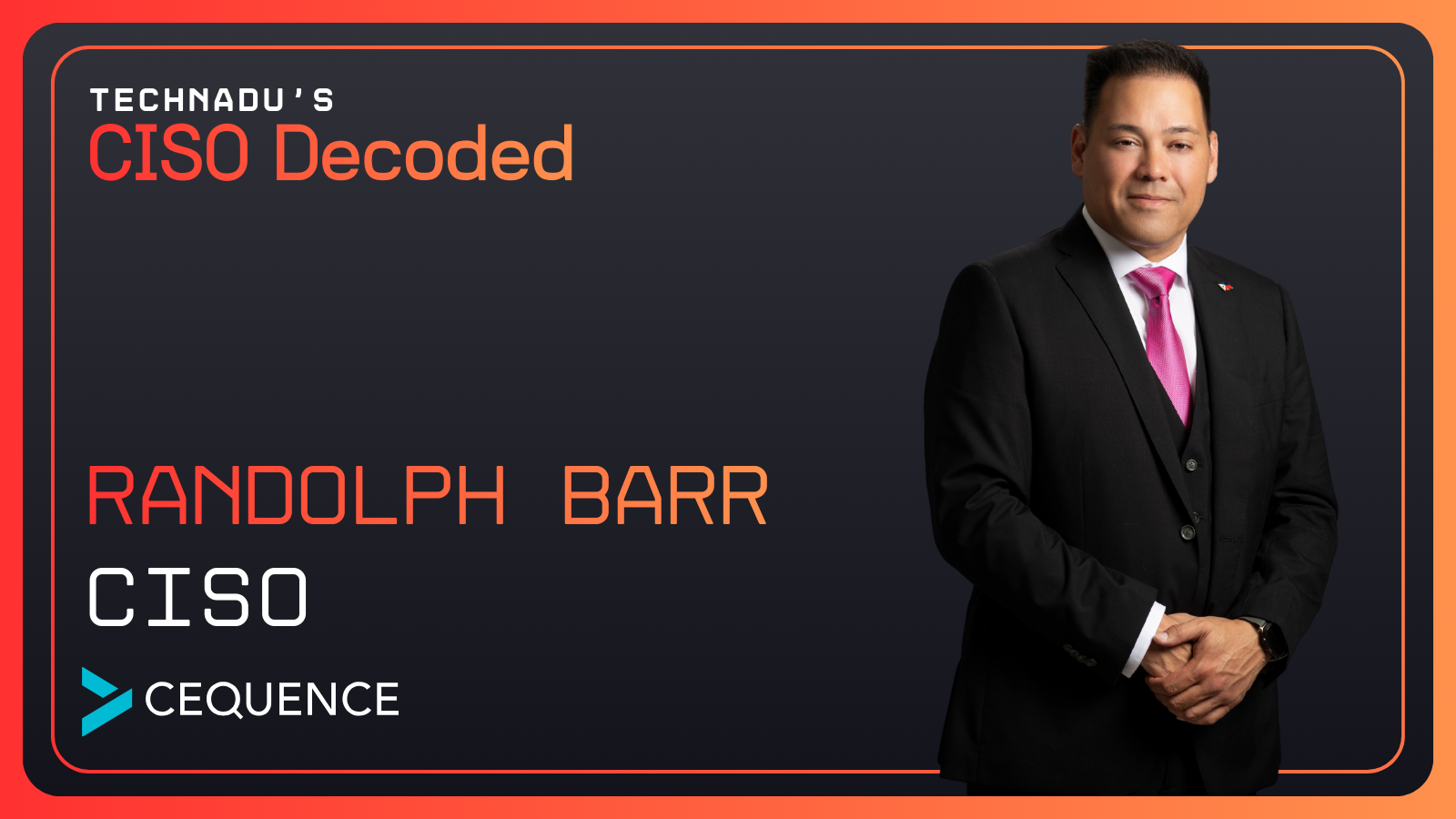
Forward-Looking CISOs: The Role Carried Not in Isolation but Together
Published on December 30, 2025

Key Takeaways
- Cameron says that security should neither be overly prohibitive nor permissive.
- One of the biggest dilemmas CISOs face is balancing security and innovation.
- Halcyon believes in security programs that remain flexible and responsive to change.
- For many CISOs, a serious incident may be the defining moment of their tenure.
- Cameron notes that tools that do not fit operational reality rarely deliver long term value.
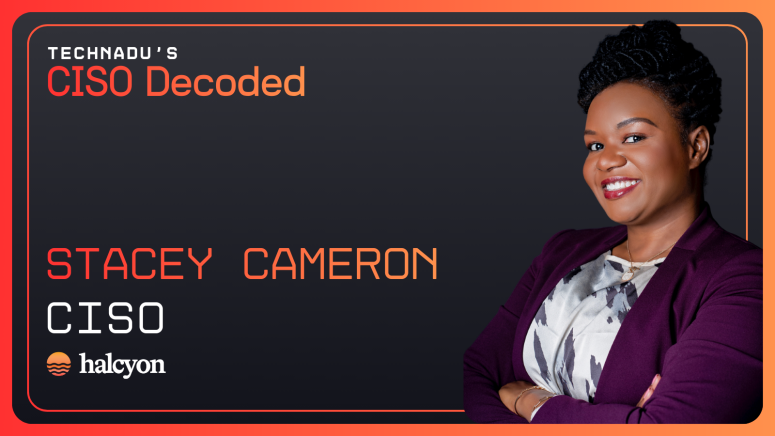
In the first CISO Decoded interview, we speak with Stacey Cameron, CISO at Halcyon, about leadership dilemmas, selecting emerging security technologies, and addressing burnout.
With over 20 years of information security experience in the private sector, federal agencies, and DoD environments. Cameron has guided organizations through compliance frameworks and in conducting risk assessments.
Cameron believes security leaders must be closely aligned with long-term business priorities to maintain the highest feasible security posture, while enabling organizations to innovate and move at the speed they require.
Planning ahead is possible despite changing attacker tactics because many underlying risks are known and repeatable, allowing security controls to be adjusted to strengthen access controls and reduce insider threat risks, both intentional and unintentional.
Trust is the primary human behavior that creates friction in daily security. Read on to know how.
Vishwa: What is the biggest leadership dilemma CISOs face in tackling risks and business goals? How could those be addressed?
Stacey: One of the biggest dilemmas CISOs face is balancing security vs. innovation. Security leaders must deeply understand business goals and priorities while determining when to be adaptive rather than overly prohibitive with security requirements. If security slows innovation unnecessarily, it can become a barrier to progress, but if it is too permissive, it can expose the organization to unacceptable risk.
The ultimate objective is to maintain the highest feasible security posture while still enabling the business to move at the speed it requires. Achieving this balance requires security leaders to stay closely aligned with the overall, long-term.
Anticipating how security requirements may impact future initiatives allows teams to plan, prepare, and mitigate risks ahead of time. This forward-looking approach reduces friction when new products or capabilities are introduced. At the same time, security programs must remain flexible and responsive to change.

Threat landscapes, technologies, and business priorities evolve quickly, requiring the ability to pivot when necessary. When security is embedded as a strategic partner rather than a gatekeeper, it becomes an enabler of innovation rather than an obstacle.
Vishwa: What is your thought process and approach to planning defenses against threats that evolve faster than response time?
Stacey: Looking at how prevention, detection, response, and recovery have evolved over time within the information security sector, these areas have matured significantly, both from a regulatory standpoint and through the real world experience of practitioners. We are moving beyond the ideology that everything must be prevented at all costs.
It is now more widely accepted that while prevention remains essential, modern threat landscapes require just as much, if not more, emphasis on response because threats will inevitably be realized. This shift changes how defenses are planned and measured. Preparation becomes the most critical factor in limiting impact.
That preparation begins with understanding which systems, data, and processes carry the highest business impact if compromised. For high risk data, mitigation starts with understanding data flows, retention, and protections such as encryption and access controls.
This reduces exposure in the event of a breach or data exfiltration. Another example is insider threats, both intentional and unintentional. Addressing these risks requires recognizing that internal controls must be as strong as, and in some cases stronger than, external controls due to the permissible actions associated with standard job roles.
While the specific tactics used by threat actors are constantly changing, the underlying risks are often known and repeatable. This allows organizations to plan ahead rather than react blindly.
Adjusting security controls over time helps maintain alignment with evolving threats and business changes. Strong incident and breach response planning ensures teams can act decisively when events occur.
Regular testing through tabletop exercises and simulations helps expose gaps before real incidents happen. Ongoing training reinforces readiness and enables practitioners to respond effectively under pressure.
Together, these practices help organizations remain resilient even when threats evolve faster than traditional response timelines.
Vishwa: What human-behavior creates the friction in daily security especially in times when support staff are being tricked into disclosing data?
Stacey: Trust. Trust is the primary human behavior that creates friction in daily security, especially when support staff are targeted. People are naturally inclined to trust emails that make it into their inboxes and appear legitimate, as well as direct messages or phone calls that seem authentic.
When someone presents themselves as tech support and demonstrates knowledge of personal details, often with a friendly and confident voice, defenses tend to drop.
That same behavior continues today. The difference now is the use of advanced technologies, including AI, which makes manipulation more convincing, more scalable, and harder to detect.
Vishwa: What indicators help you decide when to adopt or reject emerging security technologies?
Stacey: Several indicators influence whether I adopt an emerging security technology. I genuinely enjoy learning about and testing new technologies, and I believe it is important to stay informed about tools that may become relevant for future needs.
At the same time, there are far more options available than any organization can reasonably deploy, which makes selectivity critical. I start by gaining a clear understanding of existing risks, threat exposure, and business priorities, all viewed through the lens of a constantly changing security landscape.
This is typically informed by enterprise risk and threat assessments. That context helps determine whether a new technology is addressing a real problem or simply introducing additional noise.
I focus first on closing gaps in current capabilities and then on optimizing what is already deployed. If a new solution meaningfully complements or strengthens existing tools, that is a positive signal. If it does not clearly enhance current capabilities, it is rejected.
Vendor execution matters just as much as the technology itself. If I am not confident in a vendor’s ability to evolve the product, operate with agility, and respond to customer and threat-driven needs over time, I will not move forward.
Finally, value must be demonstrable. If a technology is interesting or innovative but lacks a clear return on investment or measurable impact on risk reduction, it is rejected. At an executive level, adoption decisions must be grounded in outcomes, not novelty.
Vishwa: What factor most influences successful incident response execution?
Stacey: Practice, Practice, Practice!
The single most influential factor in successful incident response execution is practice. Preparation is everything.
An organization can have the most well-documented and highly regarded incident response plan, but if it has not been thoroughly tested, it will fail when it matters most.
Practicing incident response builds muscle memory and exposes gaps that are not obvious on paper. Understanding how different types of incidents impact overall business functions helps design realistic and effective training and testing exercises.
Successful execution also depends on leveraging tool automation appropriately and understanding how to incorporate lessons learned back into existing processes. Incident response should continuously evolve based on real world experience.
Involving third parties is equally critical. Understanding how vendor, partner, legal, and cyber insurance processes integrate with, inhibit, or enhance your own response can significantly affect outcomes during a live incident.
Clear communication paths and redundancy must be established in advance. Teams need to know who is responsible for leading response efforts and who to engage with based on the type and severity of the incident.
Knowing when to involve legal counsel and cyber insurance providers is essential, as is understanding how and when to communicate internally and externally. Providing too much information can be just as damaging as providing too little.
I cannot emphasize enough the importance of preparation. Incidents are high stress events, and for many CISOs, a serious incident may be the defining moment of their tenure.
Successfully guiding an organization through a critical incident is never accidental. It is the result of extensive preparation, disciplined execution, and sometimes a little bit of luck.
Vishwa: How would you advise evaluating vendors amid promises, claims or platform feature lists?
Stacey: Having experience on both sides of the table, both as a vendor and as a purchaser, I start vendor evaluations by applying context to the initial conversation.
The level of detail and credibility I expect varies depending on whether I am speaking with a business development representative, an account executive, a solutions engineer, or company leadership.
Claims alone are not enough. Any promise should be backed by specific features, and I often ask whether there are metrics or data that support those claims. Most vendors have some level of measurement, and that information helps cut through noise early.
I also look at whether the technology clearly aligns to known business risks and integrates cleanly into existing workflows, because tools that do not fit operational reality rarely deliver long term value.
I strongly recommend proof of concept (POC) evaluations. A POC is the best way to determine whether a platform meets business needs, how easily it integrates into the environment, and what the support experience will look like in practice. It allows teams to move beyond slideware and evaluate the product.
I am generally skeptical of products that advertise one hundred percent effectiveness in any area, because there are always outliers.
That said, there is value in vendors who can show tracked performance metrics over time and clearly explain how those results are measured.
Vendor maturity and stability matter just as much as features. I look at whether the vendor demonstrates the ability to evolve the product, operate with agility, and support customers over time, including meeting relevant security and compliance expectations.
Understanding whether a vendor can sustain development and support long-term is critical to avoiding shelfware.
One important consideration is identifying tradeoffs. In conversations with executives, I often find that some enjoy working with smaller vendors or startups where you may get genie service, meaning nearly every feature you wish for is possible, but you may experience minor nuances from immature processes.
Others prefer the maturity and predictability that comes with larger, more established organizations. This is often the case for highly regulated organizations, where compliance and operational requirements are strictly passed down to vendors.
Those dependencies should be clearly understood upfront. I also value peer feedback and real-world customer experience to validate marketing claims. Ultimately, evaluating vendors requires separating real capability from marketing language and ensuring the solution delivers measurable risk reduction and business value over time.
Vishwa: What pressures you the most as a CISO and how do you address burnout and emotional stress under pressure?
Stacey: What pressures me most as a CISO is the rapid advancement of malicious actors and the exponential growth of threats. There is a constant internal question of whether we are doing enough, and that pressure never fully goes away.
I have been in the workforce for over twenty-five years, and I have experienced burnout multiple times. Even now, there are periods of intense stress that come with the role.
What has helped over time is perspective. Listening to the experiences of others, staying connected with fellow executives, and leaning on mentors across different disciplines all help normalize the pressure and prevent isolation.
Earlier in my career, burnout often came from trying to meet unrealistic expectations. Some of those expectations were set by leadership, but more often they were expectations I placed on myself.
One of the most important realizations for any executive is understanding how work fits into life, not the other way around. You must be intentional about how you want to live your life and what truly matters, and then align your work around that reality.
As an executive, business life and personal life inevitably affect each other, and there is nothing wrong with setting expectations and schedules that take both into account.
Establishing boundaries is critical. That includes identifying one or two trusted people who know how to recognize an imminent issue and understand when escalation is truly necessary.
Most importantly, do not gatekeep unless you enjoy not sleeping. While many businesses operate twenty-four by seven, most individuals do not, and expecting otherwise is unrealistic and unsustainable.
Another way I manage pressure is by reframing responsibility. The question should not be, “Are we doing enough?” It should be, “Are we doing enough together?”
This is not a role that should be carried in isolation. Sharing the load, trusting your team, and avoiding the mindset that you are operating in a bubble all help reduce emotional strain. Perspective, expectation management, and preparation matter. Prepare for the worst, expect the best.
Related



Get expert insights on threats, breaches, scams, and security trends — delivered every Monday.
Most Popular


Get expert insights on threats, breaches, scams, and security trends — delivered every Monday.
Most Popular