



VoidLink Cloud-Native Malware Framework Targets Linux Systems via Custom Plugin API
Published on January 14, 2026


Key Takeaways
- Cloud-Native Design: VoidLink is a sophisticated malware framework capable of detecting and adapting to environments like AWS, Azure, and Google Cloud.
- Modular Architecture: Its extensive plugin system has over 30 custom modules for reconnaissance, credential harvesting, and lateral movement.
- Adaptive Evasion: VoidLink employs advanced operational security measures, including runtime encryption and self-deletion protocols, to evade detection.
VoidLink, a new and highly sophisticated cloud-native Linux malware framework designed for persistent access and credential harvesting, autonomously surveys compromised hosts to identify specific cloud providers, such as AWS, GCP, and Alibaba Cloud, and adjusts its behavior accordingly.
VoidLink: Modular Design and Technical Sophistication
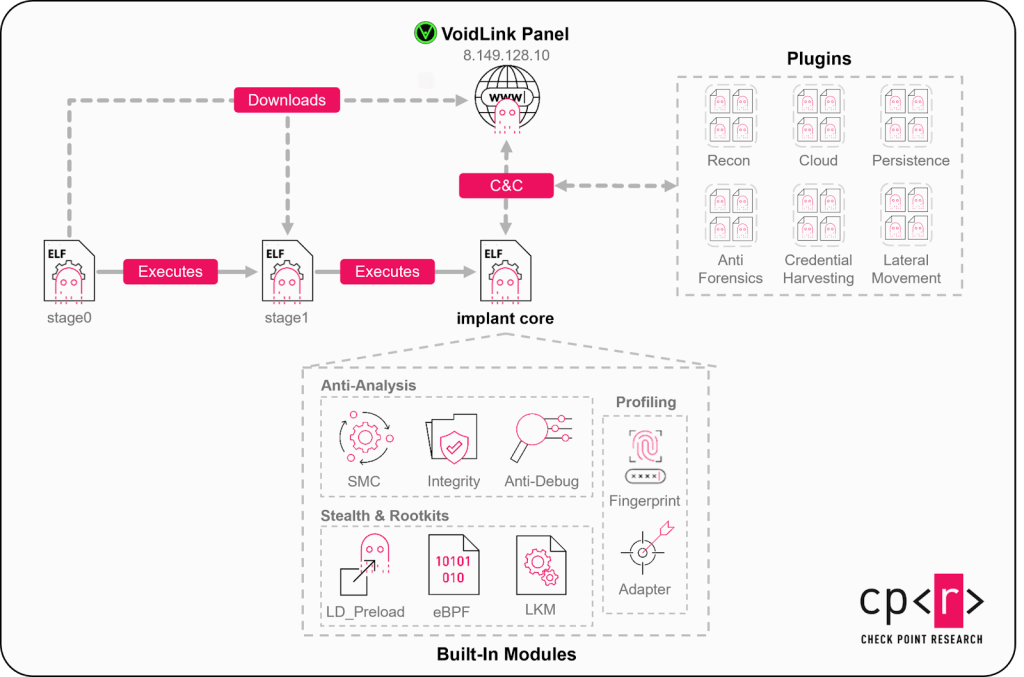
Security researchers at Check Point Research (CPR) have uncovered that the framework, a cloud-first implant written in the Zig programming language, distinguishes itself through a highly modular architecture centered around a custom development API apparently inspired by Cobalt Strike’s Beacon Object Files (BOF) approach.
VoidLink currently supports over 30 distinct modules ranging from container escape mechanisms to "mesh" command-and-control (C2) networking. Its advanced capabilities extend to user-mode and kernel-level rootkits, and its cloud capabilities include:
- Kubernetes and Docker discovery
- Privilege-escalation helpers,
- Container escape checks,
- Probes for misconfigurations that allow attackers to break out of pods or containers into the underlying host or cluster.
The malware framework has multiple plugins to harvest credentials and secrets, focusing on:
- SSH keys,
- Git credentials,
- Local passwords,
- Browser credentials
- Cookies,
- Tokens,
- API keys.
VoidLink can detect AWS, GCP, Azure, Alibaba, and Tencent, and may extend to Huawei, DigitalOcean, and Vultr.
Implications for Cloud Security
The emergence of VoidLink signals an increase in threats targeting Linux-based cloud infrastructure. By integrating adaptive stealth mechanisms, such as calculating a "risk score" based on detected security products, VoidLink prioritizes operational security over performance.
This development suggests a shift towards commercial-grade malware designed for long-term persistence. The framework appears to be built and maintained by unknown China-affiliated actors.
Organizations must bolster their defense strategies, focusing on rigorous monitoring of Linux environments to detect these evolving cybersecurity threats.
Last week, the GoBruteforcer botnet was observed deploying AI-driven tactics to target Linux servers, and access to 50 companies' cloud storage portals was auctioned using infostealer-harvested credentials.
Related






Get expert insights on threats, breaches, scams, and security trends — delivered every Monday.
Most Popular


Get expert insights on threats, breaches, scams, and security trends — delivered every Monday.
Most Popular